DNA parentage: what genetics has revealed about the origin of grape varieties
Definition: what is DNA parentage?
A DNA parentage is the parent-offspring relationship between two grape varieties established by analysing their genome, and not by tradition or the resemblance of leaves. The cultivated vine is multiplied by cuttings, but each grape variety was born one day from a seed, hence from a cross between two parents. DNA makes it possible to find these parents when they still exist.
Before these analyses, the origin of grape varieties rested on old texts, names and ampelography. Many hypotheses proved wrong.
The microsatellite method
Microsatellites (or SSRs) are short repeated DNA sequences whose length varies from one grape variety to another. For each marker, a grape variety has two alleles: one inherited from its father, the other from its mother.
The reasoning is simple:
- the profile of the studied grape is established on several dozen markers;
- this profile is compared with that of thousands of varieties kept in collections;
- a pair of grapes is retained as parents if it supplies, at each marker, an allele compatible with each of the two alleles of the offspring.
The more markers there are, the lower the probability of coincidence. Today, SNP chips carrying thousands of markers confirm and refine these results.
Reference profiles are gathered in databases such as VIVC (Vitis International Variety Catalogue), linked at the bottom of each grape sheet on the site.
The major discoveries
| Grape | Parents established by DNA | Remark |
|---|---|---|
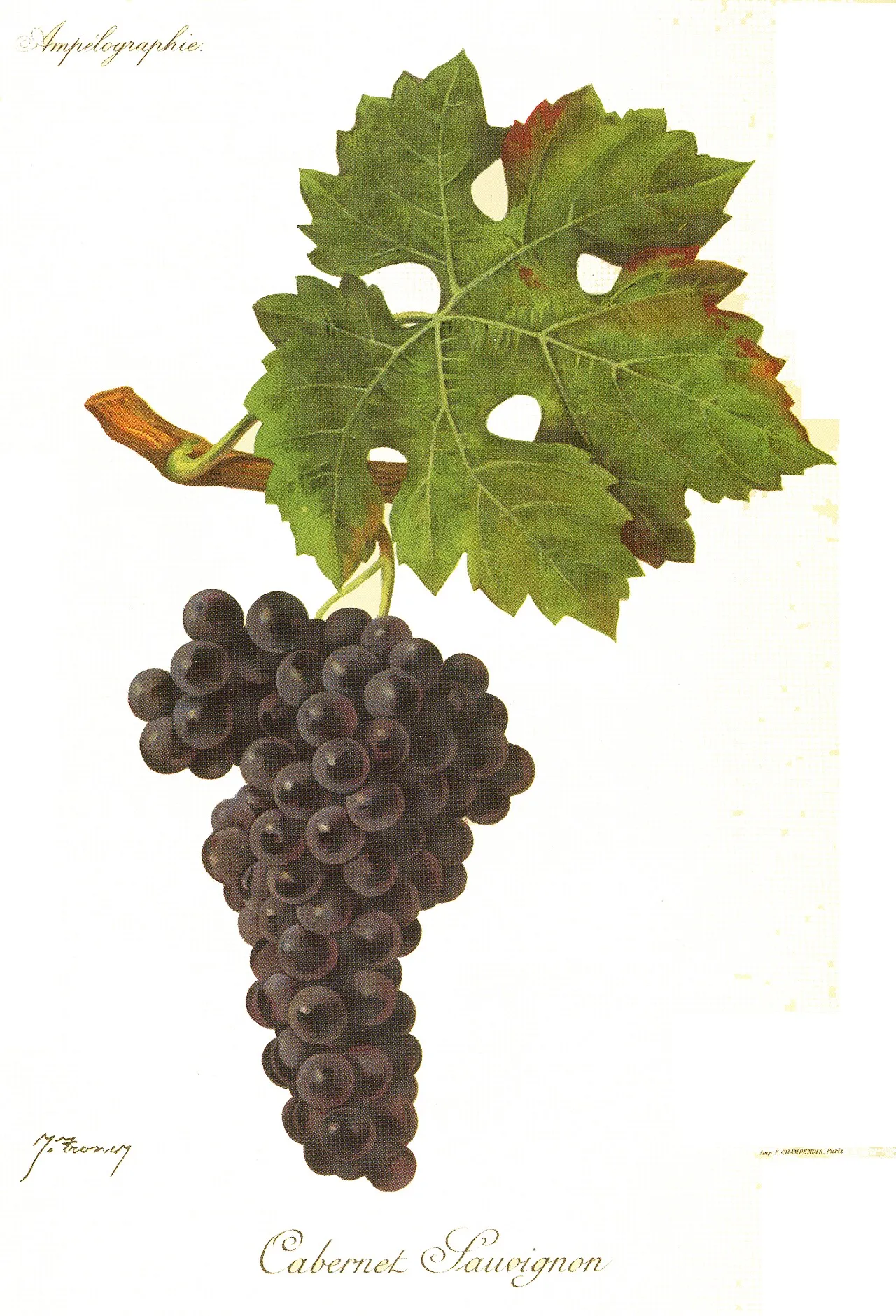
| Cabernet-sauvignon | Cabernet franc × sauvignon blanc | Published in 1997 |
| Chardonnay | Pinot × gouais blanc | Published in 1999 |
| Gamay | Pinot × gouais blanc | Same pair as chardonnay |
| Aligoté | Pinot × gouais blanc | Same |
| Melon de Bourgogne | Pinot × gouais blanc | Same |
| Merlot | Cabernet franc × magdeleine noire des Charentes | Mother identified in the 2000s |
| Malbec | Prunelart × magdeleine noire des Charentes | Half-sibling of merlot |
| Syrah | Dureza × mondeuse blanche | Two grapes of the Rhône-Alpes region |
| Carménère | Cabernet franc × gros cabernet | Cabernet family |
| Müller-Thurgau | Riesling × madeleine royale | The breeder thought he had crossed riesling and sylvaner |
These results rewrote several stories. Cabernet-sauvignon, imagined to be very old, is a relatively recent cross of two grapes of Bordeaux and the Loire. Syrah did not come from Shiraz in Persia: both its parents are local grapes of the Rhône Valley and Savoie (see syrah or shiraz).
The great ancestors
Large-scale studies, such as the one published in 2013 by a Montpellier team on several thousand varieties, show that a few grapes occupy a central place in the genealogy of the European vine.
Gouais blanc
Gouais blanc was a productive, little-esteemed white grape grown in the Middle Ages in north-eastern France and central Europe. Banned or fought several times, it almost disappeared. DNA nevertheless makes it the parent of dozens of varieties. Planted among the pinots, it crossed with them many times, giving rise to a large sibship including chardonnay and gamay.
Pinot
Pinot noir and its colour forms (see colour mutations) form the other pole of this sibship. Pinot is itself related to savagnin, though the direction of the relationship is not established with certainty.
Savagnin
Savagnin, or traminer, shows parent-offspring relationships with many grapes of central Europe and France, including sylvaner and grüner veltliner. First-degree relationships are also reported with chenin and sauvignon blanc.
Magdeleine noire des Charentes
A forgotten grape found in a few old vineyards, magdeleine noire des Charentes is the mother of merlot and malbec. Its discovery illustrates the importance of old plots and of grape variety conservatories.
Natural crosses and breeders’ crosses
Two origins must be distinguished:
- natural crosses: spontaneous pollination in a vineyard, then selection of a seedling by a winegrower; neither the exact date nor the place is known, and DNA is often the only evidence;
- breeders’ crosses: made deliberately by a researcher, with the date and parents recorded.
| Breeding | Declared parents | Breeder |
|---|---|---|
| Pinotage | Pinot noir × cinsault | Abraham Perold, South Africa, 1925 |
| Marselan | Cabernet-sauvignon × grenache noir | INRA, 1961 |
| Alicante Bouschet | Petit Bouschet × grenache | Henri Bouschet, 19th century |
Even for breedings, DNA holds surprises: Müller-Thurgau is the best-known example, its real parents not matching those announced. Recent resistant grapes have declared and verified pedigrees (see resistant grapes).
The limits of the method
A DNA parentage is a statistical conclusion, not an archive. Several limits should be known:
- the missing parent: if a parent has vanished from all collections, the analysis can identify only one parent, or none;
- the direction of the relationship: with only two grapes, DNA shows a parent-offspring relationship but does not always say which is the parent;
- labelling errors: a wrongly identified vine in a collection can produce a false parentage, hence the value of checking several accessions;
- homonyms: two grapes with the same name can be different (see synonyms and homonyms).
This is why the site’s sheets state a parentage only when it is established, specifying whether it comes from a DNA analysis or a documented breeding.
Exploring genealogies
The site’s grape genealogy tool shows the known parent-offspring links between the grapes that have a sheet. It lets one see at a glance, for example, that cabernet franc is the father of cabernet-sauvignon, merlot and carménère alike (see also cabernet franc or cabernet-sauvignon).
Grapes mentioned in this guide
- Cabernet sauvignon (black, France, Bordeaux area)
- Cabernet franc (black, France, South-West (Libournais probable))
- Sauvignon blanc (white, France, Loire Valley or South-West France)
- Chardonnay (white, France, Burgundy)
- Gamay (black, France, Burgundy)
- Pinot noir (black, France, Burgundy)
- Merlot (black, France, Bordeaux (Libournais))
- Syrah (black, France, northern Rhône Valley)
- Malbec (Côt) (black, France, Quercy (Lot))
- Savagnin (white, Europe, precise origin debated (Jura and Central Europe))
- Pinotage (black, South Africa, Stellenbosch)
- Marselan (black, France, Hérault (Languedoc))
Frequently asked questions
Who are the parents of cabernet-sauvignon?
Cabernet-sauvignon comes from a natural cross between cabernet franc and sauvignon blanc. This result, published in 1997 by Carole Meredith's team at the University of California, Davis, was one of the first demonstrations of DNA parentage in the vine.
Is chardonnay a cross?
Yes. The DNA analysis published in 1999 showed that chardonnay descends from pinot and gouais blanc, a medieval grape now almost vanished. The same pair of parents gave gamay, aligoté, melon de Bourgogne and several other varieties of north-eastern France.
How does DNA make it possible to find the parents of a grape variety?
At each microsatellite marker, every grape variety has two versions (alleles), one from each parent. If a pair of varieties explains all the offspring's alleles across dozens of markers, the parentage is retained with a high probability. The method assumes that the parents still exist in a collection.
What is gouais blanc?
It is an old white grape, once widespread in north-eastern France and central Europe, judged mediocre and largely grubbed up. DNA analyses have made it one of the great ancestors of European viticulture, parent of dozens of grapes, including chardonnay and gamay.
Sources
- Bowers J. E. and Meredith C. P., "The parentage of a classic wine grape, Cabernet Sauvignon", Nature Genetics, 1997
- Bowers J. et al., "Historical Genetics: The Parentage of Chardonnay, Gamay, and Other Wine Grapes of Northeastern France", Science, 1999
- Lacombe T. et al., "Large-scale parentage analysis in an extended set of grapevine cultivars", Theoretical and Applied Genetics, 2013