The grape varieties of Languedoc-Roussillon
Main grapes: Languedoc-Roussillon
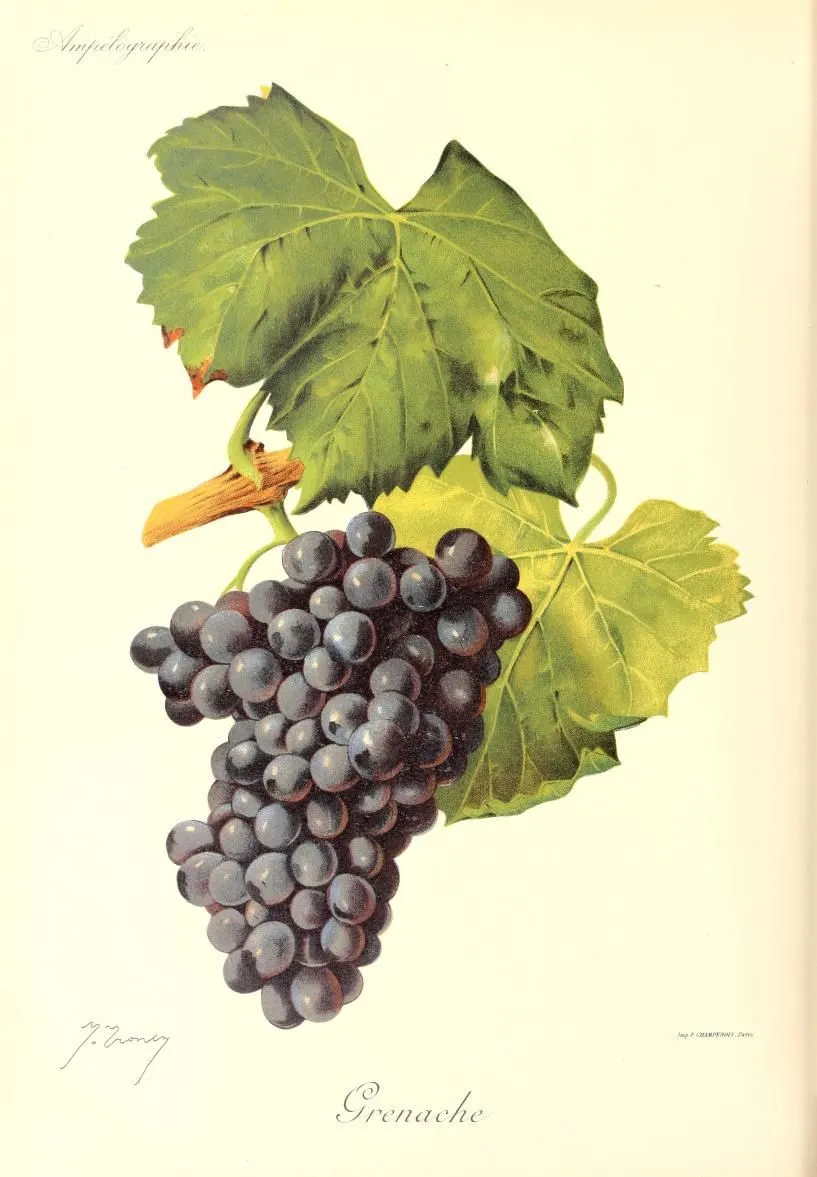
- Grenache noir (black, Spain, Aragon (origin disputed with Sardinia))
- Syrah (black, France, northern Rhône Valley)
- Carignan (black, Spain, Aragon (Cariñena region))
- Mourvèdre (black, Spain, Valencia region)
- Cinsault (black, France, Languedoc (probable))
Secondary and minor grapes
- Piquepoul blanc (white, France, Languedoc)
- Clairette (white, France, Midi)
- Macabeu (white, Spain, north-east (exact origin debated))
- Muscat à petits grains (white, Mediterranean basin (precise origin unknown))
- Muscat d'Alexandrie (white, Mediterranean basin (precise origin undetermined))
- Mauzac (white, France, South-West (Gaillac, Limoux))
- Chardonnay (white, France, Burgundy)
- Vermentino (white, Western Mediterranean (exact origin unknown))
- Roussanne (white, France, northern Rhône Valley)
- Marsanne (white, France, northern Rhône valley)
- Viognier (white, France, northern Rhône Valley)
- Chenin blanc (white, France, Loire Valley (Anjou-Touraine))
- Aramon noir (black, France, Languedoc)
- Alicante Bouschet (black, France, Hérault (Languedoc))
- Merlot (black, France, Bordeaux (Libournais))
- Cabernet sauvignon (black, France, Bordeaux area)
- Sauvignon blanc (white, France, Loire Valley or South-West France)
Other grapes grown: Grenache blanc, Grenache gris, Lladoner pelut, Bourboulenc, Terret, Tourbat (malvoisie du Roussillon), Ribeyrenc, Œillade.
The largest vineyard in France
Languedoc-Roussillon stretches from the Gard to the Pyrénées-Orientales, along the Mediterranean arc. It is the largest vineyard in France, long associated with mass-produced table wines, now shared between AOC, IGP and Vin de France.
Its recent history is one of a profound change of grape varieties: aramon and the productive grapes of the 19th century were massively uprooted in favour of quality Mediterranean grapes and international varieties.
The main areas
- Languedoc (Gard, Hérault, Aude): AOC Languedoc, Corbières, Minervois, Fitou, Saint-Chinian, Faugères, Pic Saint-Loup, Terrasses du Larzac, La Clape, Picpoul de Pinet, Clairette du Languedoc, Limoux, Malepère, Cabardès.
- Roussillon (Pyrénées-Orientales): Côtes du Roussillon, Côtes du Roussillon Villages, Collioure, and the vins doux naturels Banyuls, Maury, Rivesaltes, Muscat de Rivesaltes.
- Languedoc muscats: Frontignan, Lunel, Mireval, Saint-Jean-de-Minervois.
- Pays d’Oc IGP and the departmental IGPs, which cover a large share of the volume.
Grapes by main appellation
| Appellation | Colour | Dominant grapes |
|---|---|---|
| Languedoc, Corbières, Minervois, Saint-Chinian, Faugères | Red, rosé | Grenache, syrah, mourvèdre, carignan, cinsault (blend) |
| Pic Saint-Loup | Red | Syrah, grenache, mourvèdre |
| Fitou | Red | Carignan, grenache, syrah, mourvèdre |
| Picpoul de Pinet | White | Piquepoul blanc |
| Clairette du Languedoc | White | Clairette |
| Blanquette de Limoux | Sparkling | Mauzac (at least 90%) |
| Crémant de Limoux | Sparkling | Chardonnay, chenin |
| Limoux (still) | White | Chardonnay, chenin, mauzac |
| Collioure | Red, rosé, white | Grenache, mourvèdre, syrah; grenache blanc and gris |
| Banyuls, Maury | Vin doux naturel | Mainly grenache noir |
| Rivesaltes | Vin doux naturel | Grenaches, macabeu, malvoisie du Roussillon |
| Muscats (Frontignan, Rivesaltes, etc.) | Vin doux naturel | Muscat à petits grains; muscat of Alexandria in Rivesaltes |
The red grapes
Grenache noir is the base of many blends and of the vins doux naturels. Resistant to heat and drought, it brings alcohol and fruit.
Syrah was widely planted from the 1970s and 1980s to improve the structure and colour of the wines.
Carignan, long the most planted grape in the Languedoc, has been heavily uprooted. Its old, low-yielding vines nonetheless make wines with character, and it is being rehabilitated in Corbières and Minervois.
Mourvèdre and cinsault complete the blends: the first for structure and ageing potential, the second for finesse and rosés.
The white grapes
Picpoul (piquepoul blanc) has its own appellation, around Pinet. Clairette is one of the oldest white grapes of the South of France. Grenache blanc, roussanne, marsanne, vermentino and bourboulenc go into the whites of AOC Languedoc.
In Roussillon, macabeu, grenache blanc and grenache gris dominate the dry whites and the sweet wines. Mauzac is the historic grape of the sparkling wines of Limoux.
Known grape rules
The Languedoc AOCs generally require a blend of at least two grapes for reds, with a ceiling for carignan in some appellations and a minimum share of so-called improving grapes (syrah, mourvèdre) in others. The thresholds vary from one appellation to another and have been revised; refer to the specification in force (see reading an AOC specification).
Forgotten grapes and revivals
Lladoner pelut, a form of grenache with downy leaves, terret (noir, gris, blanc), ribeyrenc and œillade are old grapes of the South of France that a few growers are rehabilitating. Alicante bouschet, a teinturier grape bred in the 19th century, remains present in old vines.
Recent developments
Languedoc-Roussillon is on the front line of drought and heatwaves. Growers there are testing Mediterranean grapes from other countries, resistant varieties and old grapes adapted to heat. IGPs in the region have opened their grape lists to resistant varieties, and the region is a major field of study for adaptation to climate change.
Frequently asked questions
What are the grape varieties of the Languedoc?
For reds, the AOCs rely on grenache noir, syrah, mourvèdre, carignan and cinsault, most often blended. For whites, there are grenache blanc, roussanne, marsanne, vermentino, clairette, bourboulenc and picpoul. The IGPs, notably Pays d'Oc, also grow merlot, cabernet sauvignon, chardonnay or sauvignon.
Which grape is Picpoul de Pinet made from?
Picpoul de Pinet, which became a full appellation d'origine contrôlée in 2013, is made exclusively from piquepoul blanc. It is a crisp dry white, grown around the Étang de Thau.
What is the difference between Blanquette and Crémant de Limoux?
Blanquette de Limoux relies on mauzac, which must make up at least 90% of the blend. Crémant de Limoux mainly combines chardonnay and chenin, with a limited share of mauzac and pinot noir.
Which grapes make the vins doux naturels of Roussillon?
Banyuls, Maury and Rivesaltes rely mainly on the grenaches (noir, gris and blanc), complemented by macabeu and malvoisie du Roussillon. Muscat de Rivesaltes is made from muscat à petits grains and muscat of Alexandria.