Marsanne: the structured white of Hermitage
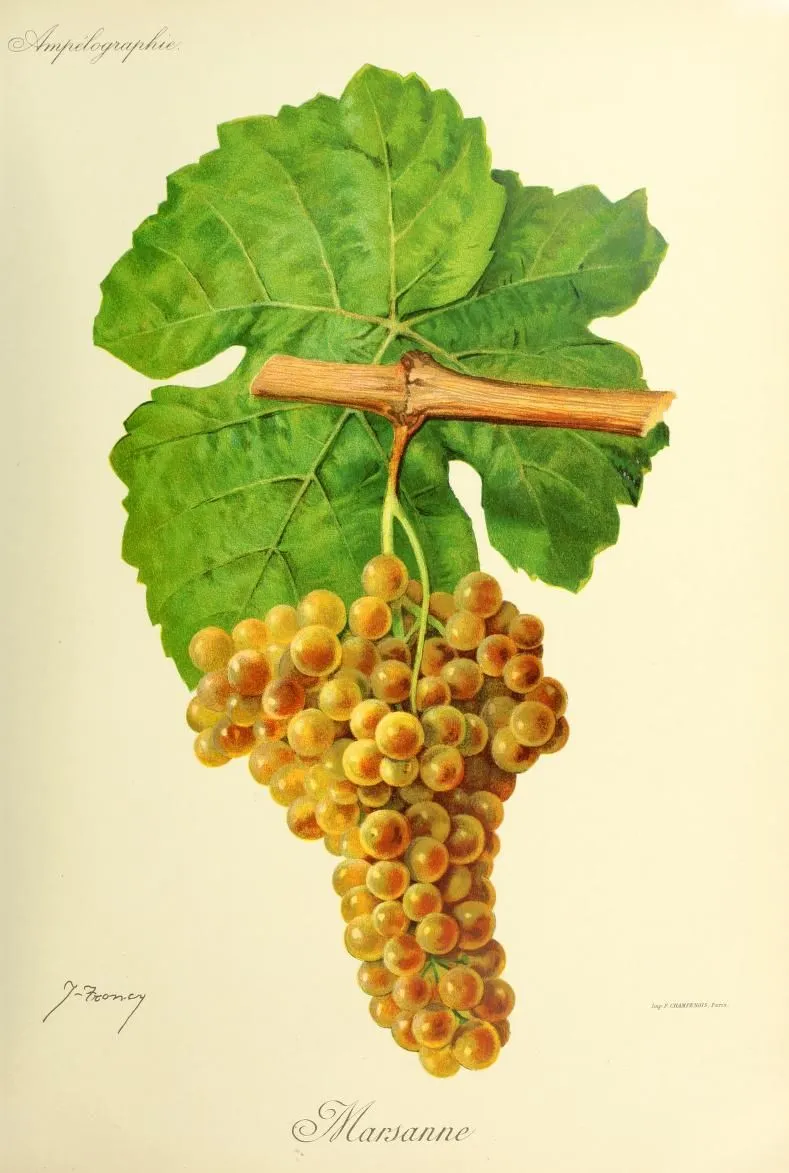
Profile: Marsanne
| Berry colour | White grape (B) |
|---|---|
| Species / status | Vitis vinifera |
| Origin | France, northern Rhône valley |
| Synonyms | Ermitage (Valais), Ermitage blanc |
| French regions | Languedoc-Roussillon, Provence, Rhône Valley |
| Grown in | France, Switzerland, Australia, United States |
| Typical aromas | pear and white fruit, almond, hawthorn and white flowers, honey (with age), beeswax, hazelnut |
| Wine style | Full, rich, low-acid dry whites, discreet when young and more complex after a few years, plus straw wines and sparkling wines. |
| Food pairings | fish in sauce, Bresse poultry, crayfish, pressed cheeses, dishes with morels |
| Identifiers | VIVC no. 7434, Wikidata Q1600638 |
Origin: a commune in the Drôme
Marsanne very probably originates from the northern Rhône valley. Its name is linked to the commune of Marsanne, in the Drôme, north-east of Montélimar. Its parentage is not established with certainty: it is often associated with roussanne, with which it is traditionally blended, but without a consensually published genetic relationship.
In the vineyard
Marsanne is a vigorous and productive grape, more reliable than roussanne. It ripens in the second period, tolerates heat well and gives fairly alcoholic wines when yields are well controlled.
It is sensitive to powdery mildew and to certain trunk diseases, but is on the whole easier to manage than its partner roussanne. This reliability explains its progress in the Rhône vineyards in the 20th century, at the expense of roussanne.
The wines: fullness and ability to evolve
When young, marsanne is discreet on the nose: white fruit, pear, hawthorn blossom, almond. On the palate, it is full and round, with moderate acidity.
With time, the best wines, notably white Hermitage, take on notes of honey, wax, hazelnut and dried fruit. The whites of Hermitage are known for going through a closed phase after a few years, before opening up again.
| Appellation | Colour and type | Place of marsanne |
|---|---|---|
| Hermitage | Dry white, straw wine | Main grape, with roussanne |
| Crozes-Hermitage | Dry white | Main grape, with roussanne |
| Saint-Joseph | Dry white | Main grape, with roussanne |
| Saint-Péray | Still and sparkling white | Main grape, with roussanne |
| Côtes du Rhône and southern Rhône | Dry white | Blending grape |
| Hermitage, Crozes-Hermitage, Saint-Joseph (reds) | Red | Permitted in small proportion with syrah |
The specifications of several northern Rhône red appellations do indeed admit a little marsanne and roussanne alongside syrah, within a limit set by the text. See reading an AOC specification.
The straw wine of Hermitage
A few producers make a straw wine in Hermitage: marsanne grapes are dried for several weeks before pressing, which concentrates the sugars. It is a confidential production.
Where it is grown
In France, marsanne is present throughout the Rhône valley, and further south in Languedoc-Roussillon and Provence, in blends or as a single-variety IGP wine. In Provence, it is notably among the grapes of the whites of Cassis.
The international angle: Valais and Victoria
Two foreign vineyards have given marsanne its own identity.
In Switzerland, in Valais, marsanne goes by the name ermitage or ermitage blanc, in tribute to the Hermitage hill. It gives rich dry whites there, and sweet wines from late harvests or shrivelled grapes. See the guide on synonyms and homonyms.
In Australia, marsanne was planted in the state of Victoria as early as the 1860s. The Tahbilk estate has marsanne vines planted in 1927, cited among the oldest of the grape in the world. It is also found in California, in the wake of the producers who champion Rhône grapes.
To compare the two great white grapes of the northern Rhône, see the comparison marsanne or roussanne. Viognier completes this trio of Rhône white grapes.
Further reading
Frequently asked questions
What is the difference between marsanne and roussanne?
They are two white grapes of the northern Rhône, often blended. Marsanne is more productive and easier to grow, and gives full, round wines. Roussanne is finer and more aromatic, but more fragile in the vineyard. Roussanne is permitted in Châteauneuf-du-Pape, marsanne is not.
What is ermitage in Switzerland?
In Valais, the name ermitage (or ermitage blanc) designates marsanne, in reference to the Hermitage hill in the Drôme. It gives dry wines there, and sometimes sweet late-harvest wines.
Where can you find marsanne?
In France, in the whites of the northern Rhône (Hermitage, Crozes-Hermitage, Saint-Joseph, Saint-Péray), in Côtes du Rhône and in Languedoc as IGP. Abroad, in Switzerland (Valais), Australia (Victoria) and California.
Related grapes
- Roussanne (white, France, northern Rhône Valley)
- Viognier (white, France, northern Rhône Valley)
- Chasselas (white, Switzerland, west of the country (Lake Geneva region))
- Ugni blanc (white, Italy, central Italy)
- Syrah (black, France, northern Rhône Valley)