Chasselas: the grape with a double life, table grape and great Swiss wine
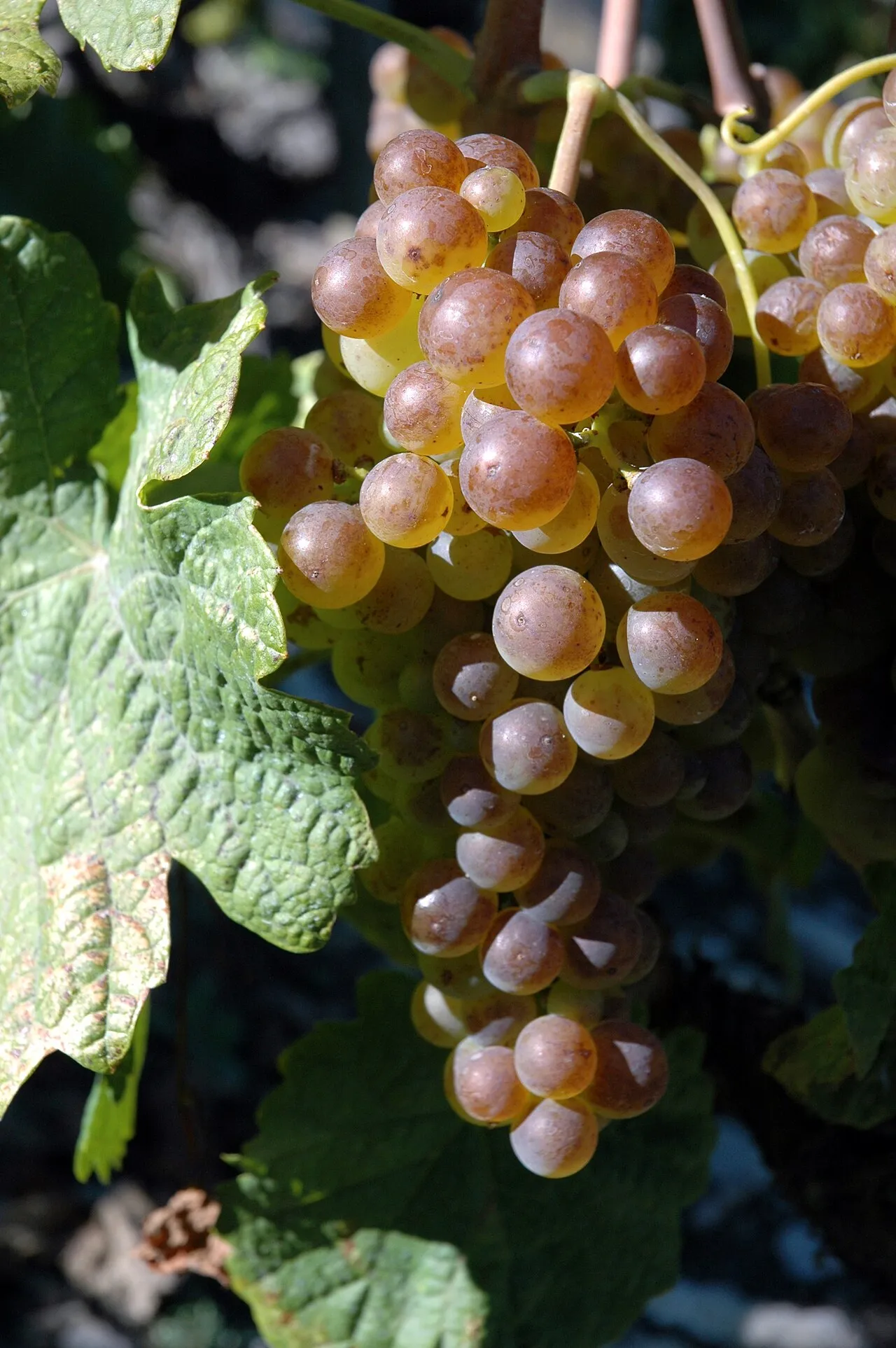
Profile: Chasselas
| Berry colour | White grape (B) |
|---|---|
| Species / status | Vitis vinifera |
| Origin | Switzerland, west of the country (Lake Geneva region) |
| Synonyms | Fendant (Valais), Perlan (Geneva), Gutedel (Germany), Chasselas doré |
| French regions | Alsace, Loire Valley, Savoie, South-West France |
| Grown in | Switzerland, France, Germany, Hungary, Turkey |
| Typical aromas | lime blossom, white flowers, apple and pear, fresh almond, gunflint, honeyed notes with age |
| Wine style | Light, supple, low-acid dry whites whose expression depends heavily on the soil, sometimes with a slight spritz. |
| Food pairings | fondue and raclette, Lake Geneva fish (perch, féra), perch fillets, charcuterie, aperitif |
| Identifiers | VIVC no. 2473, Wikidata Q939724 |
Origin: western Switzerland
For a long time, the origin of chasselas was the subject of legends, some bringing it from Egypt or the East, others from the village of Chasselas, in Saône-et-Loire, whose name it bears. A genetic study published in 2009 places its origin in western Switzerland, which fits with its historical importance around Lake Geneva.
The French name is nonetheless associated with the village of Chasselas, in the Mâconnais, from where the grape is said to have spread in France, although it cannot be called its cradle.
In the vineyard
Chasselas is an early grape, of the first period, vigorous and productive. Its bunches are medium-sized, with round, thin-skinned berries that turn golden at ripeness.
It is susceptible to downy mildew, powdery mildew and grey rot. It is also susceptible to coulure. Its low natural acidity means the picking date must be chosen carefully to keep freshness.
Table grape and wine grape: the chasselas angle
Chasselas is a textbook case of dual use, explained in the guide table grape or wine grape. Most grapes are specialised: table grapes, such as dattier de Beyrouth, have large, crunchy berries; wine grapes have smaller berries richer in sugars and acids. Chasselas does both.
| Use | Where | Examples |
|---|---|---|
| Table grape | France (Quercy, historic Île-de-France), Hungary, Turkey | AOP Chasselas de Moissac, chasselas de Thomery |
| Wine grape | French-speaking Switzerland | Fendant (Valais), Lavaux and Dézaley (Vaud), perlan (Geneva) |
| Wine grape | France | Pouilly-sur-Loire, Crépy and other Savoie crus, Alsace |
| Wine grape | Germany | Gutedel of the Markgräflerland (Baden) |
Chasselas de Moissac
In France, chasselas is best known as a table grape. Chasselas de Moissac, grown on the clay-limestone slopes of the Quercy (north-west of Tarn-et-Garonne and south-west of the Lot), was recognised as an AOC by the INAO, then registered as a European PDO in June 1996. It is one of the few table grapes in France to benefit from a designation of origin.
Thomery and the grape rooms
In the 19th century, the village of Thomery, in Seine-et-Marne, made a speciality of chasselas grown as espaliers along walls. The growers there developed the grape rooms (chambres à raisin): bunches, cut with a piece of cane, were kept with the stem in flasks of water, which made it possible to sell fresh grapes through the winter.
Chasselas as a wine grape: French-speaking Switzerland
In Switzerland, chasselas is the emblematic white grape of French-speaking Switzerland. It bears several names depending on the canton:
- Fendant in the Valais;
- Perlan in the Mandement of Geneva;
- chasselas, or the name of the terroir, in the canton of Vaud, with the terraces of the Lavaux (Dézaley, Calamin, Épesses).
There it is renowned for its ability to translate the soil: floral, tender wines on some terroirs, more mineral and structured on others. See the guide synonyms and homonyms for the variety of its names.
In France
As a wine grape, chasselas remains a minority in France:
- in Savoie, on the French shore of Lake Geneva (Crépy, Marignan, Marin, Ripaille), alongside jacquère and altesse in the rest of the region. See the grapes of Savoie;
- at Pouilly-sur-Loire, where the appellation of the same name is based on chasselas, beside Pouilly-Fumé made from sauvignon. See the grapes of the Loire Valley;
- in Alsace, where it is allowed in blends (edelzwicker in particular) and has become rare.
In Germany, the Markgräflerland, in the south of Baden, makes it, under the name gutedel, a regional speciality.
Genealogy of Chasselas
Offspring profiled on this site: Herbemont.
Further reading
Frequently asked questions
Is chasselas a table grape or a wine grape?
Both. Chasselas is one of the few grapes grown on a large scale for both the table and wine. In France it is best known as a table grape (Chasselas de Moissac), whereas in French-speaking Switzerland it is the main white wine grape.
What is Fendant?
Fendant is the name used in the Valais for chasselas and for the wine made from it. The word is said to evoke berries that split under the pressure of the fingers. In the canton of Geneva, chasselas is called perlan.
What is the AOP Chasselas de Moissac?
It is a protected designation of origin covering chasselas table grapes harvested in the north-west of Tarn-et-Garonne and the south-west of the Lot, in the Quercy. It was first recognised as an AOC by the INAO, then registered as a PDO at European level in 1996.
Does chasselas keep?
Most chasselas are drunk young. Some wines from renowned terroirs, such as those of Dézaley in the Lavaux, nevertheless have a reputation for ageing well, with honeyed and toasty notes after several years.
Related grapes
- Altesse (white, France, Savoie (origin disputed))
- Jacquère (white, France, Savoie)
- Sylvaner (white, Central Europe, probably Austria)
- Muscat à petits grains (white, Mediterranean basin (precise origin unknown))
- Dattier de Beyrouth (white, Near East (brought to France from the Beirut area))
- Sultanine (white, Asia Minor or Afghanistan (origin debated))