Jacquère: the most planted white grape of Savoie
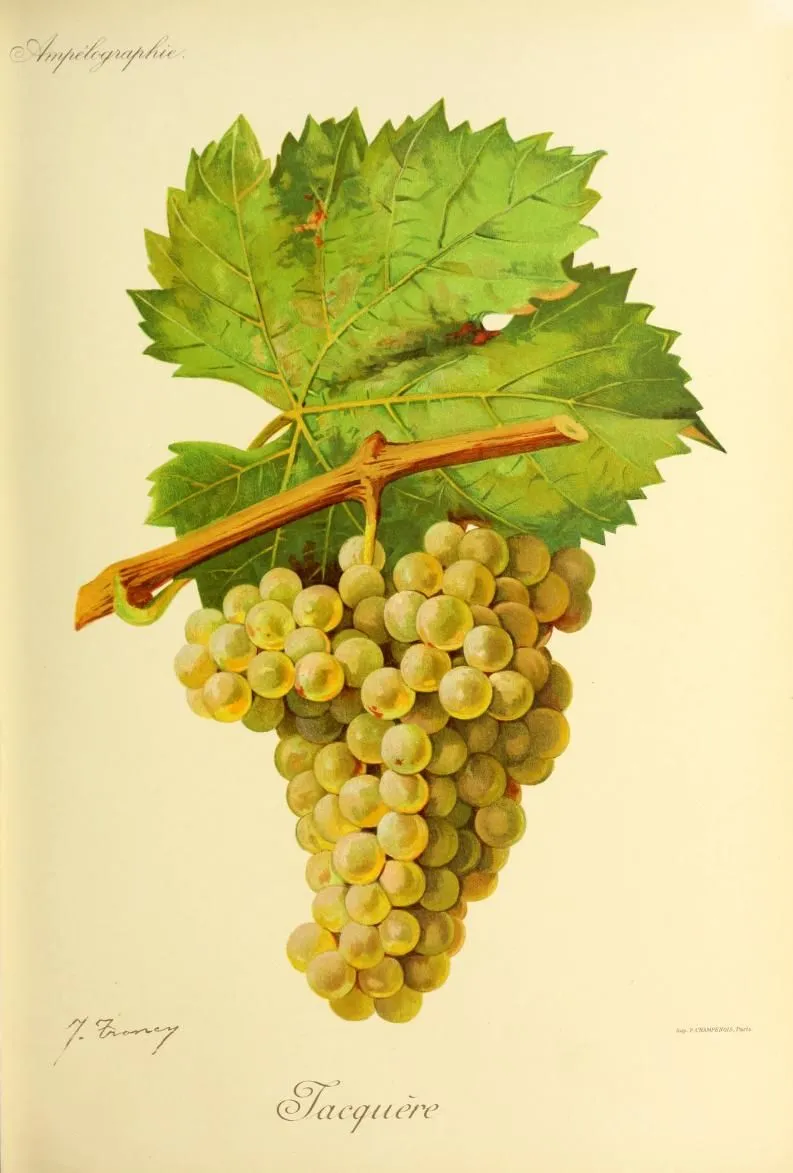
Profile: Jacquère
| Berry colour | White grape (B) |
|---|---|
| Species / status | Vitis vinifera |
| Origin | France, Savoie |
| Parentage | Gouais blanc × unknown parent |
| Synonyms | Cugnette, Plant des Abymes, Robinet, Martin Cot |
| French regions | Savoie |
| Grown in | France |
| Typical aromas | citrus, green apple, pear, white flowers, mineral notes, fresh herbs |
| Wine style | Dry, light, lively and thirst-quenching white, to drink young, often low in alcohol. |
| Food pairings | Savoyard fondue, raclette, tartiflette, lake fish (féra, perch), mountain cheeses |
| Identifiers | VIVC no. 5604, Wikidata Q282095 |
Jacquère, the white pillar of the Savoie vineyard
Jacquère is the most planted white grape in Savoie. It produces most of the white Vins de Savoie, the dry, light, thirst-quenching wines associated with winter sports and cheese dishes. It is also found in the neighbouring Bugey.
Outside these two vineyards it is almost absent. Its area in France has been stable since the 1990s, at around a thousand hectares according to current estimates.
Origin and parentage: a daughter of gouais
Jacquère is considered to be of French origin, most likely from Savoie. It is one of the many descendants of gouais blanc, a productive medieval grape that is also a parent of chardonnay, gamay and aligoté. Its second parent remains unknown.
This central role of gouais in the history of Western European grapes is detailed in the guide on DNA parentage of grape varieties.
Apremont and Abymes: vines born of a catastrophe
The most singular angle of jacquère is geological. In 1248, part of Mont Granier, in the Chartreuse massif, collapsed and buried several villages south of Chambéry. The scree, made of limestone and marl, now forms the soil of the Apremont and Abymes (or Les Abymes) crus, whose name recalls these “abysses”.
These stony, free-draining, poor soils suit jacquère well, and it gives taut, slightly mineral wines there.
The jacquère crus
Jacquère is the main grape of several geographical denominations of the Vin de Savoie AOC:
| Cru (Vin de Savoie) | Location | Profile |
|---|---|---|
| Apremont | Foot of Mont Granier | Lively, mineral, citrus |
| Abymes | Foot of Mont Granier | Light, floral |
| Chignin | Combe de Savoie | A little more body |
| Cruet | Combe de Savoie | Fresh, fruity |
| Jongieux | Banks of the Rhône, facing Lac du Bourget | Taut, delicate |
Other crus, such as Chignin-Bergeron, are by contrast reserved for roussanne: they should not be confused. For all the local grapes, see the grapes of Savoie.
In the vineyard: productive and late
Jacquère is a productive grape: without control of yields, it gives dilute, neutral wines. On well-exposed slopes and with restrained yields, it gains in concentration.
It ripens in mid to late season, which allows it to keep good acidity in the Alpine climate. Its wines rarely reach high alcohol levels, which contributes to their light profile.
The wines: lightness and freshness
Jacquère wine is a dry, light and lively white, with discreet aromas of citrus, green apple, pear and white flowers, often with a mineral sensation. A slight spritz of carbon dioxide is common in young wines, kept to emphasise freshness.
It is the classic accompaniment to Savoyard fondue and raclette. It also goes with the fish of Alpine lakes. Finally, jacquère goes into the sparkling wine blends of Savoie and Bugey.
Jacquère, altesse, chasselas: the whites of Savoie
Savoie grows several white grapes with different profiles. Jacquère gives the lightest wines; altesse produces more aromatic wines that age better (Roussette de Savoie); chasselas dominates on the French shore of Lake Geneva (Crépy, Marin, Ripaille).
Frequently asked questions
Which wine goes with a Savoyard fondue?
The traditional pairing is a dry white wine from Savoie based on jacquère, such as an Apremont or an Abymes. Its liveliness and lightness balance the richness of the melted cheese. A chasselas from Savoie or Switzerland plays a similar role.
What is the difference between Apremont and Abymes?
They are two neighbouring crus of the Vin de Savoie AOC, both made mainly from jacquère. They lie at the foot of Mont Granier, on the scree left by the collapse of part of the mountain in 1248. Their wines are close: dry, light and lively whites.
Who are the parents of jacquère?
Jacquère descends from gouais blanc, an old peasant grape that is also one of the parents of chardonnay and many other grapes. Its second parent has not been identified.
Does jacquère wine age well?
Most jacquère wines are made to be drunk young, within two or three years, to enjoy their freshness. Some cuvées from old vines or low yields gain a little complexity with a few years in bottle.
Related grapes
- Altesse (white, France, Savoie (origin disputed))
- Mondeuse noire (black, France, Dauphiné (probable), Savoie)
- Chasselas (white, Switzerland, west of the country (Lake Geneva region))
- Roussanne (white, France, northern Rhône Valley)
- Chardonnay (white, France, Burgundy)