Aligoté: Burgundy's other white grape
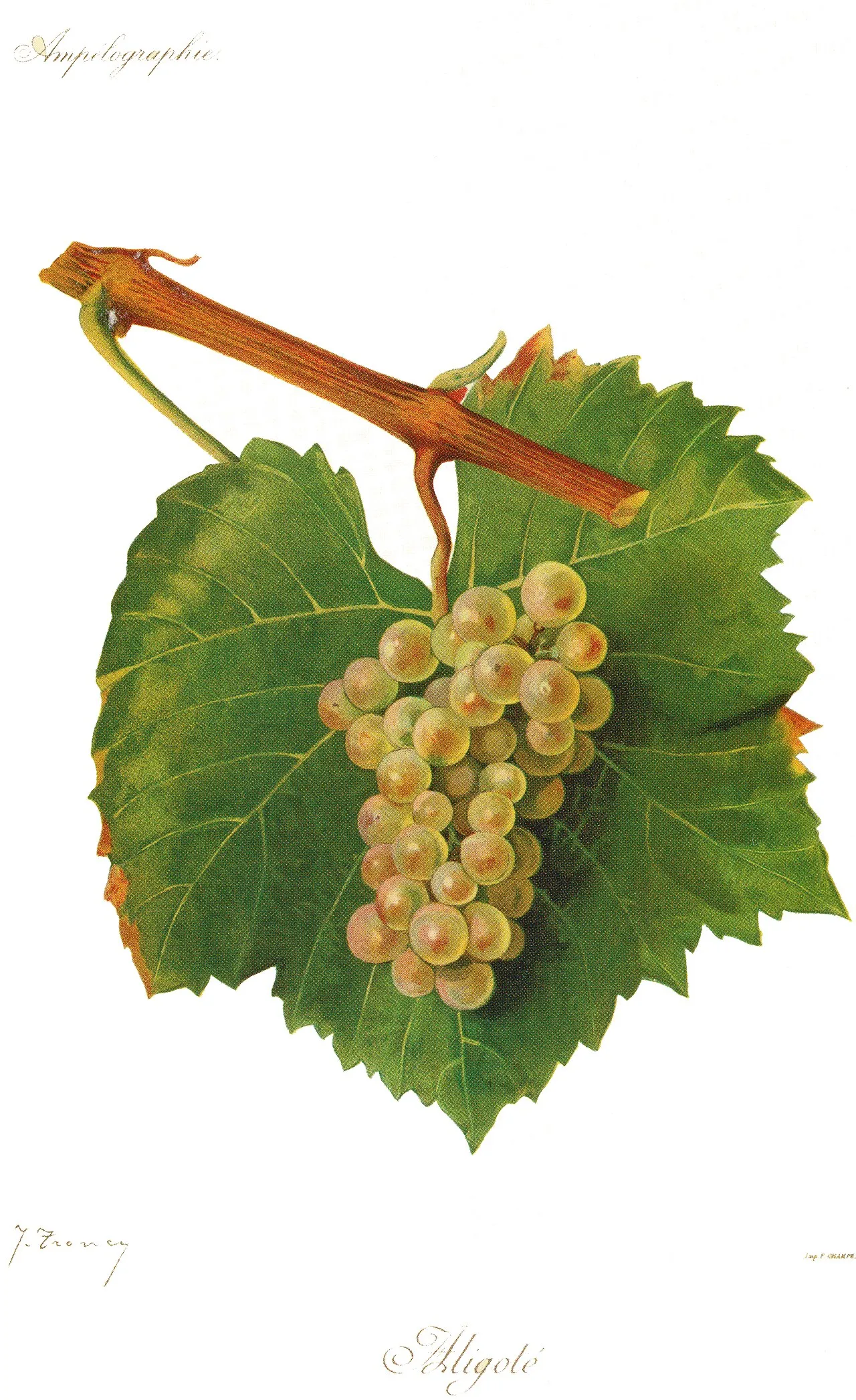
Profile: Aligoté
| Berry colour | White grape (B) |
|---|---|
| Species / status | Vitis vinifera |
| Origin | France, Burgundy |
| Parentage | Pinot × Gouais blanc (natural cross, DNA analysis of 1999) |
| French regions | Beaujolais, Burgundy |
| Grown in | France, Ukraine, Moldova, Romania, Russia, Bulgaria, Georgia |
| Typical aromas | lemon, green apple, white flowers, fresh hazelnut, saline notes |
| Wine style | Lively dry whites, light to medium-bodied, with citrus and apple notes, deeper from old vines. |
| Food pairings | Burgundy snails, gougères, jambon persillé, seafood, goat's cheeses |
| Identifiers | VIVC no. 312, Wikidata Q1514198 |
Origin: a long-established Burgundy grape
Aligoté has been grown in Burgundy since at least the 18th century, where it is mentioned under various names. The origin of the word “aligoté” remains uncertain.
Parentage: same father, same mother as chardonnay
In 1999, the genetic study published in Science on the grapes of north-eastern France established that aligoté comes from a natural cross between pinot and gouais blanc. It therefore shares both its parents with chardonnay, gamay and melon de Bourgogne.
Gouais blanc, an often despised peasant grape, is thus the origin of both of Burgundy’s white grapes. See the guide on DNA parentage of grapes.
In the vineyard
Aligoté is a vigorous and productive grape, with early to mid-season ripening. It is valued for its regularity and its relative cold hardiness. It is susceptible to grey rot, as its bunches are fairly compact.
Two types of planting material are traditionally distinguished in Burgundy: aligoté doré, reputed to be of higher quality, and aligoté vert, which is more productive. These terms belong to growers’ vocabulary more than to a formal botanical distinction.
The wines: liveliness and freshness
Aligoté makes dry whites with marked acidity, with aromas of lemon, green apple and white flowers. More discreet and more taut than chardonnay, it long remained a bar wine. From old vines and with controlled yields, it gains substance and depth, with hazelnut notes and a saline finish.
| Appellation | Location | Particularity |
|---|---|---|
| Bourgogne Aligoté | All of Burgundy’s wine-growing area | Regional appellation, the most common |
| Bouzeron | Côte Chalonnaise | Only village appellation for aligoté |
| Crémant de Bourgogne | All of Burgundy | Aligoté allowed in blends |
Bouzeron: the only village appellation
The village of Bouzeron, in the north of the Côte Chalonnaise, is where aligoté obtained its highest recognition: a village appellation whose white wines are made from this grape. The slopes of Bouzeron are reputed to give aligotés that are denser and better suited to ageing than average. See the grapes of Burgundy.
This status makes aligoté a rare case: a “secondary” grape of a great region with its own village. To understand how an appellation defines its grapes, see reading an AOC specification.
Kir: a cocktail that shaped the grape’s image
Aligoté is associated with kir, a mix of Dijon crème de cassis and dry white wine. The name comes from Canon Félix Kir, mayor of Dijon after the Second World War, who served this “blanc-cassis” at official receptions.
This association made aligoté known, but also kept alive the idea of a wine too acidic to be drunk on its own. For several years, Burgundy growers have instead been championing terroir-driven and old-vine aligotés.
Aligoté in Eastern Europe
The least-known angle of aligoté is its spread eastwards. The grape has been widely planted in the former Soviet area (Ukraine, Moldova, Russia, Georgia) as well as in Romania and Bulgaria, for its cold hardiness and productivity. A large share of the world’s aligoté plantings is in these countries, where it is used for still and sparkling wines.
In Georgia, it sits alongside rkatsiteli, a local white grape that is very widespread in the same area.
Genealogy of Aligoté
Identified parents (Wikidata): Pinot noir and Gouais.
Frequently asked questions
Which wine should be used to make a kir?
The traditional kir recipe combines crème de cassis and a dry white Burgundy, classically a bourgogne aligoté. Its lively acidity balances the sugar of the liqueur. The name comes from Canon Félix Kir, mayor of Dijon after the Second World War, who served it at receptions.
What is Bouzeron?
Bouzeron is a village in the Côte Chalonnaise and a village appellation whose white wines are made from aligoté. It is the only village appellation in Burgundy devoted to it. It is reputed to give aligotés that are deeper than average.
Are aligoté and chardonnay related?
They have the same parents. DNA analysis published in 1999 showed that aligoté, like chardonnay, gamay and melon de Bourgogne, comes from a natural cross between pinot and gouais blanc.
Where is aligoté most widely grown?
A large share of the world's plantings is in Eastern Europe and the former Soviet area (Ukraine, Moldova, Russia, Georgia), as well as in Romania and Bulgaria. In France, it is almost exclusively Burgundian.
Related grapes
- Chardonnay (white, France, Burgundy)
- Melon de Bourgogne (white, France, Burgundy)
- Gamay (black, France, Burgundy)
- Pinot noir (black, France, Burgundy)
- Pinot blanc (white, France, Burgundy (pinot mutation))
- Rkatsiteli (white, Georgia, Kakheti)
- Aramon noir (black, France, Languedoc)
- Blaufränkisch (black, Central Europe, probably Lower Styria (present-day Slovenia))