Colour mutations: one grape variety, several berry colours
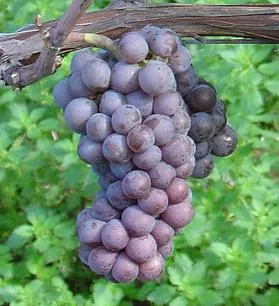
Definition: a bud that changes colour
A colour mutation is a spontaneous genetic change that occurs in a bud of a vine and changes the colour of the berry skin. The shoot that grows from this bud bears bunches of a different colour from the rest of the vine. If a winegrower or breeder takes this shoot and multiplies it by cuttings or grafting, they fix a new colour form.
This type of change is a somatic mutation: it affects cells of the plant’s body, not a seed. The variant therefore remains genetically almost identical to its original grape variety. This is what distinguishes it from a cross, which mixes two genomes (see grape DNA parentage).
In gardening, one speaks of a “sport”; in ampelography, of a variant or colour mutation.
The main colour families
| Family | Known forms | Remark |
|---|---|---|
| Pinot | Pinot noir, pinot gris, pinot blanc | Pinot meunier also belongs to the family, but its mutation affects the leaves |
| Grenache | Grenache noir, grenache gris, grenache blanc | All three are grown in Roussillon |
| Savagnin | Savagnin blanc, savagnin rose, gewurztraminer | Gewurztraminer is the aromatic pink form |
| Muscat à petits grains | White, pink, red | The three forms coexist depending on the appellations |
| Chasselas | Chasselas blanc, chasselas rose | The pink is mostly a table or collection grape |
| Piquepoul | Black, grey, white | The white is by far the most planted |
| Terret | Black, grey, white | Languedoc, now in sharp decline |
| Sauvignon | Sauvignon blanc, sauvignon gris | The grey (or pink) has tinted berries |
Within these families, the forms share the same origin and generally the same genetic profile at the markers used for identification. They differ by one or a few genes linked to colour.
What genetics says
The VvmybA1 and VvmybA2 genes
The black colour of a grape comes from anthocyanins, pigments produced in the skin. Their synthesis is switched on by regulatory genes of the MYB family, notably VvmybA1 and VvmybA2, located side by side on chromosome 2.
In 2004, a Japanese team showed in the journal Science that the white grapes studied carried a copy of VvmybA1 inactivated by the insertion of a retrotransposon, a mobile DNA element called Gret1. Later work showed that a mutation inactivating VvmybA2 was also necessary: a white grape has lost the function of both genes on both chromosomes.
An important consequence: nearly all the world’s white grape varieties descend, for this trait, from a single ancient event. White is a recessive trait; a black grape can carry a hidden “white” copy.
From black to grey, from grey to white
A colour mutation, in a black grape, often consists of losing the only functional copy of the colour genes in some of the cells. Depending on the cell layer affected and the extent of the loss, one obtains:
- a grey or pink skin: reduced pigmentation, like pinot gris;
- a white skin: absent pigmentation, like pinot blanc;
- more rarely, the reverse path: a partial return of colour from a pale form, when part of the inserted DNA is eliminated.
Studies on pinot have shown that pinot gris and pinot blanc do not necessarily descend from one another: independent mutations of pinot noir may have produced pale forms several times.
Chimeras: when a single layer mutates
The growing point of a vine shoot is organised in two main cell layers, called L1 (outer) and L2 (inner). They divide separately and give different tissues: L1 forms the epidermis, L2 forms most of the internal tissues and the reproductive cells.
If a mutation affects only one layer, the plant becomes a periclinal chimera: two genotypes coexist in the same shoot. This is the case for several colour variants. This has two practical consequences:
- cuttings keep the variant, because they reproduce the organisation of the layers;
- sowing does not reproduce it: seeds come from the L2 layer, so a seedling of pinot gris may reveal characters of the inner layer.
Pinot meunier is the classic example of a chimera that does not concern berry colour: its mutation, limited to the outer layer, gives it leaves and young shoots covered with a white down, the origin of its name “meunier” (miller). The teinturiers studied in Germany also rely on this mechanism (see teinturier grapes).
The same identity, very different wines
Changing the colour of the skin changes the wine a great deal, even if the rest of the genome is identical.
- Pinot noir gives reds, and blancs de noirs in Champagne.
- Pinot gris, whose berries are grey to coppery pink, gives full-bodied whites in Alsace, sometimes sweet; in Italy, under the name pinot grigio, lighter whites (see the comparison pinot gris or pinot grigio).
- Pinot blanc gives supple whites, often used for crémant.
The savagnin family illustrates another nuance: gewurztraminer is not only more coloured than the white savagnin of the Jura, it is also far more aromatic. Colour is therefore not the only trait that can vary within a family of mutants.
Regulatory status: distinct varieties in the catalogue
In France, colour forms are registered separately in the official catalogue of vine varieties, with their own colour code:
| Variety | Code |
|---|---|
| Pinot noir | N |
| Pinot gris | G |
| Pinot blanc | B |
| Gewurztraminer | Rs |
| Savagnin blanc | B |
| Grenache gris | G |
These codes are explained in the guide codes N, B, G, Rs. Each appellation specification states which forms it authorises: an AOC may admit grenache blanc and exclude grenache gris, or the reverse. The name of the exact form therefore matters for labelling.
Why old vineyards mix colours
In old vineyards planted by mass selection, one sometimes finds vines of several colours of the same grape variety, or “variegated” vines that bear bunches of two colours, or even striped berries. These are mutations in progress, visible to the naked eye.
These vineyards are precious for breeders and conservatories: they contain a diversity that clonal plantings have reduced (see clones and mass selection).
Key points
- A colour mutation changes the skin of a grape variety without making it a new grape in the genetic sense.
- The VvmybA1 and VvmybA2 genes control black colour; white grapes carry inactive versions.
- Many variants are chimeras, stable through cuttings but not through sowing.
- For regulation, each colour form remains a distinct variety, with its own code and its own authorisations.
Grapes mentioned in this guide
- Pinot gris (grey, France, Burgundy (pinot mutation))
- Pinot noir (black, France, Burgundy)
- Pinot blanc (white, France, Burgundy (pinot mutation))
- Grenache noir (black, Spain, Aragon (origin disputed with Sardinia))
- Savagnin (white, Europe, precise origin debated (Jura and Central Europe))
- Gewurztraminer (pink, Central Europe, South Tyrol (traminer lineage))
- Chasselas (white, Switzerland, west of the country (Lake Geneva region))
- Muscat à petits grains (white, Mediterranean basin (precise origin unknown))
- Pinot meunier (black, France, north-east (pinot mutation))
Frequently asked questions
Is pinot gris a different grape from pinot noir?
Genetically, it is the same grape: pinot gris is a colour mutation of pinot noir, which appeared in a bud and was then multiplied by cuttings. It is nonetheless registered in the catalogue as a separate variety, with its own colour code (G), and it gives very different wines.
How can a black grape become white?
Black colour is controlled by regulatory genes, VvmybA1 and VvmybA2, which switch on the production of anthocyanins in the skin. If a mutation inactivates the functional copies of these genes in the skin cells, the mutated bud gives berries without anthocyanins, hence white.
What is a chimera in the vine?
It is a plant whose cell layers do not all have the same genotype, because a mutation affected only one layer of the meristem. Several colour variants, such as some pinot gris, and pinot meunier are described as chimeras of this type.
Is gewurztraminer a mutation of savagnin?
Yes, it belongs to the savagnin family: it is a pink-berried form with a highly aromatic profile, often called aromatic traminer. The white savagnin of the Jura and the gewurztraminer of Alsace share the same basic genetic identity.