Pinot gris: one grape, two styles, from Alsace to pinot grigio
Profile: Pinot gris
| Berry colour | Grey grape (G) |
|---|---|
| Species / status | Vitis vinifera |
| Origin | France, Burgundy (pinot mutation) |
| Parentage | Colour mutation of pinot noir |
| Synonyms | Pinot grigio (Italy), Grauburgunder (Germany), Ruländer (Germany), Malvoisie (Valais, Coteaux d'Ancenis), Fromenteau gris, Beurot (Burgundy) |
| French regions | Alsace, Burgundy, Champagne, Loire Valley |
| Grown in | France, Italy, Germany, United States, New Zealand, Australia, Hungary, Romania |
| Typical aromas | pear, yellow fruit, undergrowth and mushroom, smoke, honey, sweet spices |
| Wine style | Two faces: in Alsace, rich, round and smoky whites, from dry to lusciously sweet; in Italy, light, lively and neutral whites. |
| Food pairings | poultry and white meat in sauce, foie gras (sweet versions), mushroom dishes, mildly spiced cuisine, grilled fish (pinot grigio) |
| Identifiers | VIVC no. 9275, Wikidata Q778601 |
Origin: a mutation of pinot noir
Pinot gris is a grey variation of pinot noir, born of a mutation affecting skin colour. Its DNA is almost identical to that of pinot noir and pinot blanc. It appeared in Burgundy, where it was known as fromenteau gris or beurot.
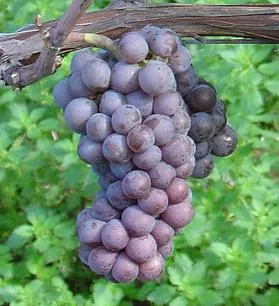
Its berries, bluish-grey to pinkish-grey depending on ripeness and exposure, earn it the code G (gris, grey) in the official catalogue. See grape colour codes and colour mutations.
In the vineyard
Pinot gris is an early-ripening grape, with small, compact bunches, which easily accumulates sugar. It is susceptible to grey rot but, in good years, botrytis can turn into noble rot. Its yields are moderate.
It keeps rather moderate acidity, which partly explains the difference in styles between regions: harvested early, it stays light and lively; harvested ripe, it becomes rich and opulent.
The wines: two schools
| Criterion | Alsace pinot gris | Italian pinot grigio |
|---|---|---|
| Harvest date | At full ripeness, sometimes overripe | Rather early |
| Body | Full, rich, high alcohol | Light to medium |
| Aromas | Pear, yellow fruit, smoke, undergrowth, honey | Citrus, green apple, discreet |
| Sugar | Dry to lusciously sweet (VT, SGN) | Generally dry |
| Regions | Alsace | Veneto, Friuli, Alto Adige |
This contrast is detailed in the comparison pinot gris or pinot grigio.
Alsace: from “Tokay” to pinot gris
The most striking angle on pinot gris is the history of its name in Alsace. For a long time, it was called Tokay d’Alsace there, then Tokay pinot gris. A legend, with no established basis, attributed its introduction to General Lazare de Schwendi, who is said to have brought it back from Hungary in the 16th century.
Yet Tokaji is a Hungarian wine made mainly from furmint, unrelated to pinot gris. Following Hungary’s accession to the European Union, the term “Tokay” was removed from Alsace labels: it has not been permitted since 2007. Only the name pinot gris remains.
In Alsace, pinot gris is one of the grapes historically permitted for grand cru, along with riesling, gewurztraminer and muscat. It makes dry, off-dry or sweet wines there, as well as late-harvest wines (vendanges tardives) and sélections de grains nobles. See the grapes of Alsace.
Malvoisie and other regional names
Pinot gris bears other names that cause confusion:
- Malvoisie: in Valais (Switzerland) and in the Coteaux d’Ancenis, on the Loire, this name refers to pinot gris, often in sweet wines. It has no link with the Mediterranean grapes of the malvasia group.
- Grauburgunder and Ruländer: in Germany, both names refer to the same grape; Ruländer is traditionally associated with sweeter wines.
- Beurot: an old Burgundian name.
See the guide synonyms and homonyms.
Where it is grown
In France, pinot gris is mainly found in Alsace, with a presence in Burgundy, the Loire (Coteaux d’Ancenis, Reuilly rosé) and in IGP wines. In Italy, pinot grigio is widely planted in the north-east. It is also found in Germany, Hungary, Romania, Oregon, New Zealand and Australia.
Further reading
- Pinot gris or pinot grigio: same grape, two opposite styles
- N, B, G, Rs codes: the official colour of grape varieties explained
- Colour mutations: pinot gris, grenache blanc and multicoloured grapes
- Grape synonyms and homonyms: côt, rolle, auxerrois, malvoisie
- Clones and mass selection: how a grape variety is propagated
Frequently asked questions
Are pinot gris and pinot grigio the same grape?
Yes, pinot grigio is simply the Italian name for pinot gris. But the style of the wines often differs: Italian pinot grigio is generally harvested earlier and makes light, lively wines, whereas Alsace pinot gris is riper, richer and more aromatic.
Why is it no longer called "Tokay d'Alsace"?
The name Tokay evoked Tokaji, a Hungarian wine made mainly from furmint, unrelated to pinot gris. With Hungary's accession to the European Union, the use of the term Tokay for Alsace wines was gradually phased out and has not been permitted since 2007.
Is pinot gris a white or a rosé wine?
It is a white wine, even though the grape has a pinkish-grey skin, hence its code G (gris, grey). Made with skin maceration, it can take on a coppery hue: this is the principle of the so-called ramato wines of north-eastern Italy.
Is Alsace pinot gris sweet?
It can be, but not always. Pinot gris easily reaches high sugar levels and many Alsace wines keep a little residual sugar. There are also dry pinot gris, as well as clearly sweet late-harvest wines (vendanges tardives) and sélections de grains nobles.
Related grapes
- Pinot noir (black, France, Burgundy)
- Pinot blanc (white, France, Burgundy (pinot mutation))
- Pinot meunier (black, France, north-east (pinot mutation))
- Riesling (white, Germany, Rhine Valley)
- Gewurztraminer (pink, Central Europe, South Tyrol (traminer lineage))
- Chardonnay (white, France, Burgundy)