Riesling: the great white grape of the Rhine, from Alsace to the Mosel
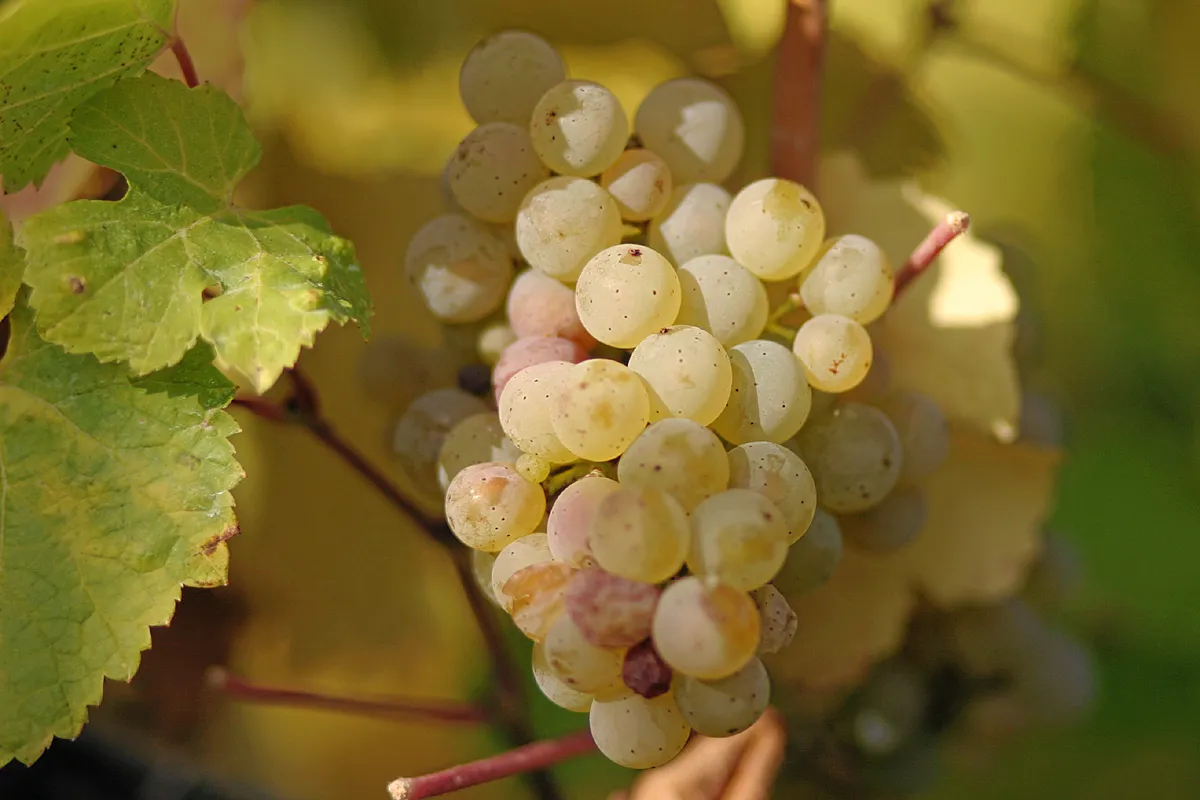
Profile: Riesling
| Berry colour | White grape (B) |
|---|---|
| Species / status | Vitis vinifera |
| Origin | Germany, Rhine Valley |
| Parentage | Gouais blanc × (traminer × wild vine), DNA analysis |
| Synonyms | Rhine riesling, Weißer Riesling, Rheinriesling (Austria), Johannisberg Riesling (United States) |
| French regions | Alsace |
| Grown in | Germany, France, Austria, Australia, United States, New Zealand, Canada |
| Typical aromas | lemon and lime, white peach, white flowers, wet stone, petrol (hydrocarbon) with age, honey and apricot (late harvest) |
| Wine style | From razor-sharp dry whites to botrytised sweet wines, always carried by high acidity and significant ageing potential. |
| Food pairings | choucroute and Alsatian cuisine, river fish, shellfish, spicy Asian cuisine (off-dry versions), washed-rind cheeses |
| Identifiers | VIVC no. 10077, Wikidata Q456471 |
Origin: the Rhine Valley and a mention from 1435
Riesling is a German grape, very probably born in the Rhine Valley. Its oldest known mention dates from 13 March 1435: a cellar inventory of Count John IV of Katzenelnbogen, at Rüsselsheim, near the Rheingau, records the purchase of riesling vines for a vineyard.
It then spread along the Rhine and the Mosel, then to Alsace, Austria and the rest of the world.
Parentage: a descendant of gouais blanc
The genetic work of Ferdinand Regner showed that one of riesling’s parents is gouais blanc (Weißer Heunisch in German), the same peasant grape that gave chardonnay with pinot. The other parent is thought to come from a cross between traminer and a wild vine.
Since traminer is the Germanic form of savagnin, riesling is thus attached to the large family of descendants of savagnin and gouais. See the guide on DNA parentage of grape varieties.
In the vineyard
Riesling is a late-ripening grape with hard wood, very resistant to winter cold, which explains its success in northern vineyards such as the Mosel or the Rheingau. It needs warm exposures (steep south-facing slopes) to ripen fully.
Its small, compact berries are susceptible to grey rot but, in good conditions, botrytis takes the form of noble rot, the origin of the great sweet wines. Riesling keeps high acidity even at full ripeness.
The wines: from trocken to Trockenbeerenauslese
In Germany, the system of designations (Prädikat) classifies quality wines according to the sugar content of the grapes at harvest. It does not say directly whether the wine is dry or sweet, which is often confusing.
| German designation | Grape ripeness | Most common style |
|---|---|---|
| Kabinett | Normal ripeness | Light, dry or with a little sugar |
| Spätlese | Late harvest | Richer, dry or medium-sweet |
| Auslese | Selected bunches | Often sweet |
| Beerenauslese | Selected berries, often botrytised | Sweet |
| Trockenbeerenauslese | Berries shrivelled by botrytis | Very sweet, rare |
| Eiswein | Grapes harvested frozen | Sweet, very high acidity |
In Alsace, riesling is one of the four grapes historically permitted for grand cru, with gewurztraminer, pinot gris and muscat. The wines there are mostly dry, with the designations vendanges tardives and sélection de grains nobles for sweet wines. See the grapes of Alsace.
Where it is grown
Germany is the leading producer, with regions such as the Mosel, the Rheingau, the Nahe and the Pfalz. In France, it is confined to Alsace (and to French Moselle in small quantities).
Austria (Wachau, Kamptal, Kremstal) makes powerful dry wines from it. Australia (Clare Valley, Eden Valley) produces very lively dry rieslings. It is also found in New York State (Finger Lakes), Canada, New Zealand and Washington State.
The petrol note and the “false rieslings”
Two subjects often come up when talking about riesling.
The petrol note. With age, many rieslings develop a hydrocarbon aroma, due to a molecule, TDN (1,1,6-trimethyl-1,2-dihydronaphthalene). It is associated with ageing and with strong sun exposure of the bunches. Some see it as a signature, others as a fault when it dominates.
The homonyms. The name “riesling” has been attached to unrelated grapes:
- welschriesling (riesling italico), a distinct grape widespread in Central Europe;
- Müller-Thurgau, formerly called “riesling-sylvaner”, although it comes from riesling and madeleine royale;
- in the New World, commercial names such as “Hunter River Riesling” have denoted other grapes.
To compare it with the great aromatic grape of Alsace, see the comparison riesling or gewurztraminer.
Genealogy of Riesling
Offspring profiled on this site: Müller-Thurgau.
Further reading
Frequently asked questions
Is riesling a dry or a sweet wine?
Both exist. In Alsace, most rieslings are dry, whereas in Germany every sugar level is found, from trocken (dry) to sweet wines (Beerenauslese, Trockenbeerenauslese, Eiswein). On a German label, the word trocken indicates a dry wine.
Why do some rieslings smell of petrol?
This note, sought after by some wine lovers and criticised by others, is due to a molecule called TDN (trimethyl-dihydronaphthalene). It appears mainly with bottle ageing and is thought to be favoured by strong sun exposure of the grapes.
Is welschriesling a riesling?
No. Welschriesling (riesling italico, olaszrizling) is a distinct grape, with no established parentage link to Rhine riesling. Likewise, Müller-Thurgau was long wrongly called "riesling-sylvaner": it comes from riesling and madeleine royale.
What is the difference between riesling and gewurztraminer?
Riesling is a high-acid white grape with aromas of citrus and white flowers. Gewurztraminer is a pink-berried grape, low in acidity, with powerful aromas of lychee and rose. Both are among the grapes permitted for Alsace grand cru.
Related grapes
- Gewurztraminer (pink, Central Europe, South Tyrol (traminer lineage))
- Pinot gris (grey, France, Burgundy (pinot mutation))
- Sylvaner (white, Central Europe, probably Austria)
- Savagnin (white, Europe, precise origin debated (Jura and Central Europe))
- Welschriesling (white, Central Europe (uncertain origin))
- Müller-Thurgau (white, Germany, Geisenheim (bred by Hermann Müller in 1882))