Welschriesling: graševina, olaszrizling, riesling italico
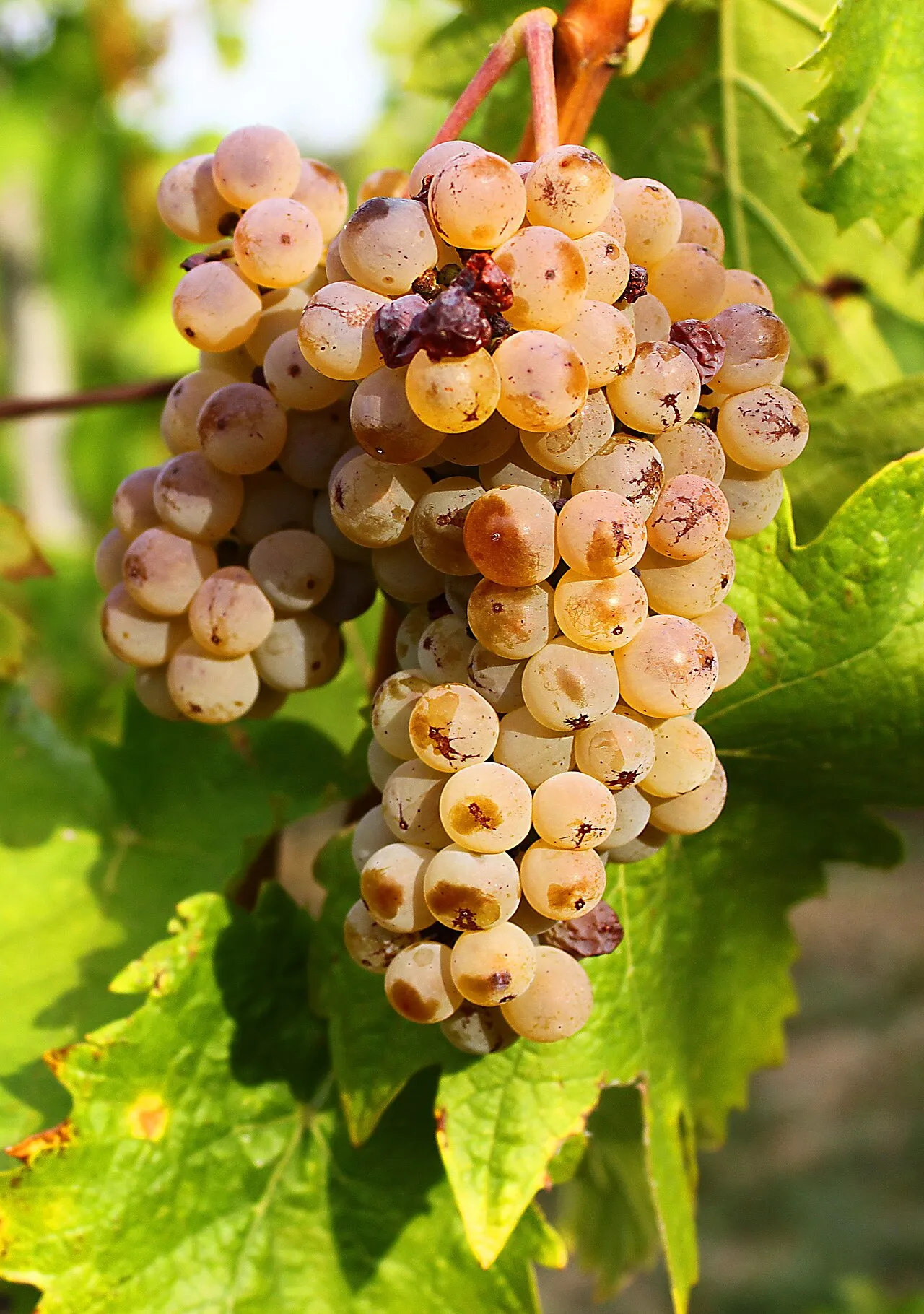
Profile: Welschriesling
| Berry colour | White grape (B) |
|---|---|
| Species / status | Vitis vinifera |
| Origin | Central Europe (uncertain origin) |
| Parentage | Coccalona nera |
| Synonyms | Graševina (Croatia), Olaszrizling (Hungary), Laški rizling (Slovenia), Riesling italico (Italy), Ryzlink vlašský (Czech Republic) |
| Grown in | Croatia, Hungary, Austria, Slovenia, Serbia, Italy, Czech Republic, Slovakia, Romania |
| Typical aromas | green apple, citrus, white flowers, bitter almond, herbs, honey and apricot (sweet wines) |
| Wine style | Fresh, supple dry white to drink young, but also sparkling, late-harvest and high-quality botrytised sweet wines. |
| Food pairings | freshwater fish, charcuterie and paprika dishes, salads, fruit desserts (sweet wines), blue cheeses (sweet wines) |
| Identifiers | VIVC no. 13217, Wikidata Q644796 |
A misleading name
Welschriesling is a white grape from Central Europe, one of the most planted in the region. Its name makes it a false relative of riesling: the two grapes have no known genetic relationship.
“Welsch” is an old German term for what is foreign, and more precisely Latin or Romance. “Welschriesling” therefore means roughly “riesling of Romance origin”. Most of its names in Central Europe mean “Italian riesling”.
The niche angle: one grape, a thousand names, no riesling
Welschriesling changes name at every border:
| Country | Name | Meaning |
|---|---|---|
| Austria | Welschriesling | “Romance riesling” |
| Croatia | Graševina | Name specific to Croatian |
| Hungary | Olaszrizling | “Italian riesling” |
| Slovenia | Laški rizling | “Italian riesling”, distinct from renski rizling (riesling) |
| Czech Republic, Slovakia | Ryzlink vlašský, rizling vlašský | “Romance riesling” |
| Italy | Riesling italico | “Italian riesling” |
| Romania | Riesling italian | “Italian riesling” |
This case perfectly illustrates the pitfalls of grape names, detailed in the guide synonyms and homonyms. For buyers, the word “riesling” on a Central European or Italian label therefore deserves careful reading: see the guide the grape name on the label.
Origin: several hypotheses, no certainty
The origin of welschriesling is unknown. Several leads have been suggested:
- an early introduction from Italy or by the Romans, suggested by its names;
- an origin east of the Balkans, which the Croatian name graševina might reflect;
- a French origin, from Champagne, from where it is said to have reached Central Europe via Heidelberg.
None of these hypotheses has been demonstrated to date.
Where it is grown
Welschriesling is the most planted white grape in Croatia, under the name graševina, notably in Slavonia (Kutjevo, Ilok). It is also one of the most widespread grapes in Hungary (olaszrizling), for example in Csopak, on the shores of Lake Balaton, and in Serbia.
In Austria, it is found in southern and south-eastern Styria, Burgenland and the Weinviertel. It is also grown in Slovenia, the Czech Republic (South Moravia), Slovakia, Romania and north-eastern Italy (Friuli, Collio, Trentino). It is not grown on any significant scale in France.
The sweet wines of Lake Neusiedl
While dry welschriesling is often a simple wine, it reaches its peak in Austrian sweet wines. Around Lake Neusiedl, in Burgenland, autumn mists encourage botrytis. There, welschriesling makes Beerenauslese and Trockenbeerenauslese of great intensity, and it takes part in the Ausbruch tradition of Rust.
These wines, rich but balanced by acidity, are close in spirit to the Hungarian sweet wines made from furmint.
In the vineyard and the wines
Welschriesling is a productive, late-ripening grape, long considered of average quality because of its high yields. It is susceptible to bunch-stem necrosis.
As a dry wine, it makes fresh, light and supple whites, with notes of green apple, citrus, flowers and sometimes bitter almond. It is also used for sparkling and late-harvest wines. In Austria, it shares the vineyard with grüner veltliner and blaufränkisch.
Further reading
Frequently asked questions
Is welschriesling a riesling?
No. Welschriesling is not related to Rhine riesling, despite its name. "Welsch" means "foreign" or "Latin" in German, and the grape's Central European names often mean "Italian riesling". In Slovenia, laški rizling (welschriesling) is in fact distinguished from renski rizling (riesling).
What is graševina?
It is the Croatian name for welschriesling. It is the most planted white grape in Croatia, grown in all inland regions, particularly in Slavonia, around Kutjevo and Ilok.
Where does welschriesling come from?
Its origin is not known for certain. Several hypotheses exist: an early introduction from Italy, a Balkan origin suggested by the Croatian name, or a French origin, from Champagne. None has been demonstrated.
Does welschriesling make sweet wines?
Yes, and it is one of its most renowned expressions. Around Lake Neusiedl, in the Austrian Burgenland, its botrytised grapes make sweet wines of the Beerenauslese, Trockenbeerenauslese or, in Rust, Ausbruch type.
Related grapes
- Riesling (white, Germany, Rhine Valley)
- Grüner veltliner (white, Austria, Lower Austria)
- Furmint (white, Hungary, Tokaj (probable origin))
- Müller-Thurgau (white, Germany, Geisenheim (bred by Hermann Müller in 1882))
- Blaufränkisch (black, Central Europe, probably Lower Styria (present-day Slovenia))