Grüner veltliner: Austria's national grape
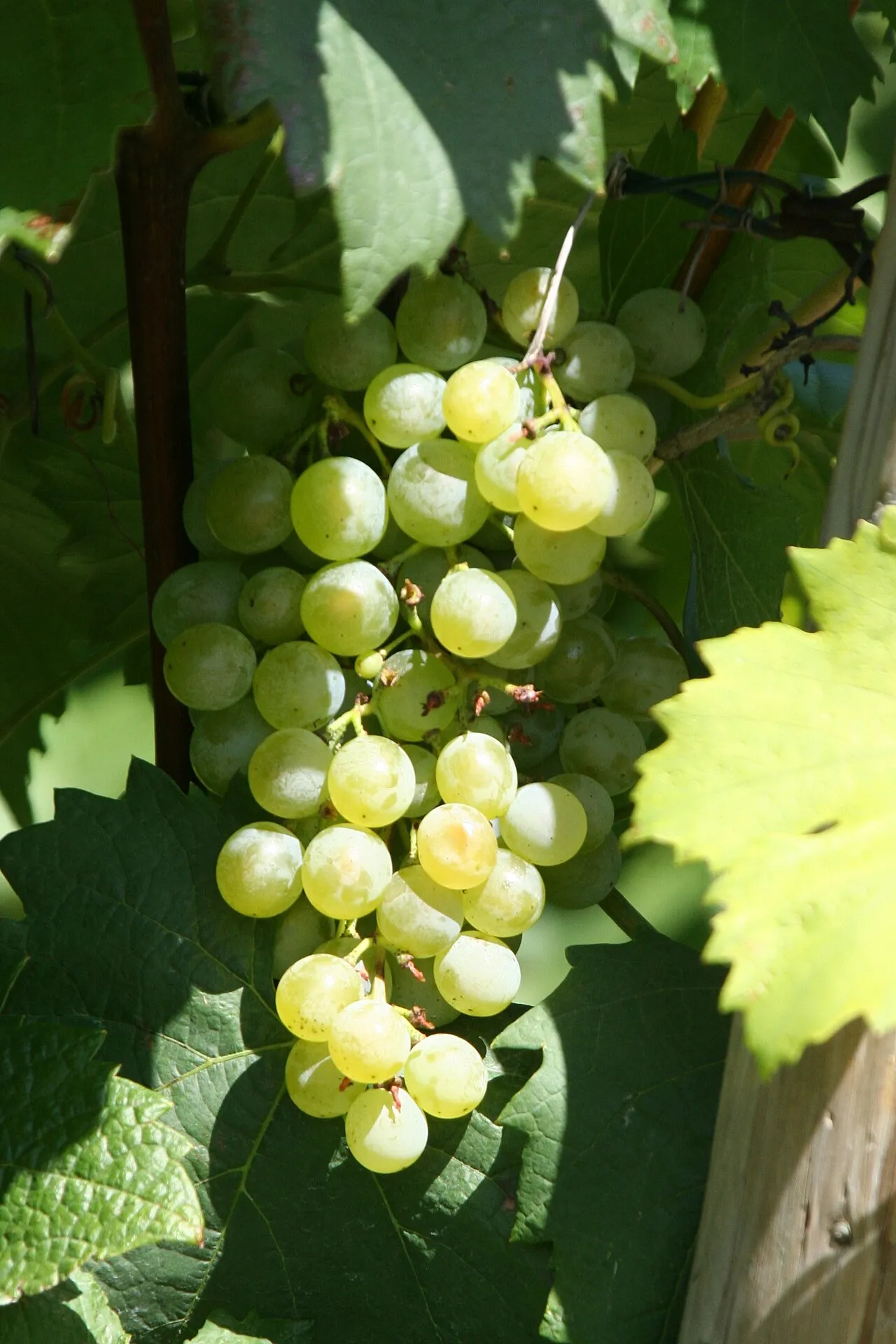
Profile: Grüner veltliner
| Berry colour | White grape (B) |
|---|---|
| Species / status | Vitis vinifera |
| Origin | Austria, Lower Austria |
| Parentage | Savagnin (traminer) × St. Georgener-Rebe (natural cross, DNA analysis published in 2007) |
| Synonyms | Grüner, Weissgipfler, Veltlínske zelené, Veltlinské zelené, Zöld veltelini |
| Grown in | Austria, Slovakia, Czech Republic, Hungary, Italy (Alto Adige), New Zealand, Australia, United States |
| Typical aromas | white pepper, citrus, green apple, fresh pea and green bean, lentil, yellow fruit (Smaragd) |
| Wine style | Lively, spicy dry white, from light everyday wine to the great concentrated, age-worthy wines of the Wachau. |
| Food pairings | Wiener Schnitzel, asparagus, spicy Asian cuisine, artichokes, herb salads |
| Identifiers | VIVC no. 12930, Wikidata Q180175 |
Grüner veltliner, Austria’s national grape
Grüner veltliner is the most planted grape in Austria, where it covers about a third of the vineyard. It dominates in Lower Austria (Niederösterreich), notably in the Weinviertel, the Wachau, the Kremstal, the Kamptal and the Traisental.
“Grüner” means “green” in German. Despite its name, it has no established link with the other grapes called “veltliner”, such as roter veltliner. Grauer veltliner, however, is a colour mutation of grüner veltliner.
A mother vine found in a meadow
The most surprising angle of grüner veltliner is its genealogy. In 2000, an isolated and very old vine was spotted in an abandoned meadow at St. Georgen am Leithagebirge, near Eisenstadt, in Burgenland. Nobody managed to identify it.
Samples, taken in 2005 while the vine was under threat, were analysed at Klosterneuburg. The work of Ferdinand Regner then showed, in 2007, that this vine, named St. Georgener-Rebe, is one of the two parents of grüner veltliner, the other being savagnin, or traminer.
In 2011, the vine was vandalised. What remains of it is now protected as a natural monument. For the context of this type of discovery, see the guide DNA parentage of grapes, and for the role of vine collections, grape variety conservatories.
In the vineyard: productive and demanding in water
Grüner veltliner is a fertile and productive grape, of medium ripening. It particularly likes the deep, water-retentive loess soils of Lower Austria. It is susceptible to downy mildew and powdery mildew.
Traditionally, Austria trains it in Hochkultur, a high trellising system with widely spaced rows, developed by Lenz Moser.
The wines: from the “Heuriger” to the Wachau
Grüner veltliner gives a very wide range of styles depending on yield and terroir. In the Wachau, the Vinea Wachau association classifies its dry wines into three categories:
| Category (Wachau) | Profile |
|---|---|
| Steinfeder | The lightest, fresh and low in alcohol |
| Federspiel | Intermediate, dry and tense |
| Smaragd | The ripest and most concentrated, suited to ageing |
Elsewhere, Weinviertel DAC is reserved for grüner veltliner alone. Leithaberg DAC, in Burgenland, allows it alone or blended with pinot blanc, chardonnay and neuburger.
Typical aromas combine citrus, green apple, vegetal notes (fresh pea, green bean, lentil) and, often, a touch of white pepper, nicknamed “Pfefferl”. This peppery note remains debated: it does not appear in all wines.
Where it is grown outside Austria
Grüner veltliner is very present in Central Europe: it is the most planted white grape in Slovakia, and one of the most widespread in the Czech Republic. It is also found in Hungary and in Italian Alto Adige.
It has been adopted more recently in New Zealand, Australia and the United States. In France, it is not permitted in any AOC and remains experimental. Its Austrian neighbours are riesling, welschriesling and, among the reds, blaufränkisch.
Genealogy of Grüner veltliner
Identified parents (Wikidata): St. Georgen and Savagnin.
Frequently asked questions
Who are the parents of grüner veltliner?
DNA analysis published in 2007 established that grüner veltliner is a natural cross between savagnin (traminer) and an unknown vine, named St. Georgener-Rebe. This isolated vine had been found in 2000 in a meadow at St. Georgen am Leithagebirge, in Burgenland.
Why does grüner veltliner taste of pepper?
A note of white pepper, nicknamed "Pfefferl" in Austria, is often cited as typical of the grape. It is not systematic: several critics, including Jancis Robinson, observe that it has become less frequent in recent wines.
Is grüner veltliner grown in France?
Very marginally. It is not permitted in any French AOC and exists only on an experimental basis on a few hectares. Its vineyards are mainly in Austria and Central Europe.
What is the difference between grüner veltliner and riesling?
Both are the great Austrian whites, often grown side by side in the Wachau, Kremstal or Kamptal. Riesling is more aromatic and more acidic, with notes of citrus and peach; grüner veltliner is spicier, more vegetal and often fuller.
Related grapes
- Savagnin (white, Europe, precise origin debated (Jura and Central Europe))
- Riesling (white, Germany, Rhine Valley)
- Welschriesling (white, Central Europe (uncertain origin))
- Blaufränkisch (black, Central Europe, probably Lower Styria (present-day Slovenia))
- Sylvaner (white, Central Europe, probably Austria)
- Trousseau (black, France, Jura)
- Duras (black, France, Tarn (Gaillac))
- Sauvignon blanc (white, France, Loire Valley or South-West France)