N, B, G, Rs: what do the letters after a grape variety name mean?
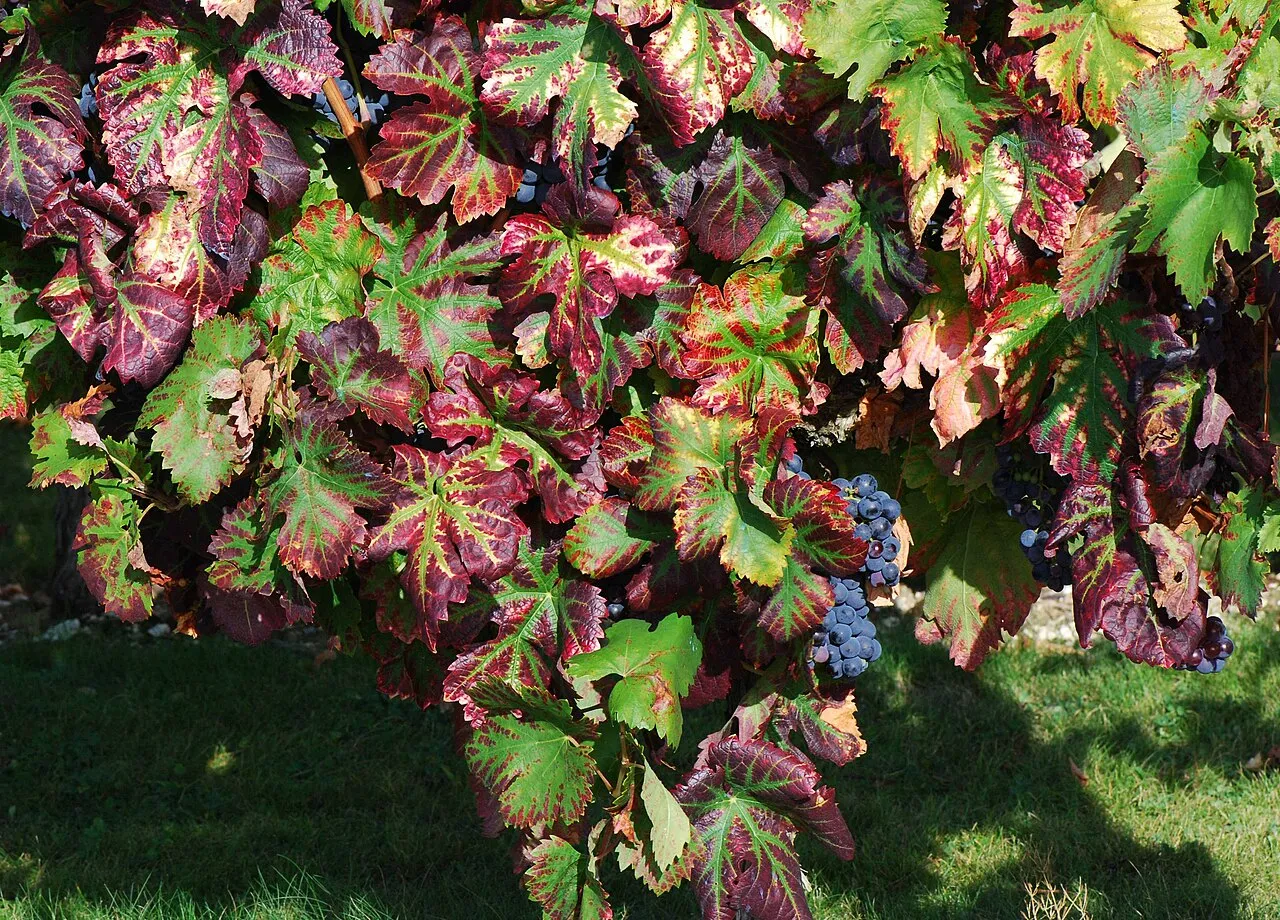
A four-letter code for berry colour
A grape variety’s colour code is a letter (or two) placed after its name, which indicates the colour of the berry skin at ripeness. In France, four notations dominate:
| Code | Meaning | Skin colour | Examples |
|---|---|---|---|
| N | noir (black) | blue-black, dark purple | carignan N, pinot noir N, syrah N |
| B | blanc (white) | green, yellow, golden | chardonnay B, pinot blanc B, sauvignon B |
| G | gris (grey) | pinkish grey, coppery, mauve | pinot gris G, sauvignon gris G, grenache gris G |
| Rs | rose (pink) | clear pink to light red | gewurztraminer Rs, souvignier gris Rs, cardinal Rs |
The notation “Carignan N” is therefore read as “carignan with black berries”. This is the form found in official texts: lists of varieties classified for wine production, appellation specifications, nursery catalogues, ampelographic sheets.
Where do these codes come from?
The colour code is a French administrative convention. European law requires each Member State to classify the wine grape varieties authorised on its territory (Article 81 of Regulation (EU) No 1308/2013). In France, this classification and the official catalogue designate each variety by its name followed by the colour of its berries. AOC specifications use the same notation: that of Saumur-Champigny, for example, lists “cabernet franc N” as the main grape, then “cabernet-sauvignon N, pineau d’Aunis N” as accessory grapes.
The code is not decoration. It is part of the variety’s official name and removes ambiguities that would otherwise be legally awkward.
Why the code is essential: colour mutations
The code’s first role is to distinguish varieties that share the same base name but differ in colour. Most of these are colour mutations: variants that appeared spontaneously on a bud, then were propagated by cuttings.
- Pinot exists as pinot noir N, pinot gris G and pinot blanc B. A study published in 2012 showed that the grey and the white arose independently of each other from the black.
- Grenache exists as grenache noir N, grenache gris G and grenache blanc B.
- Sauvignon exists as sauvignon B (known as sauvignon blanc) and sauvignon gris G, the latter with a pinkish skin.
- Savagnin exists in a white form (savagnin B, the grape of vin jaune) and in a pink form, of which gewurztraminer Rs is the aromatic variant.
Without the code, a planting rule that simply mentioned “grenache” would be ambiguous. With it, a specification can authorise grenache noir N as the main grape of a red and grenache blanc B in a white, with no possible confusion. For the genetic detail of these variants, see our guide on colour mutations.
What the code does not say
The colour code describes the skin of the grape, not the wine. This is the source of most misunderstandings.
An N variety does not necessarily give a red wine
The flesh of the vast majority of black grapes is colourless. The juice of a pinot noir pressed directly is white: this is the principle of “blanc de noirs” champagne. An N variety can therefore give a red wine (skin maceration), a rosé (short maceration or direct pressing) or a white.
The code does not flag teinturiers
Teinturier grapes, whose flesh itself is coloured, remain marked N. Alicante Bouschet is an “N” like carignan, even though its juice comes out of the press red. The code makes no distinction between colourless and coloured flesh.
G and Rs are not “rosé grapes”
A grey or pink variety is most often vinified as white. Alsace pinot gris and gewurztraminer are white wines, sometimes of a golden or slightly coppery hue. Conversely, most rosés come from N varieties.
The border between G and Rs
The difference between “grey” and “pink” is a matter of the intensity of the skin colour, judged by eye on ripe berries. In practice:
- G designates a weakly pigmented skin, whose hue ranges from bluish grey to coppery pink depending on exposure and ripeness. Pinot gris, highly variable from one bunch to another, is the archetype.
- Rs designates a clearly pink skin, more uniform. Gewurztraminer, whose berries take a pink-red hue at ripeness, is the typical example.
These categories are descriptive conventions. The colour of a given variety can vary with climate, load and bunch exposure, but the code is fixed: it belongs to the variety.
Codes in a specification: a reading example
In the “grape varieties” section of an AOC specification, each grape is designated by its name and its code. Typically one reads:
- “main grape: cabernet franc N”;
- “accessory grapes: cabernet-sauvignon N, pineau d’Aunis N”.
The code carries legal weight here: a winegrower who planted a colour variant other than the one authorised could not claim the appellation for the corresponding harvest. This is also why the white wines of certain Rhône or Languedoc appellations list grenache blanc B and grenache gris G separately. To learn to read these texts, see our guide reading an AOC specification.
Colour codes and grape names: common pitfalls
The code also helps spot misleading names.
| Common name | Official code | Pitfall |
|---|---|---|
| Sauvignon blanc | sauvignon B | “Blanc” is often omitted in French texts: the code is enough |
| Gewurztraminer | Rs | White wine from a pink grape |
| Pinot gris | G | White wine, sometimes slightly coppery, despite the “gris” |
| Alicante Bouschet | N | Red flesh, which the code does not flag |
| Souvignier gris | Rs | Resistant variety whose name says “gris” but whose official code is Rs |
The case of souvignier gris illustrates a simple rule: a variety’s commercial name is not a technical description. Only the code reflects the observation of berry colour.
How to use it to read a grape variety sheet
On this site, each sheet shows the colour code in the identity card. It lets you see at a glance:
- whether a grape has colour variants to look for (pinot, grenache, sauvignon, savagnin);
- whether a white wine can come from a non-white grape (blanc de noirs, grey, pink);
- how the grape will be designated in specifications and in the rules for naming the grape on the label.
The colour code is modest information, but it is the entry point to the whole official nomenclature of vine varieties, and the first thing to check when two grapes share the same name.
Grapes mentioned in this guide
- Carignan (black, Spain, Aragon (Cariñena region))
- Pinot gris (grey, France, Burgundy (pinot mutation))
- Gewurztraminer (pink, Central Europe, South Tyrol (traminer lineage))
- Grenache noir (black, Spain, Aragon (origin disputed with Sardinia))
- Pinot blanc (white, France, Burgundy (pinot mutation))
- Pinot noir (black, France, Burgundy)
- Alicante Bouschet (black, France, Hérault (Languedoc))
- Souvignier gris (pink, Germany, Baden (Freiburg viticulture institute))
Frequently asked questions
What does the N in "Carignan N" mean?
The N stands for "noir" (black): it designates the colour of the skin of ripe carignan berries. It is the official notation used in the French classification of varieties and in AOC specifications. It says nothing about the colour of the wine, only about that of the grape.
Is a variety marked G a red or white grape?
A G (gris, grey) variety has berries with a greyish, coppery pink or mauve skin, but colourless flesh. It is most often vinified as white, sometimes as rosé or as an "orange" wine with maceration. Pinot gris, sauvignon gris and grenache gris are the best-known examples.
Why is gewurztraminer marked Rs and not B?
Because its ripe berries have a pink skin, clearly coloured. The code Rs (rose, pink) applies to varieties whose skin is pinkish without being black. Gewurztraminer wine nonetheless remains a white wine, often a deep gold.
Where are these colour codes found?
They appear in regulatory texts: lists of classified varieties, AOC and IGP specifications (grape variety section), nursery documents and ampelographic databases such as Plantgrape. They rarely appear on labels, which give the grape name without a code.
Sources
- INAO, search for a product: access to AOC and IGP specifications (in French)
- Regulation (EU) No 1308/2013, Article 81: wine grape varieties and classification by Member States (in French)
- Vezzulli S. et al., "Pinot blanc and Pinot gris arose as independent somatic mutations of Pinot noir", Journal of Experimental Botany, 2012