Noah, Clinton, Jacquez...: the history and current status of grapes banned since 1934
Definition: what is a direct-producer hybrid?
A direct-producer hybrid (HPD, from the French hybride producteur direct) is a vine from a cross between one or more American species of the genus Vitis and, most often, Vitis vinifera, grown on its own roots, without grafting. The name comes from this: the vine “produces directly”, without a rootstock, because it tolerates phylloxera.
These vines spread in France after the phylloxera crisis, from the 1870s, as an alternative to grafting European grape varieties onto American rootstocks (see rootstocks and phylloxera). They were robust, undemanding in treatments and productive, which explains their success on small family farms.
The six grapes concerned
| Grape | Colour | Known origin |
|---|---|---|
| Noah | B | United States (Illinois), seedling with riparia and labrusca character |
| Othello | N | Canada (Ontario), bred by Charles Arnold in 1859, descendant of clinton |
| Isabelle | N | United States, variety with labrusca character |
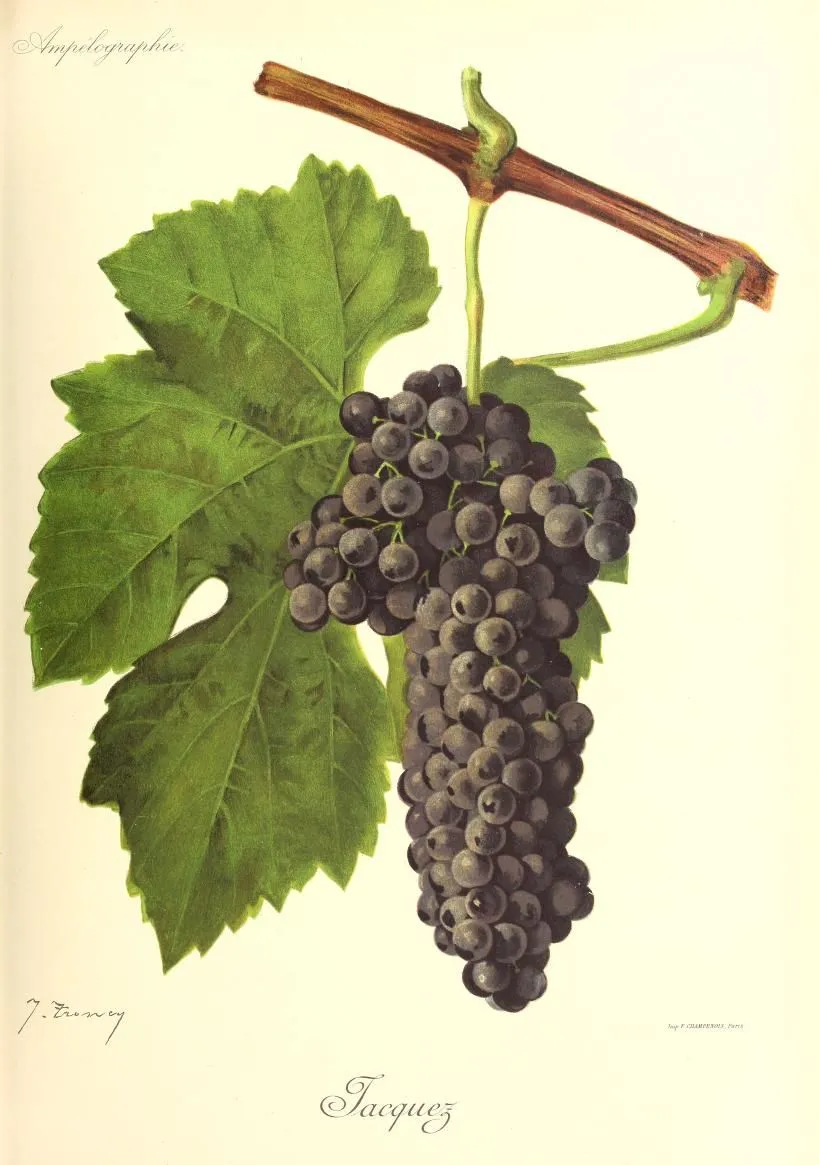
| Jacquez | N | Southern United States, exact origin uncertain |
| Clinton | N | United States (New York State), presumed riparia × labrusca hybrid |
| Herbemont | N | Southern United States, often linked to jacquez |
Their common point is not genetic: many other hybrids existed in 1934. They are simply the six varieties retained on the prohibition list, no doubt because they were among the most widespread.
The law of 24 December 1934
The law of 24 December 1934 is part of the “wine statute” of the 1930s, a series of texts intended to absorb the overproduction of wine. Its Article 5 forbids offering for sale, selling, transporting and planting the varieties on a list to be set by decree. The decree of 15 January 1935 designates the six varieties.
The ministerial reply published in the Journal officiel of 3 December 2013 sums up the context: these hybrids, “formerly used following the phylloxera crisis”, were banned “in response to a crisis of overproduction”.
The arguments of the time
The commission in charge of drawing up the list invoked several arguments, which are found in debates to this day:
- the so-called “foxy” taste, an animal and very ripe fruit note typical of certain American species, notably V. labrusca;
- a general quality judged poor;
- a high methanol content, presented as making these wines dangerous;
- insufficient resistance to certain diseases and poor adaptation to chalky soils.
The health argument is the most contested. Methanol comes from the breakdown of pectins, more abundant in the skins of some of these grapes, but the levels depend strongly on winemaking. Several recent parliamentary questions maintain that it has never been confirmed; the Ministry’s 2026 reply does not repeat it and speaks of “quality problems”.
From French law to European regulation
The ban was introduced into Community regulations in 1987. It now appears in Article 81 of Regulation (EU) No 1308/2013:
Only wine grape varieties meeting the following conditions may be classified by Member States: […] the variety is not one of the following varieties: Noah, Othello, Isabelle, Jacquez, Clinton and Herbemont.
As a result, the legal basis is no longer French: the 2013 ministerial reply states that the ban “therefore no longer appears in national legislation”. Repealing the 1934 law would not be enough; only an amendment to the European regulation could reopen the door.
The same Article 81 brings two nuances that are often overlooked:
- plantings for experimental and research purposes are possible;
- the grubbing-up obligation does not apply when production is intended exclusively for the producer’s family consumption.
What is allowed today
| Use | Situation |
|---|---|
| Collection or conservatory vine | Possible |
| Family consumption by the producer | Possible, no compulsory grubbing-up |
| Sale under the name “wine” | Impossible |
| Claiming a PGI or AOC | Impossible |
| Grape juice, table grapes | Outside the scope of Article 81 on wine grapes |
Some productions from these grapes are marketed under names other than “wine”, as a written question of December 2025 recalls. These practices remain marginal.
A debate revived since 2013
The question returns regularly in Parliament, raised by elected members from the Gard, the Ardèche or the Lozère, where these grapes survived in family vineyards.
- In 2013, a member of parliament asks the government to act at European level. The Ministry replies that the exclusion is “essentially motivated by poor hygienic quality (high methanol content) and taste (so-called foxy taste)”.
- In 2025, during negotiation of the “wine package”, the European Parliament adopts an amendment aimed at authorising their reintroduction.
- On 6 January 2026, the Ministry states that no Member State has raised the subject in European discussions, and that no trade organisation has asked for a debate within the Vine section of the CTPS, the INAO wine committees or the specialised council of FranceAgriMer.
- Regulation (EU) 2026/471 of 24 February 2026, resulting from the wine package, amends Regulation No 1308/2013 on many points, but not the list in Article 81.
Banned hybrids and resistant grapes: an apparent paradox
The paradox is often stressed: the six HPDs are banned while resistant varieties, also from interspecific crosses, are classified and can even enter PDOs since 2021. Regent or souvignier gris are examples.
The difference is legal before it is genetic: the exclusion targets six names, not a botanical category. It also reflects the history of selection: modern resistant varieties have been backcrossed many times with vinifera and evaluated for wine quality, which the HPDs never were. See the regulation of resistant grapes.
A heritage preserved nonetheless
These grapes survive in pergolas, gardens and family vineyards of the Cévennes, the Ardèche or South-West France, and in public collections such as the Vassal estate (see grape variety conservatories). They now interest researchers for their hardiness and disease tolerance, and heritage defenders for their place in rural wine-growing history.
To find all the sheets, see the direct-producer hybrids section.
Grapes mentioned in this guide
- Jacquez (black, Southern United States (exact origin uncertain))
- Noah (white, United States, Illinois)
- Clinton (black, United States, New York State)
- Isabella (black, United States, South Carolina (probable origin))
- Othello (black, Canada, Ontario)
- Regent (black, Germany, Pfalz (Geilweilerhof institute, Siebeldingen))
- Souvignier gris (pink, Germany, Baden (Freiburg viticulture institute))
Frequently asked questions
Which six grape varieties are banned in France?
Noah, othello, isabelle, jacquez, clinton and herbemont. They are direct-producer hybrids, that is, vines from crosses with American species, grown without grafting after the phylloxera crisis. They are now excluded from the classification of wine grape varieties by Article 81 of Regulation (EU) No 1308/2013.
Why were these grapes banned?
The law of 24 December 1934 was first a response to a wine overproduction crisis. The arguments put forward at the time concerned the so-called "foxy" taste, the poor quality attributed to the wines and a high methanol content. The methanol argument is now contested, and the Ministry of Agriculture now mainly cites "quality problems".
Is it illegal to drink noah or clinton wine?
No, consumption is not targeted. European law forbids classifying these varieties for wine production; it does not require the grubbing-up of vines whose production is intended exclusively for family consumption. However, the drink made from these grapes cannot be marketed under the name "wine".
Will the ban on hybrid grapes be lifted?
In 2025 the European Parliament adopted an amendment in favour of their reintroduction during negotiation of the "wine package". The regulation finally adopted, Regulation (EU) 2026/471 of 24 February 2026, does not change the exclusion list. In January 2026 the Ministry stated that no trade organisation had asked for a debate within the competent bodies.
Sources
- Ministerial reply to written question No 41311 (Journal Officiel of 3 December 2013): law of 24 December 1934 and incorporation into Community law in 1987 (in French)
- Ministerial reply to written question No 10664 (Journal Officiel of 6 January 2026) on the reintroduction of banned grape varieties (in French)
- Regulation (EU) No 1308/2013, Article 81, EUR-Lex (in French)
- Wikipedia (in French), "Hybride producteur direct"