Clinton: the forbidden grape of the Cévennes
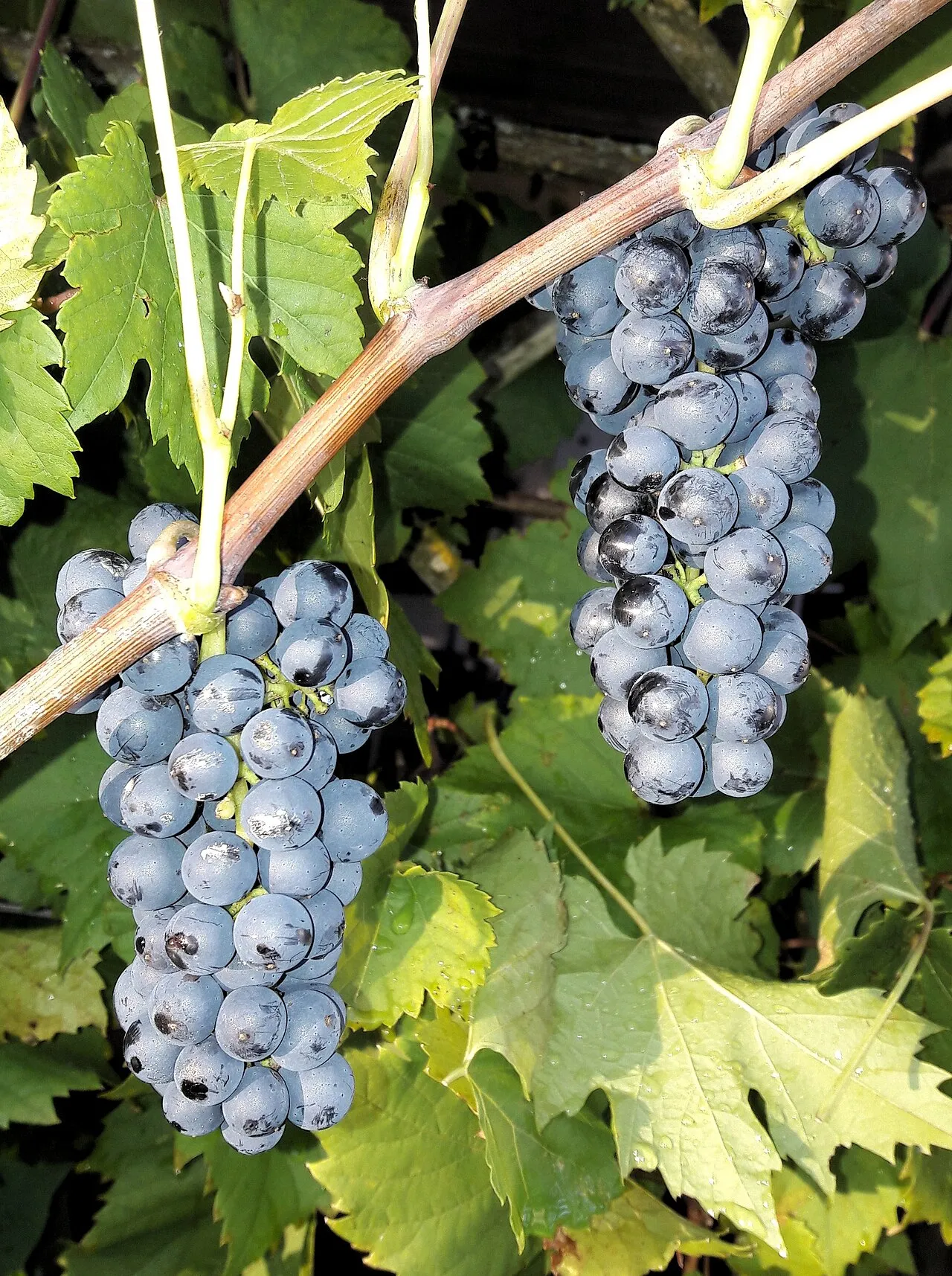
Profile: Clinton
| Berry colour | Black grape (N) |
|---|---|
| Species / status | Direct producer hybrid |
| Origin | United States, New York State |
| Parentage | Vitis riparia × Vitis labrusca (presumed natural hybrid) |
| Synonyms | Zéphyrin |
| Grown in | France, Italy, United States |
| Typical aromas | foxy, tart red fruit |
| Wine style | Light red, often under 10% abv, acidic and sometimes slightly sparkling, to drink very young. |
| Food pairings | soup (chabrot), Cévennes charcuterie, chestnuts |
| Identifiers | VIVC no. 2711, Wikidata Q1101665 |
Origin: an American vine from New York State
Clinton is a black grape of North American origin. It was first planted in New York State in 1821. It is considered a natural hybrid between two American vine species, Vitis riparia and Vitis labrusca, with no contribution from Vitis vinifera.
It was imported to France in the 19th century, during the phylloxera crisis, for its ability to resist the pest aphid. Planted ungrafted, it made it possible to produce wine without grafting: it is a direct-producer hybrid (HPD).
A Cévennes grape
Clinton took hold mainly on the southern foothills of the Massif Central: Lozère, Ardèche, Gard, northern Hérault and Aveyron. It became a symbol of the Cévennes, where the family vine supplemented the economy of small farms. It is also grown in north-east Italy (Friuli and Veneto). The neighbouring wine regions are described in the grapes of Languedoc-Roussillon.
The ban of 1934-1935
Clinton is one of the six grapes banned in France following the law of December 1934 and its 1935 texts:
| Grape | Origin | Colour |
|---|---|---|
| Clinton | New York State | Black |
| Noah | Illinois | White |
| Isabelle | South-east United States | Black |
| Jacquez | Southern United States | Black |
| Othello | Ontario (Canada) | Black |
| Herbemont | South Carolina | Black |
The official argument concerned the quality and methanol content of these wines; the context, for its part, was one of serious overproduction. The details of this history are in the guide on the hybrids banned in 1934.
Clinton wine
Clinton wine is light, often under 10% abv, acidic, sometimes slightly sparkling, and keeps poorly: it is drunk very young. It has the foxy taste of labrusca-type vines. In the Cévennes, it was customary to sweeten it with sugar or lemonade, or to use it to faire chabrot (pour a little wine into the remains of a soup).
Offspring
Clinton has been used as a parent. Othello comes from its crossing with a European grape of the frankenthal (black hamburg) type. This offspring illustrates the first generation of hybrids created in North America to combine hardiness and European quality.
Current status and revival
Articles 95 and 96 of the wine code, which dealt with these grapes, were repealed on 6 September 2003. The ban was, however, taken up at European level: the 2008 regulation, then regulation (EU) no. 1308/2013, exclude clinton from the list of varieties that can be classified. Its wine therefore cannot be sold as “wine”.
In the Cévennes, the association Fruits Oubliés Réseau, based in Saint-Jean-du-Gard, works for its rehabilitation: annual meetings around Cévennes grapes, publication in 2014 of the book Pour la renaissance des cépages interdits, and promotion as grape juice. The debate was taken to the European Parliament in 2025, without a lifting of the ban being confirmed at the date of this update. See also the page on direct-producer hybrids.
Further reading
Frequently asked questions
Is clinton banned in France?
Yes, in the sense that its wine cannot be sold as "wine". Clinton is one of the six grapes covered by the 1934-1935 legislation, and European regulation no. 1308/2013 still prohibits classing it as a wine grape variety. The obligation to uproot the vines has, however, disappeared, and production for family consumption remains tolerated.
What is chabrot with clinton?
Chabrot (or chabròl) is a custom of southern France in which a little wine is poured into the bottom of a bowl of soup, and the mixture is then drunk straight from the bowl. In the Cévennes, light, acidic clinton was traditionally used for this.
What is the difference between clinton and othello?
Othello is a descendant of clinton: it was obtained by crossing clinton with a European grape of the frankenthal (black hamburg) type. Both are black hybrids, both banned in 1934-1935, but othello contains a share of Vitis vinifera that clinton does not.
Where can clinton be found today?
A few vines survive in the Cévennes, in the Ardèche, in the Lozère or in the north of the Hérault, often kept by private individuals. The association Fruits Oubliés Réseau, based in Saint-Jean-du-Gard, campaigns for its rehabilitation and promotes the grape, notably as juice.
Related grapes
- Othello (black, Canada, Ontario)
- Noah (white, United States, Illinois)
- Isabella (black, United States, South Carolina (probable origin))
- Jacquez (black, Southern United States (exact origin uncertain))
- Herbemont (black, United States, South Carolina)
- Concord (black, United States, Massachusetts (Concord))