Noah: the white hybrid banished from French vineyards
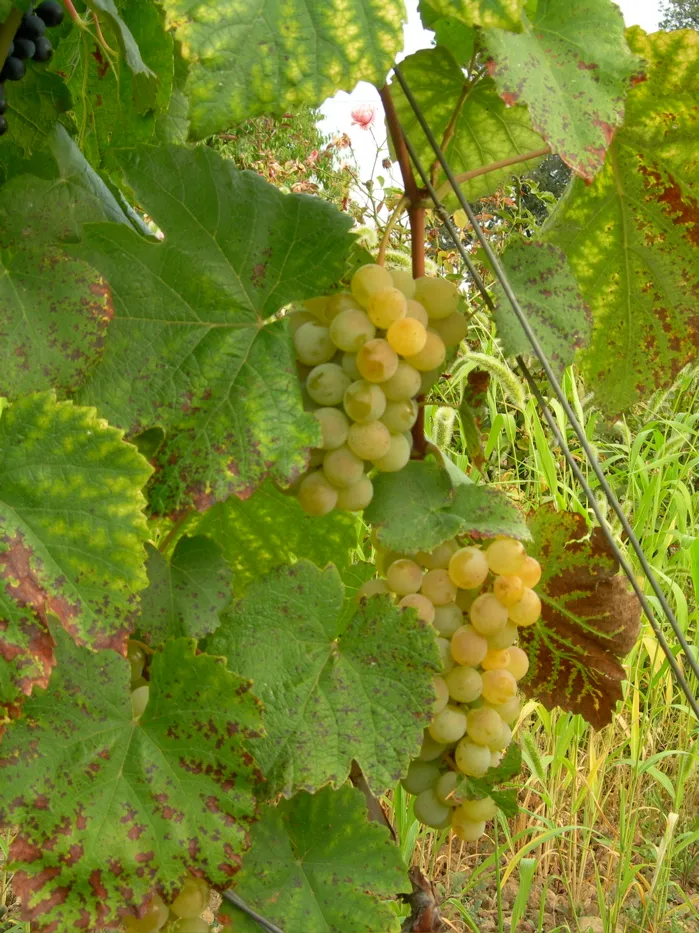
Profile: Noah
| Berry colour | White grape (B) |
|---|---|
| Species / status | Direct producer hybrid |
| Origin | United States, Illinois |
| Parentage | Seedling of Taylor (Vitis riparia) × Vitis labrusca |
| Synonyms | Noha, Noja |
| Grown in | United States, France, Austria, Croatia, Serbia, Romania, Italy |
| Typical aromas | foxy (fur, sweets), very ripe fruit, raspberry and rose (eau-de-vie) |
| Wine style | White with a marked foxy flavour, traditionally drunk at home; sometimes distilled. |
| Food pairings | country cooking, chestnuts, farmhouse cheeses |
| Identifiers | VIVC no. 8573, Wikidata Q838655 |
Origin: an American seedling from Illinois
Noah is a white grape of American origin, born in Illinois from a seedling of the Taylor grape, itself linked to Vitis riparia. The other parent is a vine of the Vitis labrusca type, sometimes identified as the Hartford grape. Noah is therefore a hybrid between two American vine species, with no significant share of Vitis vinifera.
It spread to Europe in the 19th century, when phylloxera was ravaging the vineyards. Like other American vines, it made it possible to produce wine without grafting: this is what is called a direct-producer hybrid (hybride producteur direct, HPD).
Six grapes banned in 1934-1935
Noah is one of the six grapes banned in France by the legislation of late 1934 and 1935. The law passed in December 1934 and its implementing texts targeted:
| Grape | Colour | Page |
|---|---|---|
| Noah | White | This page |
| Clinton | Black | Clinton |
| Isabelle | Black | Isabelle |
| Jacquez | Black | Jacquez |
| Othello | Black | Othello |
| Herbemont | Black | Herbemont |
The official justification was health-related: these wines were blamed for a high methanol content and a flavour considered detestable. In the background, the stakes were also economic: reducing wine overproduction in a France in crisis. The full story is told in the guide on the banned hybrids of 1934.
In the vineyard
Noah is a vigorous and fertile grape, even with short pruning, ripening in the second period (about two and a half weeks after chasselas). It is resistant to downy mildew, powdery mildew and black rot, which explains its success with small growers. Its resistance to phylloxera is, however, weak, and it is susceptible to chlorosis on calcareous soils.
The wine: a “foxy” flavour
Noah wine has the so-called “foxy” flavour, typical of labrusca-type vines: an animal, fur or sweet-like note that lovers of classic wines often find unpleasant. It has sometimes been used to make sparkling wines. Distilled, it gives an eau-de-vie with aromas recalling raspberry and rose.
On the question of methanol, the available measurements put the 1934 argument into perspective: noah wine contains slightly more than the average vinifera wine, without a dramatic difference, and winemaking strongly influences this level.
Where it is still found
In France, noah has survived in areas of small-scale family viticulture: Charente, Vendée, Ardèche and the Cévennes are often cited. Plantings of American hybrids there have fallen sharply since the 1950s. It is also found in the United States, in Austria (where it goes into the Uhudler of southern Burgenland), in Croatia, Serbia, Romania and Italy.
Current status and the rehabilitation debate
Articles 95 and 96 of the wine code, which targeted these grapes, were repealed in 2003. But the European regulation of 2008 on the organisation of the wine market, then Regulation (EU) No 1308/2013 (Article 81), took up the exclusion: noah and its five companions cannot be classified as wine grape varieties. Their wine therefore cannot be sold under the name “wine”.
The debate on their return is revived regularly. In October 2025, a meeting devoted to these “forgotten grapes” was held at the European Parliament, and French members of parliament questioned the government on their reintroduction. At the date this page was last updated, no definitive lifting of the ban could be confirmed. Noah also remains part of the history of armagnac, since it is one of the parents of baco blanc. See also the page direct-producer hybrids.
Further reading
Frequently asked questions
Why is noah banned?
It is one of the six grapes (noah, clinton, isabelle, jacquez, othello, herbemont) banned by French legislation of 1934-1935. Officially, their wines were blamed for mediocre quality and excessive methanol content; in practice, the aim was also to fight overproduction. European law still excludes them from the list of wine grape varieties that can be classified.
Is noah wine dangerous?
Noah wine contains slightly more methanol than the average Vitis vinifera wine, but published measurements do not show a substantially higher content than in other red wines. The winemaking method also influences this level. The health argument put forward in 1934 is now widely questioned.
Can noah still be grown?
The articles of the wine code that targeted these grapes were repealed in 2003, and the obligation to grub up no longer exists. However, noah cannot be classified as a wine grape variety in the European Union: its wine therefore cannot be marketed under the name "wine". Production for family consumption remains tolerated.
What is the link between noah and armagnac?
Noah is one of the two parents of baco blanc, bred in 1898 by François Baco by crossing folle blanche with noah. Baco blanc is today the only hybrid of this type permitted in an AOC, armagnac.