Teinturier grapes: when the flesh of the grape is red
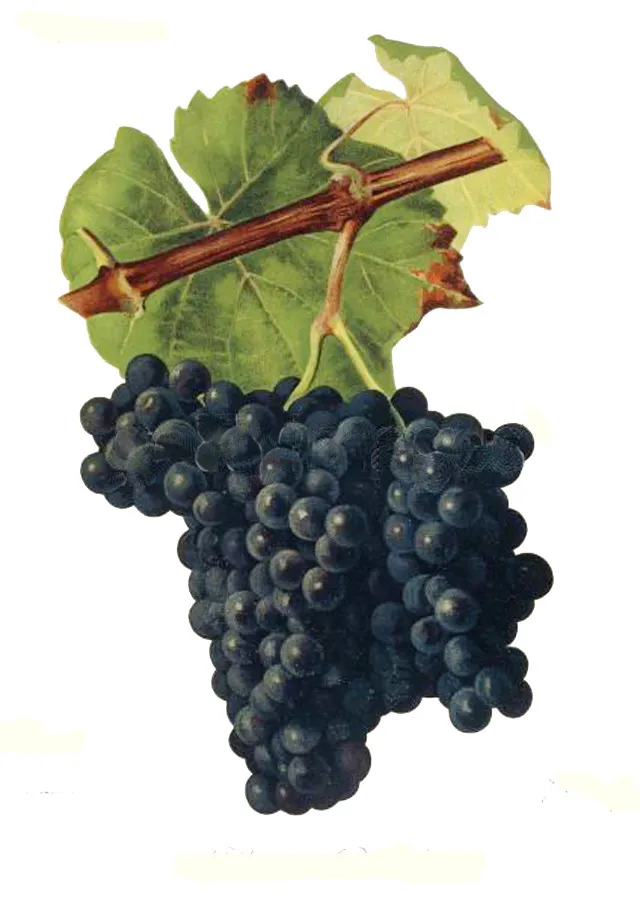
Definition: coloured flesh, not just skin
A teinturier grape is a vine variety whose flesh is coloured by anthocyanins, the red pigments of the grape. In almost all black grapes, these pigments are confined to the skin: the flesh is colourless and the juice comes out of the press white. In a teinturier, the juice is red without any maceration.
The word comes from the use: these grapes were used to “dye” (teindre) wines that were too pale. The term does not designate a genetic family but a trait, which appeared independently in several lines.
The official colour code does not flag this trait: a teinturier is recorded as N like any black grape (see the codes N, B, G, Rs).
How to recognise a teinturier
Three clues make it possible to spot a teinturier in the vineyard and in the winery:
- the flesh: crushed between the fingers, a ripe berry leaves a red juice, and the flesh is coloured right to the seeds;
- the foliage: leaves often turn red early in the season, and sometimes the veins and shoots are tinted; the 2020 study describes typically reddish leaves;
- the free-run juice: direct pressing gives a red must, impossible to obtain from ordinary pinot noir or gamay.
The genetics of red flesh
Grape colour depends on a genetic regulator, the VvmybA1 gene, which activates anthocyanin synthesis in the skin. In 2020, a team from the Julius Kühn Institute (Geilweilerhof) associated the teinturier trait with a DNA element of 408 base pairs, repeated in the promoter of this gene.
The authors identified teinturier clones carrying two, three or five repeats. The number of repeats is strongly correlated with gene expression and anthocyanin content: the more there are, the darker the flesh. They also show that these clones are periclinal chimeras, with genetically different cell layers, a mechanism also found in the colour mutations of pinot.
The French family: from teinturier du Cher to the Bouschets
| Variety | Origin | Current status |
|---|---|---|
| Teinturier du Cher | Old variety, obscure origin | Almost extinct, kept in collections |
| Gamay de Bouze | Seedling related to the gamays | Marginal |
| Gamay de Chaudenay | Mutation of gamay de Bouze | Marginal |
| Gamay Fréaux | Mutation of gamay de Bouze | Marginal |
| Petit Bouschet | Aramon × teinturier du Cher | Practically extinct |
| Alicante Bouschet | Petit Bouschet × grenache | Still grown in the Midi, Spain and Portugal |
Teinturier du Cher
This is the ancestor of most French teinturiers. Its date and place of origin are unknown. It gives a very deeply coloured but thin wine, and its cultivation has almost disappeared; it survives in collections.
The teinturier gamays
Gamay de Bouze is a seedling linked to the gamay family; gamay de Chaudenay and gamay Fréaux are two mutations of gamay de Bouze. They were planted in Burgundy and the Centre to colour gamay wines, before being removed from the appellations. The official name of the Beaujolais grape, “gamay noir à jus blanc” (gamay with white juice), is explained precisely by the need to distinguish it from these colour-juiced gamays.
The breeds of Louis and Henri Bouschet
In the 19th century, Louis Bouschet and then his son Henri, in the Hérault, crossed teinturier du Cher with productive grapes of the Midi to obtain coloured, high-yielding wines:
- petit Bouschet, from aramon and teinturier du Cher;
- alicante Bouschet, from petit Bouschet and grenache noir, bred by Henri Bouschet in the 1850s-1860s (sources differ on the year).
Alicante Bouschet spread very quickly in the Midi, in Algeria, Spain and Portugal, because it made it possible to colour very productive but pale aramon wines.
Teinturiers outside France
Other teinturiers appeared independently elsewhere:
- saperavi, the great black grape of Georgia, whose coloured flesh gives wines of very deep colour, capable of ageing;
- colorino, in Tuscany, formerly used to strengthen the colour of sangiovese wines;
- several recent German breeds, created for the same purpose.
Saperavi shows that a teinturier is not doomed to mediocrity: there it is a noble grape, vinified on its own.
Winemaking uses
Teinturiers have three main uses:
- Strengthening the colour of a blend, in small proportion; this was the historic function.
- Filling gaps in a vineyard: alicante vines were long planted to replace missing vines in plots of other varieties, which explains its scattered presence in the old vineyards of the Midi.
- Making concentrated single-variety wines, as in Portugal or Georgia.
Their limit is well known: lots of colour, but a wine that is often flat and not very fine when yields are high. As with carignan, old low-yielding vines give very different results.
Regulatory status in France
Teinturiers have been largely removed from AOC specifications, which favour grapes with colourless flesh and colour obtained by maceration. Alicante Bouschet remains classified for wine production and appears in some PGIs of the Midi, such as Pays d’Oc. As always, the specification of each appellation must be checked (see reading an AOC specification).
Not to be confused
| Notion | What it is | Example |
|---|---|---|
| Teinturier | Coloured flesh | Alicante Bouschet, saperavi |
| Deeply coloured grape | Skin rich in anthocyanins, white flesh | Syrah, tannat |
| Blanc de noirs | White wine from black grapes with white flesh | Pinot noir champagne |
| Colour mutation | Skin colour variant of the same grape | Pinot gris, grenache blanc |
A “blanc de noirs” is impossible with a teinturier: this is the simplest test for remembering the definition.
Grapes mentioned in this guide
- Alicante Bouschet (black, France, Hérault (Languedoc))
- Saperavi (black, Georgia, Kakheti)
- Aramon noir (black, France, Languedoc)
- Grenache noir (black, Spain, Aragon (origin disputed with Sardinia))
- Gamay (black, France, Burgundy)
- Pinot noir (black, France, Burgundy)
- Carignan (black, Spain, Aragon (Cariñena region))
Frequently asked questions
What is a teinturier grape?
It is a black grape variety whose flesh is coloured red, in addition to the skin. The juice is therefore red without maceration. The vast majority of black grapes, by contrast, have colourless flesh and white juice.
Is alicante Bouschet authorised in AOCs?
It is very rarely admitted in French appellations, which have removed most teinturiers from their lists of grape varieties. It remains used in wines without a geographical indication and in some PGIs such as Pays d'Oc. Outside France, it is appreciated in Portugal, notably in the Alentejo, and in Spain under the name garnacha tintorera.
Is Beaujolais gamay a teinturier?
No. Gamay noir à jus blanc, the Beaujolais grape, has colourless flesh, as its official name states. The teinturier gamays (gamay de Bouze, gamay de Chaudenay, gamay Fréaux) are distinct varieties with coloured flesh, marginal today.
Why is the flesh of teinturiers red?
Anthocyanins, pigments normally limited to the skin, are also produced in the flesh and often in the leaves. A study published in 2020 associates this trait with a repeated DNA element in the promoter of the VvmybA1 gene, which drives anthocyanin synthesis; the more repeats, the more intense the colour.