Grenache noir: the Mediterranean grape of blends and sweet wines
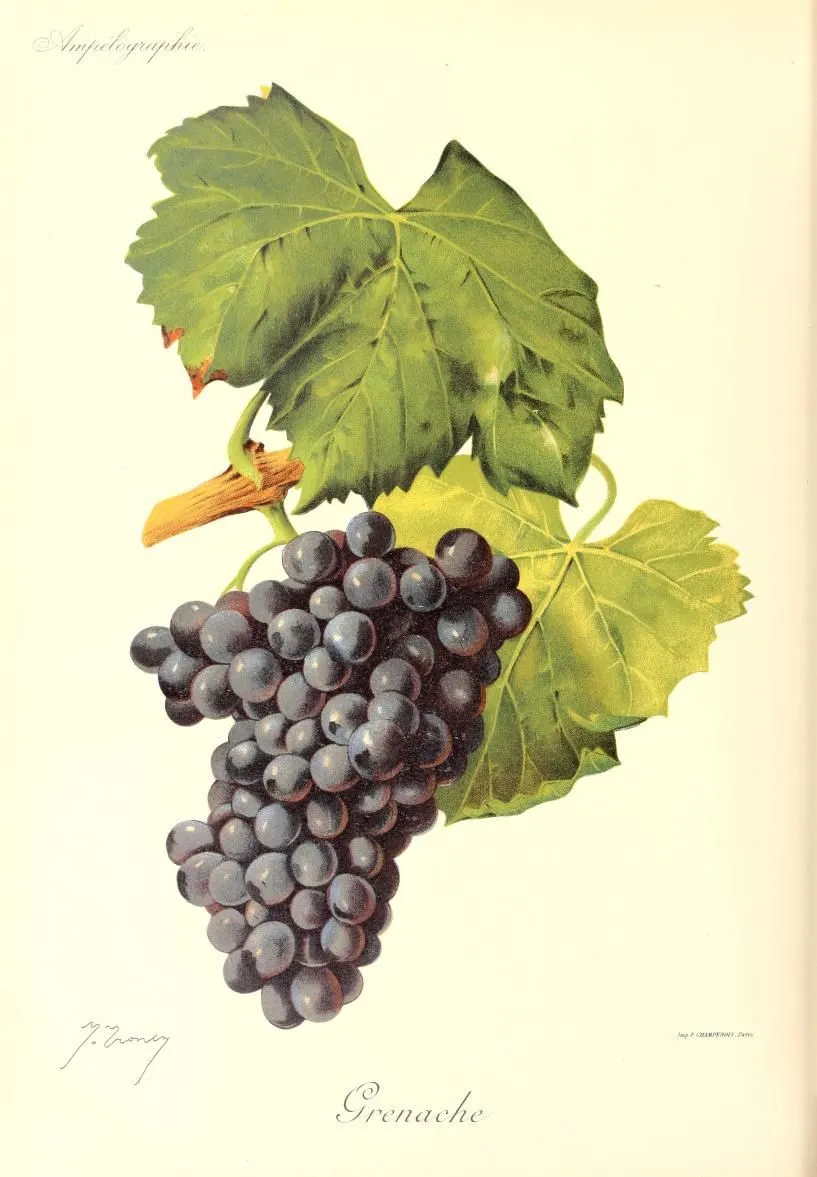
Profile: Grenache noir
| Berry colour | Black grape (N) |
|---|---|
| Species / status | Vitis vinifera |
| Origin | Spain, Aragon (origin disputed with Sardinia) |
| Synonyms | Garnacha (Spain), Garnatxa (Catalonia), Cannonau (Sardinia), Alicante (former Spanish synonym), Tinto aragonés |
| French regions | Corsica, Languedoc-Roussillon, Provence, Rhône Valley |
| Grown in | Spain, France, Italy, Australia, United States, Algeria |
| Typical aromas | ripe strawberry, raspberry, cherry, garrigue, white pepper, dried fruit and cocoa (sweet wines) |
| Wine style | Warm, fruity, low-tannin reds, generous rosés and long-lived vins doux naturels. |
| Food pairings | Provençal daube, lamb with herbs, spicy dishes, dark chocolate (vins doux naturels) |
| Identifiers | VIVC no. 4461, Wikidata Q390242 |
Origin: a Mediterranean dispute
Grenache noir is a grape of the western Mediterranean. Its cradle is the subject of a debate between Spain and Sardinia.
- Aragonese hypothesis: this is the dominant hypothesis among ampelographers. The grape has long been attested in Aragon under the name garnacha, and the old synonym tinto aragonés points to this region. It is thought to have spread through the territories of the Crown of Aragon, including Roussillon and Sardinia.
- Sardinian hypothesis: Sardinia, where it is called cannonau, puts forward archaeological finds and old documents to claim a local origin.
No genetic demonstration allows the matter to be settled today. We therefore keep to an origin that is probably Aragonese, but debated.
A family of mutations
Like pinot, grenache exists in several colours, arising from mutations. See colour mutations.
| Form | Main use | Where in France |
|---|---|---|
| Grenache noir | Reds, rosés, vins doux naturels | Southern Rhône, Languedoc-Roussillon, Provence, Corsica |
| Grenache gris | Whites, rosés, sweet wines | Mainly Roussillon |
| Grenache blanc | Dry whites and sweet wines | Roussillon, Rhône, Languedoc |
In the vineyard
Grenache noir is resistant to drought and heat, and withstands wind well. Traditionally trained as a free-standing bush vine (gobelet), it lives a long time: old-vine grenache is sought after.
It is, however, susceptible to poor fruit set (coulure) at flowering, which makes its harvest irregular. Its compact bunches expose it to grey rot and it is susceptible to downy mildew. It ripens late and accumulates a lot of sugar, hence wines that are often high in alcohol.
The wines
Grenache noir gives wines that are pale in colour, low in tannin and high in alcohol, with aromas of ripe strawberry, raspberry, cherry and garrigue. It oxidises fairly easily, which suits the oxidative ageing of sweet wines.
This is why it is often blended:
- with syrah, for colour and structure;
- with mourvèdre, for tannins and ageing potential;
- with carignan and cinsault, in the Languedoc and in Provence.
See also the comparison grenache or syrah.
The angle to know: the grape of the vins doux naturels
Grenache is the main grape of the red vins doux naturels of Roussillon: Banyuls, Maury and Rivesaltes. These wines are fortified (muté), that is, fermentation is stopped by adding alcohol, which keeps part of the grape sugar.
Two major families of ageing result:
- wines in a reductive style (grenat, rimage), kept away from air, with red and black fruit aromas;
- wines in an oxidative style (tuilé, hors d’âge, rancio), aged in contact with air, sometimes in glass demijohns exposed to the sun, with aromas of dried fruit, cocoa and coffee.
Where it is grown
In France, it is one of the most planted black grapes. It dominates the blends of the south of the Rhône Valley, in particular at Châteauneuf-du-Pape, where it is the majority grape among the many permitted varieties, and at Gigondas. It is very present in Languedoc-Roussillon, in Provence and in Corsica.
In Spain, garnacha is grown in Aragon (Campo de Borja, Calatayud, Cariñena), in Navarre, in Rioja and in Catalonia (Priorat). It is also found in Sardinia, in Australia (McLaren Vale, Barossa) and in California.
Genealogy of Grenache noir
Offspring profiled on this site: Alicante Bouschet, Marselan.
Further reading
- Grenache or syrah: 10 differences to know
- N, B, G, Rs codes: the official colour of grape varieties explained
- Teinturier grapes: red-fleshed varieties, alicante and the gamays
- Colour mutations: pinot gris, grenache blanc and multicoloured grapes
- Grape synonyms and homonyms: côt, rolle, auxerrois, malvoisie
- Grape varieties and climate change: adapting the plantings
- Single-varietal or blend: two philosophies of wine
- Reading an AOC specification: grapes, yields, rules
Frequently asked questions
Is grenache Spanish or Sardinian?
Most ampelographers place its origin in Aragon, in northern Spain, where it has long been known as garnacha. Sardinia, where it is called cannonau, also claims the origin, relying on archaeological finds. The question has not been settled definitively.
What is the difference between grenache noir, gris and blanc?
They are colour mutations of a single variety. Grenache noir gives reds and rosés, grenache gris has pinkish berries used mainly for whites and rosés, and grenache blanc has white berries. All three are permitted in several appellations of Roussillon and the Rhône.
Why is grenache used for sweet wines?
It accumulates a lot of sugar in a hot climate. This is an asset for vins doux naturels, in which fermentation is stopped by adding alcohol (mutage) to keep part of the grape sugar. Banyuls, Maury and Rivesaltes are the French examples.
What is the difference between grenache and syrah?
Grenache gives paler wines, higher in alcohol and low in tannin, with ripe red fruit aromas. Syrah is deeper in colour, more tannic, and brings notes of black fruit and pepper. The two are often blended in the southern Rhône Valley.