Marselan: the INRA cross that became a star in China
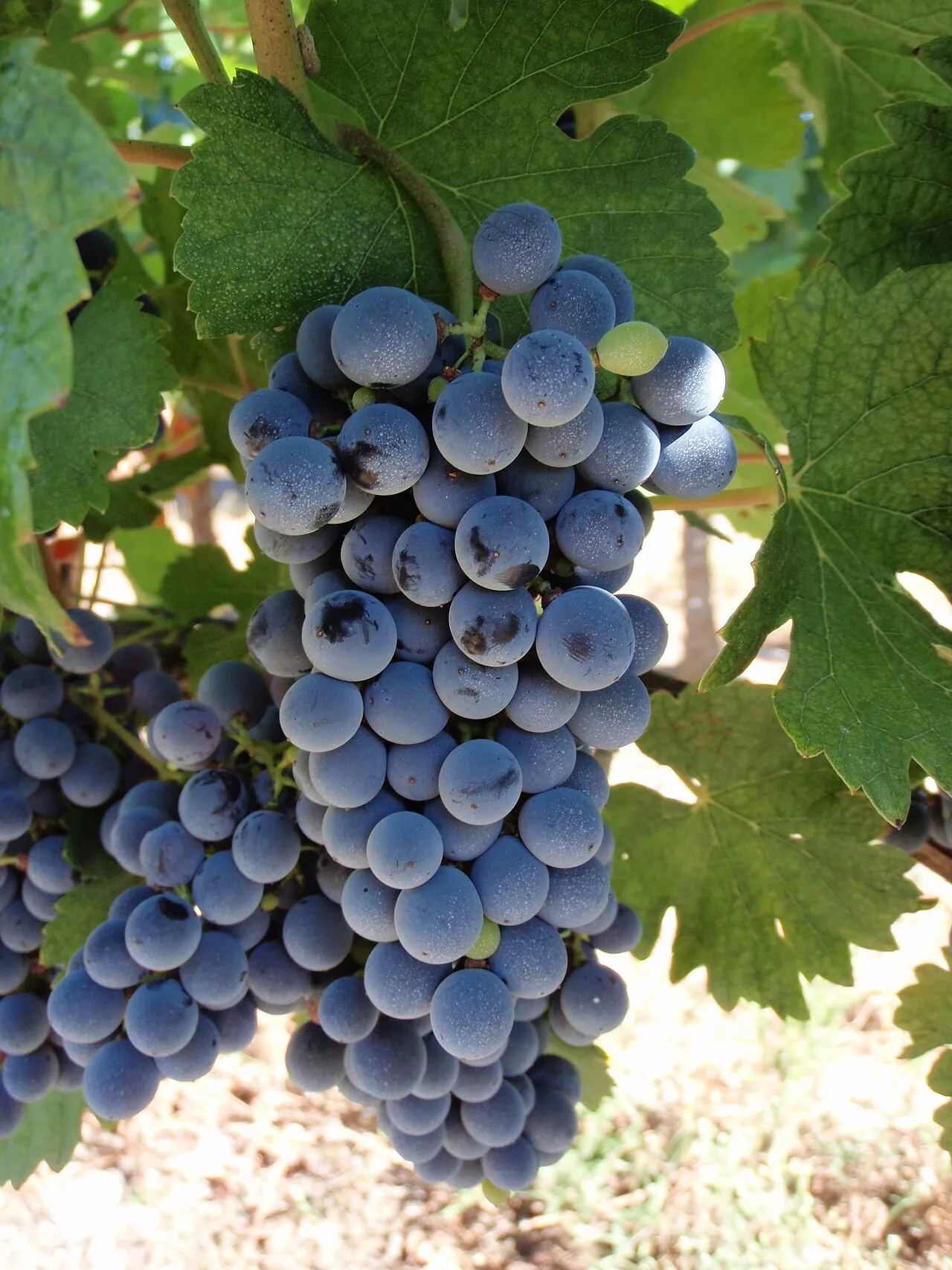
Profile: Marselan
| Berry colour | Black grape (N) |
|---|---|
| Species / status | Vitis vinifera |
| Origin | France, Hérault (Languedoc) |
| Parentage | Cabernet sauvignon × Grenache noir (bred by Paul Truel, INRA, in 1961) |
| Synonyms | INRA 1810-68 |
| French regions | Bordeaux, Languedoc-Roussillon, Rhône Valley |
| Grown in | France, China, Spain, Argentina, Brazil, United States, Switzerland |
| Typical aromas | blackcurrant, blackberry, black cherry, sweet spices, minty notes |
| Wine style | Deeply coloured, aromatic reds with supple tannins, drinkable young but capable of medium-term ageing. |
| Food pairings | roast lamb, duck breast (magret), grilled skewers, spicy cuisine, pressed cheeses |
| Identifiers | VIVC no. 16383, Wikidata Q833144 |
Origin: an INRA cross put on the shelf
Marselan is an intraspecific cross made in 1961 by the ampelographer Paul Truel at INRA, in collaboration with the École nationale supérieure agronomique de Montpellier. Its parents are cabernet sauvignon and grenache noir.
Its name comes from Marseillan, a commune in the Hérault near which it was bred. Its breeding code is INRA 1810-68.
At the time, research aimed at productive grapes with large berries. Marselan, which gives large bunches but small berries, did not meet this expectation. It was therefore set aside for nearly thirty years.
A second life in the 1990s
At the end of the 20th century, priorities changed: the aim was now quality grapes, less productive and more resistant to disease to reduce spraying. Marselan was reassessed and registered in the official Catalogue of grapevine varieties in 1990. Only one clone is approved, no. 980.
To understand how a variety enters the catalogue, see our guide on the official Catalogue of grapevine varieties.
In the vineyard
| Trait | Marselan |
|---|---|
| Type | Vitis vinifera × Vitis vinifera cross (not a hybrid) |
| Bunches | Large, with small berries |
| Ripening | Medium to late |
| Resistance | Good tolerance of grey rot, powdery mildew, coulure and mites |
| Juice yield | Low, because of the small size of the berries |
| Climate asset | Copes well with heat and drought |
Note: despite its good resistance, marselan is not a “resistant grape” in the current regulatory sense. That term designates varieties carrying resistance genes from other vine species. See our guide on resistant grapes.
The wines
Marselan sought to combine the finesse of cabernet sauvignon with the colour, heat tolerance and generosity of grenache. The result gives reds that are:
- deep in colour;
- aromatic, with blackcurrant, blackberry and spice;
- with suppler tannins than those of cabernet;
- pleasant young, with medium ageing potential.
It is made as a single variety in IGP (notably Pays d’Oc) or goes into blends with syrah, grenache or merlot.
Where it is grown in France
- Languedoc-Roussillon: its cradle and main growing area, mainly in IGP.
- Southern Rhône valley: present in blends.
- Bordeaux: since 2021, marselan is one of the varieties of interest for adaptation authorised in the Bordeaux and Bordeaux supérieur AOCs, alongside notably arinarnoa, castets and touriga nacional. Their share is capped in the planting and in the blend, and their name does not appear on the label.
The little-known angle: a French grape that became Chinese
Marselan is one of the few French grapes whose recent history is written first in China. It was introduced there in the early 2000s in the Franco-Chinese demonstration vineyard at Huailai, in Hebei province, the fruit of cooperation between the two countries. It was then planted in other regions, including Shandong.
Several reasons explain this success: its disease resistance, suited to climates that are sometimes humid in summer; its colour and fruit, appreciated by consumers; and its lack of historical competition, which allows Chinese producers to make it a signature. The grape is often cited as a candidate for the role of the country’s emblematic grape.
Elsewhere in the world
Marselan is also planted in Spain (Catalonia, Valencia), Argentina, Brazil, Switzerland (canton of Vaud) and the United States, where its name was approved for labelling in 2007. In all these countries, it remains a niche grape.
Marselan and its parents
Marselan inherits traits from both parents, without being a simple average of the two.
| Benchmark | Cabernet sauvignon | Grenache noir | Marselan |
|---|---|---|---|
| Origin | Bordeaux region | Spain (Aragon) | Hérault, INRA breeding |
| Berries | Small | Medium | Small |
| Colour of the wines | Deep | Medium, evolves fast | Deep |
| Tannins | Firm | Supple | Supple to medium |
| Known weak point | Late ripening in cool climates | Sensitivity to coulure | Low juice yield |
This combination explains its interest in the Midi: the colour and structure of cabernet, with better adaptation to heat. To compare cabernet sauvignon with its neighbours, see the comparison merlot or cabernet sauvignon.
Genealogy of Marselan
Identified parents (Wikidata): Cabernet sauvignon and Grenache noir.
Further reading
Frequently asked questions
Who are the parents of marselan?
Marselan comes from a controlled cross between cabernet sauvignon and grenache noir, made in 1961 by Paul Truel at INRA, in collaboration with the École nationale supérieure agronomique de Montpellier. It is not a hybrid: both its parents belong to the species Vitis vinifera.
Where does the name marselan come from?
Its name recalls the commune of Marseillan, in the Hérault, near which it was bred. The Domaine de Vassal, where an important vine collection is kept, is in this commune.
Is marselan authorised in Bordeaux?
Yes, since 2021, as a variety of interest for adaptation to climate change for the Bordeaux and Bordeaux supérieur AOCs. These varieties are limited to a small share of the estate's area and of the blend, and their name may not appear on the label.
Why is marselan popular in China?
It was planted from the early 2000s in the Franco-Chinese demonstration vineyard at Huailai (Hebei), then in other provinces. Its disease resistance and its ability to give coloured, fruity wines appealed to Chinese producers, to the point that several observers present it as an emblematic grape of Chinese wine.
Related grapes
- Cabernet sauvignon (black, France, Bordeaux area)
- Grenache noir (black, Spain, Aragon (origin disputed with Sardinia))
- Syrah (black, France, northern Rhône Valley)
- Merlot (black, France, Bordeaux (Libournais))
- Touriga nacional (black, Portugal, probably Dão)
- Alicante Bouschet (black, France, Hérault (Languedoc))