Syrah: a Rhône grape freed from its legends by DNA
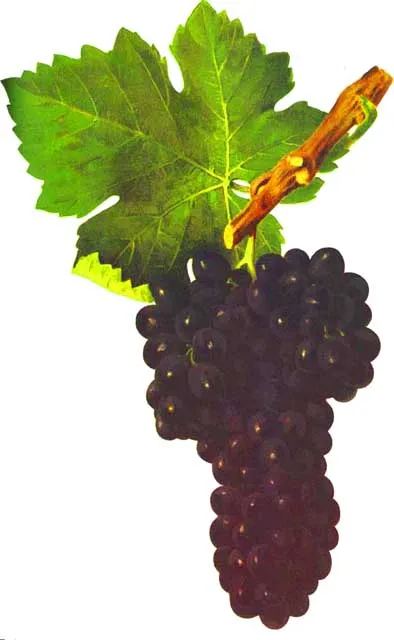
Profile: Syrah
| Berry colour | Black grape (N) |
|---|---|
| Species / status | Vitis vinifera |
| Origin | France, northern Rhône Valley |
| Parentage | Dureza × Mondeuse blanche (natural cross, DNA analysis of the late 1990s) |
| Synonyms | Shiraz (Australia, South Africa), Sérine (Côte-Rôtie, Isère) |
| French regions | Corsica, Languedoc-Roussillon, Provence, Rhône Valley, South-West France |
| Grown in | France, Australia, Spain, South Africa, United States, Argentina, Chile, Italy |
| Typical aromas | blackberry, blackcurrant, violet, black pepper, black olive, smoked bacon and leather (mature wines) |
| Wine style | Deeply coloured, peppery and floral reds in temperate climates, richer, warmer and jammier in hot climates. |
| Food pairings | game, lamb with herbs, grilled rib of beef, Provençal daube |
| Identifiers | VIVC no. 11748, Wikidata Q332720 |
Origin: the end of the legends
Syrah was long surrounded by stories of a distant origin. Two legends dominate:
- it supposedly came from Shiraz, in Iran, brought by travellers or crusaders;
- it supposedly came from Syracuse, in Sicily, brought by the Roman legions.
None of these hypotheses rests on documentary evidence, and they contradict ampelographic observations. The answer came from genetics.
The angle to know: parents from Ardèche and Savoie
In the late 1990s, Carole Meredith’s team (University of California, Davis), working with French researchers, established that syrah is a natural cross between two grapes of south-eastern France:
| Parent | Colour | Region of origin | Status today |
|---|---|---|---|
| Dureza | Black | Ardèche | Very rare grape |
| Mondeuse blanche | White | Savoie | Rare grape of Savoie and Bugey |
Syrah is therefore a Rhône grape of Alpine stock. This parentage also links it to mondeuse noire, itself related to mondeuse blanche through a parent-offspring relationship. For the method, see DNA parentage of grape varieties.
In the vineyard
Syrah is a vigorous grape, with fragile shoots that need careful trellising against the wind. It ripens mid-season. It is susceptible to chlorosis on limestone soils and can quickly lose its acidity if picked too late.
In the northern Rhône, it is planted on steep slopes of granite and schist, often in terraces.
The wines
Syrah makes deeply coloured wines with aromas of black fruit, violet and black pepper. The peppery note is due to rotundone, more abundant in cool climates. With age, notes of black olive, smoked bacon and leather appear.
| Style | Where | Characteristics |
|---|---|---|
| Taut, peppery, floral | Côte-Rôtie, Hermitage, Cornas, Saint-Joseph | Black fruit, violet, pepper, long ageing |
| Southern blend | Côtes du Rhône, Languedoc, Provence | With grenache and mourvèdre, structure and colour |
| Rich and sunny | Barossa (Australia) | Jammy fruit, chocolate, higher alcohol |
| Fresh, temperate climate | New Zealand, Washington | Pepper, black fruit, preserved acidity |
In Côte-Rôtie, syrah may be co-fermented with a little viognier. In Hermitage, it may include a share of white grapes (marsanne and roussanne).
For the differences in style between the names, see syrah or shiraz. For its role in southern blends, see grenache or syrah.
Where it is grown
In France, syrah is the red grape of the northern Rhône Valley, and an improving grape widely planted in the South from the second half of the 20th century: Rhône Valley, Languedoc-Roussillon, Provence.
Outside France, Australia has made it its emblematic red grape. It is also grown in Spain, South Africa, the United States, Argentina and Chile.
Further reading
- Grenache or syrah: 10 differences to know
- Syrah or shiraz: the same grape, two styles of wine
- Grape DNA parentage: how genetics rewrote history
- Grape synonyms and homonyms: côt, rolle, auxerrois, malvoisie
- Grape varieties and climate change: adapting the plantings
- Clones and mass selection: how a grape variety is propagated
- Single-varietal or blend: two philosophies of wine
- Reading an AOC specification: grapes, yields, rules
Frequently asked questions
Does syrah come from Persia?
No. One legend has it coming from the Iranian city of Shiraz, another from Syracuse in Sicily, but no documentary evidence supports them. DNA analyses have shown that it comes from two grapes of south-eastern France, dureza and mondeuse blanche. It is therefore of Rhône origin.
Are syrah and shiraz the same grape?
Yes, it is the same grape. Shiraz is the name used in Australia and South Africa, and it is often associated with a riper, richer style. Syrah is the French name, also used for more peppery, taut wines from temperate climates.
Why is viognier added to syrah in Côte-Rôtie?
In the Côte-Rôtie appellation, syrah may be co-fermented with a small proportion of viognier, a white grape. This old practice brings floral notes and is said to help stabilise the wine's colour. It has been taken up by some Australian producers.
Where does syrah's peppery taste come from?
It is due to a molecule called rotundone, found in the grape skin. It is more abundant in cool climates and less exposed sites, which explains why northern Rhône syrahs are often more peppery than those from hot regions.
Related grapes
- Grenache noir (black, Spain, Aragon (origin disputed with Sardinia))
- Mourvèdre (black, Spain, Valencia region)
- Viognier (white, France, northern Rhône Valley)
- Mondeuse noire (black, France, Dauphiné (probable), Savoie)
- Marsanne (white, France, northern Rhône valley)
- Cinsault (black, France, Languedoc (probable))