Clones and mass selection: two ways to replant a grape variety
A grape variety is not uniform
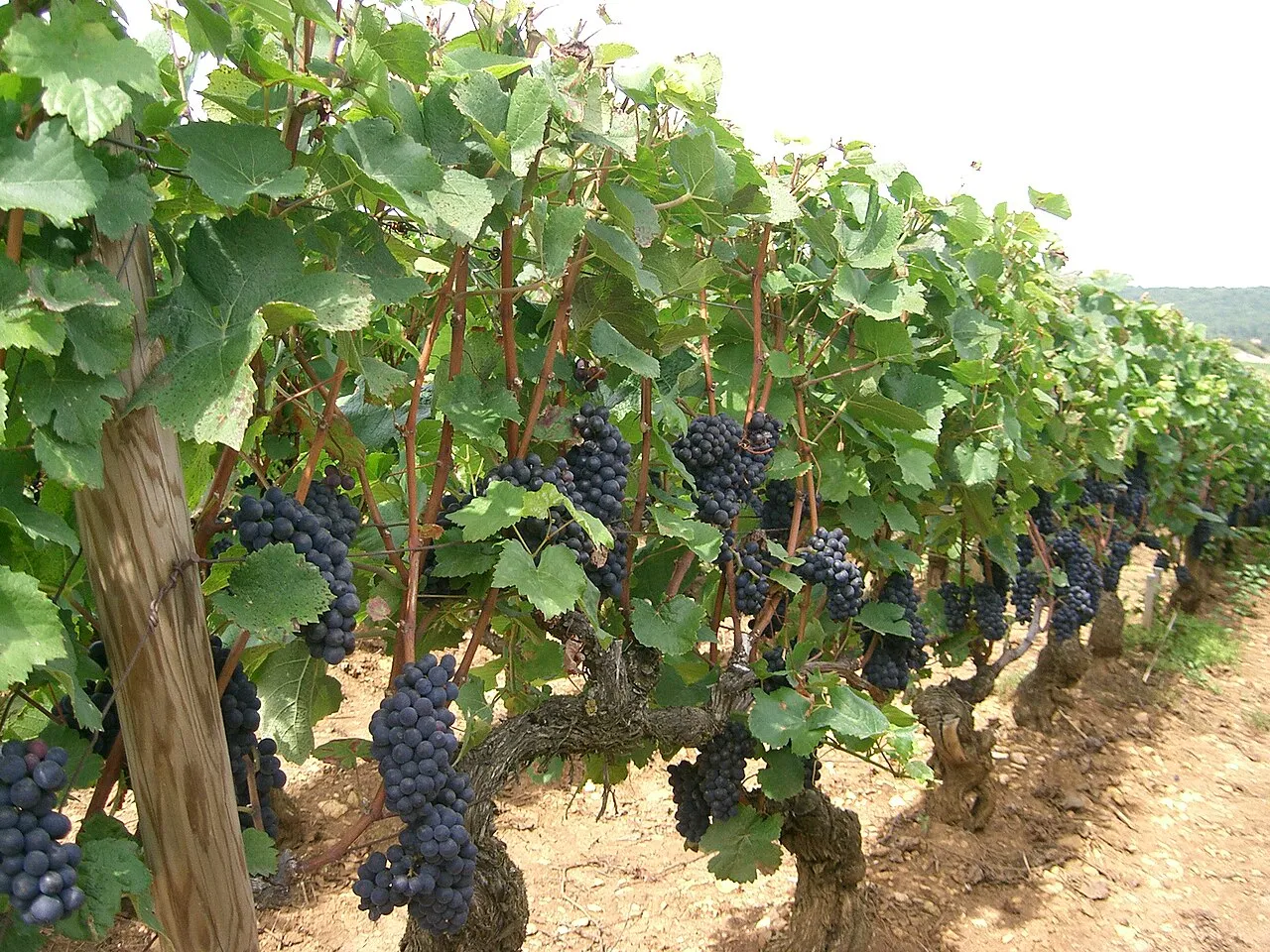
A grape variety has been propagated vegetatively (cuttings, grafting) since its birth: in principle, all its vines are copies of the first. But small mutations can occur at each cell division. Over the centuries, an old variety such as pinot noir thus accumulates internal diversity: vines with smaller or larger bunches, more or less early, more or less coloured.
Some mutations are spectacular, such as those that change the colour of the berries (see colour mutations). Most are discreet and only visible on close observation. Selection exploits this diversity in two opposite ways.
The clone: one vine, one line
A clone is the vegetative offspring of a single mother vine, chosen in a vineyard for its qualities. All plants of a clone are identical to one another.
Clonal selection follows several steps, over many years:
- spotting interesting vines in old vineyards;
- health checks: the vines are tested for the main viruses, and eliminated or sanitised if infected;
- agronomic and oenological evaluation: candidates are planted side by side, followed over several harvests and vinified separately;
- approval: the best are officially registered and receive a number;
- propagation: mother vines for scions supply the wood to nurseries.
In France, this work was organised from the 1960s by the technical institutes and public research, now brought together around the IFV and INRAE. Several hundred clones are approved, for most of the grape varieties of the official catalogue.
Numbered clones
Each clone carries a number. Some have become famous worldwide, such as the pinot noir clones from Burgundian selections (including 115 or 777) or those of chardonnay, often called “Dijon clones” outside France.
The technical sheets of a clone describe its characteristics: fertility, bunch size, berry weight, earliness, sugar potential, acidity, aptitude for producing wines for keeping or light wines. The winegrower chooses according to their objectives.
Mass selection: preserving diversity
Mass selection consists of taking graft wood from a large number of vines of the same plot, setting aside diseased or atypical vines. The new planting reproduces the original population, with its diversity.
This was the universal method before clonal selection: each winegrower replanted from their own vines, or those of a well-regarded neighbour.
| Criterion | Clonal selection | Mass selection |
|---|---|---|
| Origin | A single mother vine | Many vines of a plot |
| Homogeneity | High | Variable |
| Health status | Checked, tested for the main viruses | Depends on visual sorting and any tests |
| Characteristics | Known and described | Those of the original vineyard, less predictable |
| Genetic diversity | Low in a single-clone plot | High |
| Availability | Nurseries’ catalogue | Old vineyards, specialist nurseries |
The big issue: viruses
The vine suffers from viral diseases that cannot be cured once established, notably:
- fanleaf, transmitted by a soil nematode, which shortens internodes, deforms leaves and makes yields drop;
- leafroll, which causes leaves to roll and change colour in autumn and delays ripeness.
These viruses travel with propagation wood. Clonal selection has brought healthy plants, which has greatly improved the state of vineyards. Mass selection, done without checks, risks spreading the viruses present in the old vineyard; serious mass selections today combine visual sorting and health tests.
Categories of planting material
European regulations classify vine plants in categories, with coloured labels:
| Category | Meaning |
|---|---|
| Pre-basic and basic | Starting material, reserved for propagation |
| Certified | From an approved clone, checked for identity and health status (blue label) |
| Standard | Guaranteed varietal identity, lighter health checks (dark yellow label) |
Material from mass selection sold by a nursery generally falls into the standard category. The exact requirements change; nurseries and the IFV hold the reference.
The limits of uniformity
The success of clonal selection had a downside: in some regions, a few clones were planted massively. The risks are well known:
- reduced diversity, which makes the vineyard more vulnerable to a disease or a change in conditions;
- standardisation of wines, when all winegrowers plant the same productive clones;
- loss of old vines, grubbed up with old vineyards before being studied.
In response, several practices have developed:
- polyclonal plantings, which mix several clones of the same grape variety;
- clone conservatories, which gather hundreds of vines taken from a region’s old vineyards to preserve intravarietal diversity (see grape variety conservatories);
- the return of mass selection among winegrowers attached to the heritage of their vines.
Clones and adapting to climate
Intravarietal diversity is also a resource in the face of climate change. Within a single grape variety, one can look for later clones, clones lower in sugar or more tolerant of drought, without changing grape variety or amending an appellation’s specification. It is one of the simplest levers for AOCs, combined with the choice of rootstock.
Key points
- A clone is the offspring of a single selected and checked vine; it remains the same grape variety.
- Mass selection reproduces a population of vines and keeps its diversity.
- Clonal selection has cleaned up the vineyard; mass selection preserves its variability.
- The two methods complement each other, and conservatories provide the link between them.
Grapes mentioned in this guide
- Pinot noir (black, France, Burgundy)
- Chardonnay (white, France, Burgundy)
- Syrah (black, France, northern Rhône Valley)
- Sauvignon blanc (white, France, Loire Valley or South-West France)
- Pinot gris (grey, France, Burgundy (pinot mutation))
- Pinot meunier (black, France, north-east (pinot mutation))
- Cabernet franc (black, France, South-West (Libournais probable))
Frequently asked questions
What is a vine clone?
It is the set of plants obtained by cutting or grafting from a single mother vine, chosen for its characteristics (yield, quality, earliness) and its good health status. All plants of a clone are genetically identical to one another. In France, approved clones carry a number.
What is the difference between clonal selection and mass selection?
Clonal selection propagates a single selected and checked vine: the planting is homogeneous. Mass selection takes wood from many vines of the same plot, often an old vineyard: the planting keeps the diversity of the original population, with its variations in yield, earliness and taste.
Is a clone a different grape variety?
No. A clone remains the same grape variety, with the same name and the same identifying DNA profile. It is a selected variant of it, which may differ in bunch size, earliness or sugar level, but not to the point of constituting a new variety.
Why do viruses matter so much?
Viral diseases such as fanleaf or leafroll reduce the vigour, yield and quality of the vine, and cannot be cured. They are transmitted through propagation wood. Clonal selection guarantees plants tested for the main viruses, which is harder with mass selection.