Cabernet franc: the parent grape of the cabernet family
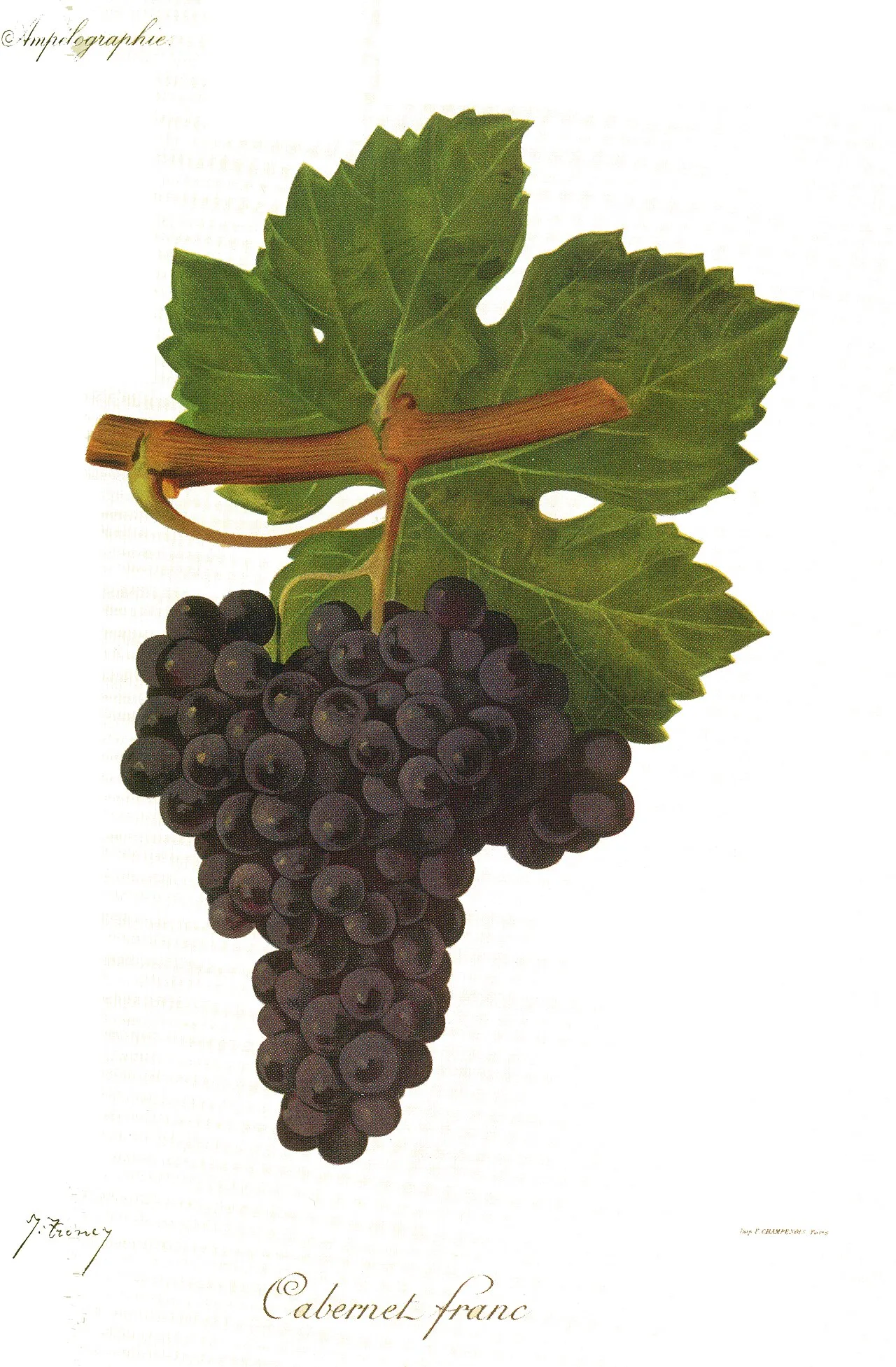
Profile: Cabernet franc
| Berry colour | Black grape (N) |
|---|---|
| Species / status | Vitis vinifera |
| Origin | France, South-West (Libournais probable) |
| Synonyms | Breton (Loire Valley), Bouchet (Saint-Émilion, Pomerol), Achéria (Basque Country) |
| French regions | Bordeaux, Languedoc-Roussillon, Loire Valley, South-West France |
| Grown in | France, Italy, United States, Canada, Hungary, Argentina, Chile, South Africa |
| Typical aromas | raspberry, cherry, violet, green pepper and tomato leaf, graphite and pencil lead, liquorice |
| Wine style | Reds lighter and more fragrant than cabernet sauvignon: supple in the Loire on sands, structured and long-lived on tuffeau or in Bordeaux blends. |
| Food pairings | rillettes and charcuterie, roast poultry, pork with prunes, aged goat's cheeses |
| Identifiers | VIVC no. 1927, Wikidata Q63591 |
Origin: Libournais, with debated Basque roots
Cabernet franc is an old grape of south-west France. It is placed in the Libournais (Saint-Émilion, Pomerol) from the 17th century, even though the Bordeaux archives that mention it explicitly only go back to the end of the 18th century.
Some ampelographers also link its origins to the Basque Country, where it bears the name achéria, notably in Irouléguy. The exact cradle remains debated: neither hypothesis has been conclusively demonstrated. Its own parents have not been established with certainty.
The parent of the cabernet family
Cabernet franc is best known for its offspring. DNA analyses have shown that it is one of the two parents of several great grapes of the South-West:
| Offspring | Other parent | Probable region of birth |
|---|---|---|
| Cabernet sauvignon | Sauvignon blanc | Bordeaux area |
| Merlot | Magdeleine noire des Charentes | South-West |
| Carménère | Gros cabernet | Bordeaux area |
The case of cabernet sauvignon, published in 1997, is the most famous. That of merlot was established in the late 2000s, after the rediscovery of its mother, a grape that had almost disappeared. For the method, see DNA parentage of grapes.
The angle to know: “breton” in the Loire, “bouchet” in the Gironde
Cabernet franc is a good example of a grape with multiple regional identities. It bears a different name depending on the region:
- Breton in Touraine and the Saumur area. A tradition attributes this name to an abbot named Breton, who is said to have had the grape planted at the abbey of Bourgueil at the request of Cardinal Richelieu. This story belongs to tradition, not documented fact;
- Bouchet in Saint-Émilion and Pomerol;
- Achéria in the Basque Country.
These synonyms still sometimes appear in growers’ vocabulary. Our guide on synonyms and homonyms explains how these local names were matched to a single variety.
In the vineyard
Cabernet franc ripens earlier than cabernet sauvignon, by about a week according to sources. This is what allows it to reach ripeness in the cooler climate of the Loire Valley, where its son struggles.
It tolerates cold winters well, which explains its presence in Canada and northern Italy. It is, however, susceptible to poor fruit set (coulure) and to viruses. Like the other cabernets, it can keep a green pepper note when ripeness is insufficient, due to methoxypyrazines.
The wines
In the Loire Valley, it dominates Chinon, Bourgueil, Saint-Nicolas-de-Bourgueil and Saumur-Champigny. Wines from sands and gravels are light and fruity; those from the tuffeau slopes are more structured and age well. The grape often grows alongside chenin, the region’s great white. See the grapes of the Loire Valley.
In Bordeaux, it is mainly planted on the Right Bank, in Saint-Émilion and Pomerol, where it is blended with merlot. It brings freshness, perfume and tension. See the grapes of Bordeaux.
In the South-West, it goes into the blends of Bergerac, Madiran and Irouléguy.
Its typical aromas are raspberry, cherry, violet and a graphite note, accompanied by a fresh green note when the grape is less ripe.
For a detailed comparison of the two cabernets, see cabernet franc or cabernet sauvignon.
Outside France
Cabernet franc is grown in Friuli and Veneto in Italy, in Hungary (Villány region), in the United States (Long Island, Virginia, California), in Canada (Ontario) and in South America. Long confined to a supporting role, it is increasingly made as a single-varietal wine, which reveals its own aromatic profile.
Genealogy of Cabernet franc
Offspring profiled on this site: Cabernet sauvignon, Carménère.
Further reading
Frequently asked questions
What is the difference between cabernet franc and cabernet sauvignon?
Cabernet franc is the parent and cabernet sauvignon the child, born of a cross between cabernet franc and sauvignon blanc. Cabernet franc ripens a little earlier, which lets it succeed in the Loire Valley, and generally gives wines that are less tannic, more floral and more fruity. Cabernet sauvignon is deeper in colour, more austere when young and later ripening.
Why is cabernet franc called "breton"?
It is the traditional name of the grape in Touraine and the Saumur area. According to local tradition, it comes from an abbot named Breton, steward to Cardinal Richelieu, who is said to have had vines from the Bordeaux area planted at the abbey of Bourgueil. The story cannot be verified, but the synonym is well attested.
Which wines are made with cabernet franc?
In France, it dominates the reds of Chinon, Bourgueil, Saint-Nicolas-de-Bourgueil and Saumur-Champigny. It is also a major grape of Saint-Émilion, alongside merlot. It is also found in the wines of Bergerac, in north-east Italy and in Canada, including as icewine.
Is cabernet franc a light wine?
It depends on the soil and the winemaking. On the sands and gravels of the Loire, it gives light, fruity wines for easy drinking. On the tuffeau slopes or clay-limestone soils, and in Saint-Émilion, it produces deeper wines capable of ageing for a long time.
Related grapes
- Cabernet sauvignon (black, France, Bordeaux area)
- Merlot (black, France, Bordeaux (Libournais))
- Carménère (black, France, Bordeaux area)
- Chenin blanc (white, France, Loire Valley (Anjou-Touraine))
- Malbec (Côt) (black, France, Quercy (Lot))
- Fer servadou (black, France, South-West)