Carménère: from the pre-phylloxera Médoc to Chilean vineyards
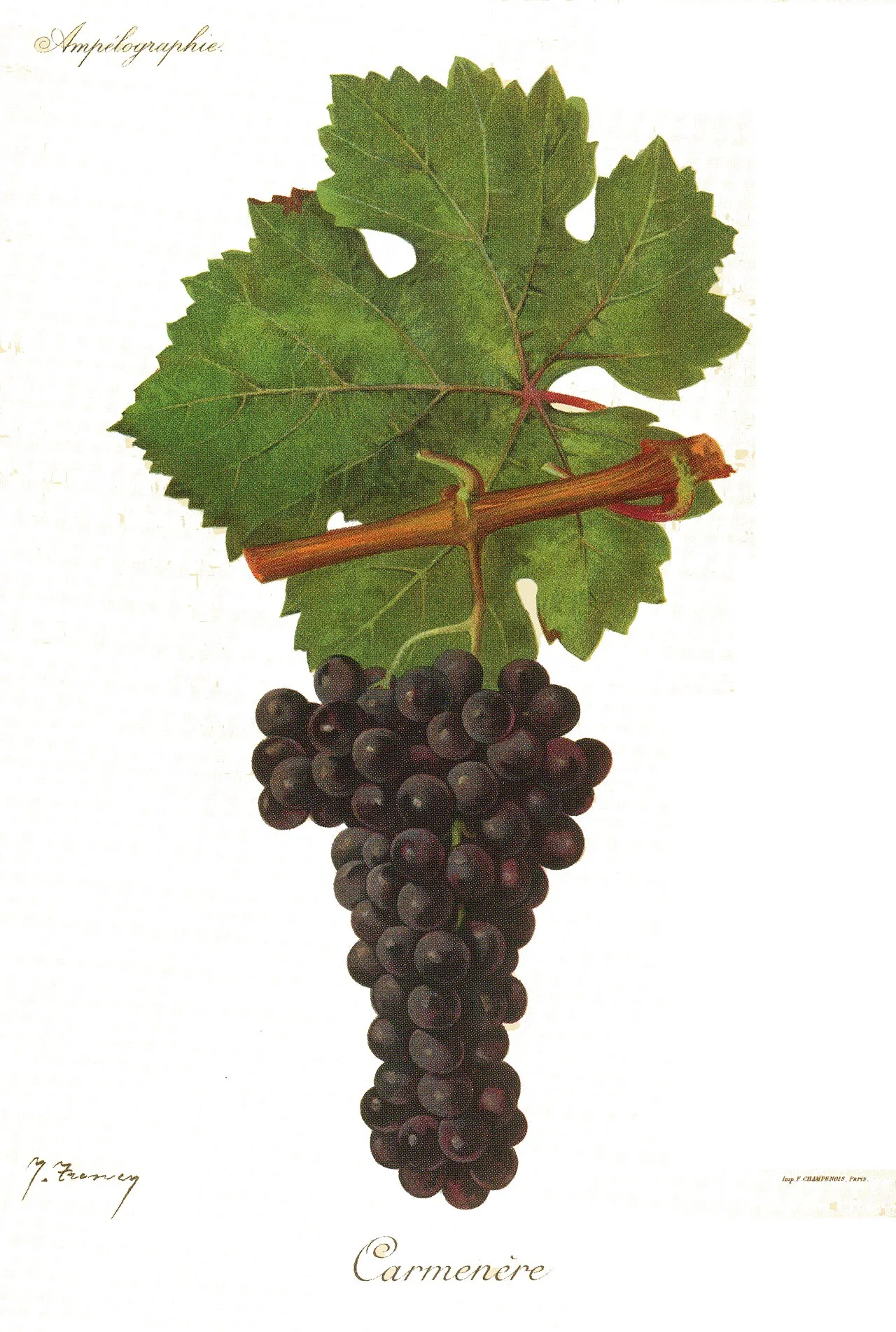
Profile: Carménère
| Berry colour | Black grape (N) |
|---|---|
| Species / status | Vitis vinifera |
| Origin | France, Bordeaux area |
| Parentage | Cabernet franc × Gros cabernet (DNA analysis) |
| Synonyms | Grande vidure (old Bordeaux name), Carmenelle, Cabernelle |
| French regions | Bordeaux |
| Grown in | Chile, France, Italy, China, Argentina |
| Typical aromas | blackcurrant, blackberry, red and green pepper, black pepper, paprika, smoky notes |
| Wine style | Coloured, supple reds with soft tannins and spicy, vegetal notes, more or less marked depending on ripeness. |
| Food pairings | grilled meats, empanadas, dishes with paprika or sweet chilli, stuffed vegetables |
| Identifiers | VIVC no. 2109, Wikidata Q1043868 |
Origin: one of the historic grapes of the Bordeaux area
Carménère is a grape of the Bordeaux area, where it was among the historic red grapes. It was notably widely planted in the Graves and the Médoc at the start of the 19th century, under names such as grande vidure, carmenelle or cabernelle.
Its name is often linked to the word “carmine”, for the red colour its leaves take on in autumn, although this etymology is not demonstrated.
Parentage: a half-sibling of merlot and cabernet sauvignon
According to DNA analysis, carménère comes from a cross between cabernet franc and gros cabernet. As cabernet franc is also the parent of cabernet sauvignon and merlot, carménère is a half-sibling of these two grapes. See DNA parentage of grapes.
Decline in France
Carménère is susceptible to coulure at flowering, which makes its crops irregular. After powdery mildew in the mid-19th century, then phylloxera from the 1860s, Bordeaux growers replanted with more reliable grapes. Carménère thus almost disappeared from France, to the point of being long considered extinct. See rootstocks and phylloxera.
The angle to know: the Chilean “merlot” that was not one
Carménère was introduced to Chile in the 19th century, with other Bordeaux grapes, before the phylloxera crisis in Europe. Over the 20th century, it was mistaken for merlot: the two grapes were planted together, harvested together and sold under the name merlot.
In 1994, the French ampelographer Jean-Michel Boursiquot, a researcher in Montpellier, identified a large share of these “merlots” in Chilean vineyards as carménère. The Chilean Ministry of Agriculture officially recognised the grape in 1998.
| Criterion | Carménère | Merlot |
|---|---|---|
| Underside of young leaves | Reddish colouring | No marked reddish colouring |
| Ripening | Late | Early, two to three weeks sooner |
| Typical aromas | Pepper, spices, black fruits | Plum, black cherry |
| Risk if picked early | Marked vegetal notes | Lower |
This confusion explains why some older Chilean “merlots” showed vegetal notes: the two grapes were harvested on the same date, although carménère was not ripe. For identification methods, see ampelography: recognising a grape.
In the vineyard
Carménère is a late grape, vigorous and susceptible to coulure. It needs a long warm season to ripen: picked too early, it gives wines with marked vegetal notes, due to methoxypyrazines.
The wines
Carménère makes coloured, supple wines with soft tannins, with aromas of blackcurrant, blackberry, pepper, black pepper and sometimes paprika. It is made on its own or blended with cabernet sauvignon or merlot.
Where it is grown
- Chile: by far the leading producing country, where it has become an emblematic grape.
- Italy: in the North-East, where it too was long confused, with cabernet franc.
- China: vines formerly called “cabernet gernischt” have been identified with carménère.
- France: a few plots in the Bordeaux area, where some estates are replanting it.
Genealogy of Carménère
Identified parents (Wikidata): Cabernet franc and Gros Cabernet.
Further reading
Frequently asked questions
Is carménère a merlot?
No. They are two different grapes, but they were mixed up in Chile for much of the 20th century, to the point of being planted and harvested together under the name merlot. The French ampelographer Jean-Michel Boursiquot established in 1994 that part of these Chilean "merlots" was in fact carménère. The two grapes are, however, half-siblings through cabernet franc.
How can carménère and merlot be told apart in the vineyard?
The young leaves of carménère show a reddish colouring on the underside, and the grape ripens markedly later than merlot, by two to three weeks. These ampelographic clues made it possible to separate them in Chilean vineyards.
Why did carménère disappear from Bordeaux?
It was susceptible to poor fruit set (coulure), which made its crops irregular. After the powdery mildew and phylloxera crises of the 19th century, growers rebuilt the vineyard with more reliable grapes, such as merlot and cabernet sauvignon. Carménère survived in France only on small areas.
Where can carménère be found today?
Chile is by far the leading producing country, and carménère has become an emblematic grape there. It is also found in north-east Italy, in China and, in small quantities, in the Bordeaux area.
Related grapes
- Cabernet franc (black, France, South-West (Libournais probable))
- Cabernet sauvignon (black, France, Bordeaux area)
- Merlot (black, France, Bordeaux (Libournais))
- Petit verdot (black, France, South-West (Bordeaux))
- Malbec (Côt) (black, France, Quercy (Lot))
- País (Listán prieto) (black, Spain, Castile)