País: the first grape of the Americas, from Castile to Chile
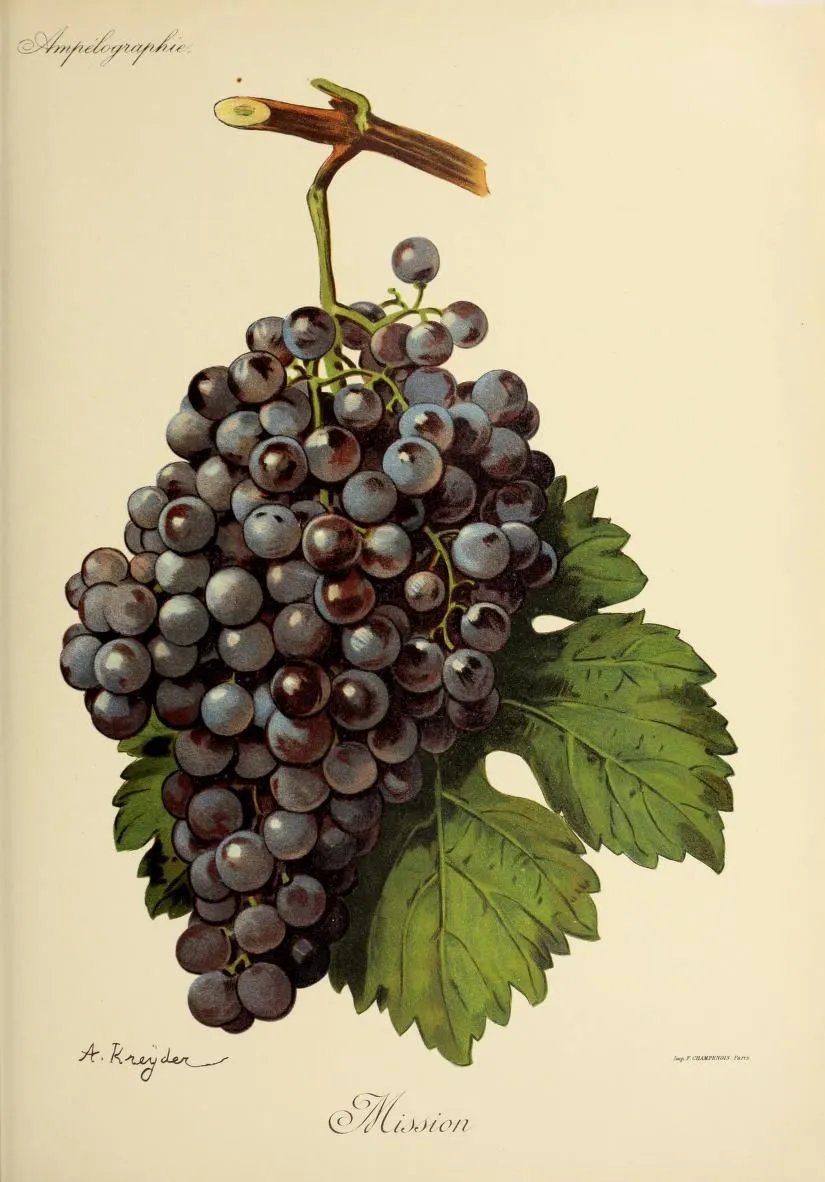
Profile: País (Listán prieto)
| Berry colour | Black grape (N) |
|---|---|
| Species / status | Vitis vinifera |
| Origin | Spain, Castile |
| Synonyms | Listán prieto (Canary Islands), Mission (California), Misión (Mexico), Criolla chica (Argentina), Negra peruana |
| Grown in | Chile, Argentina, Mexico, United States, Peru, Spain (Canary Islands) |
| Typical aromas | red fruit, strawberry, cherry, earthy notes, light spices |
| Wine style | Light, pale, low-tannin reds, rustic originally, now also made into fresh, easy-drinking wines. |
| Food pairings | empanadas, cazuela, charcuterie, simple grilled dishes, vegetable dishes |
| Identifiers | VIVC no. 6860, Wikidata Q498598 |
One grape, four names, two continents
País is one of the oldest grapes grown in the Americas. It was born in Spain, passed through the Canary Islands, then accompanied the Spanish colonisation from Mexico to Chile.
| Name | Where | Note |
|---|---|---|
| Listán prieto | Canary Islands (Spain) | Original Spanish name, almost vanished from the mainland |
| País | Chile | Most planted grape in the country until the 2000s |
| Criolla chica | Argentina | Not to be confused with criolla grande |
| Mission (misión) | California, Mexico | Grape of the Franciscan missions |
A DNA study published in 2007 by the Spanish National Biotechnology Centre confirmed that mission and listán prieto are the same variety. Centuries of separation may have produced clonal variations, which explains why some catalogues still treat them separately. See our guide on synonyms and homonyms.
Origin: Castile and the Canary Islands
Listán prieto probably originates from Castile, where it was widely planted in the 16th century. It then reached the Canary Islands, a stopover for ships bound for the New World. It has almost disappeared from the mainland, but survives in the Canary Islands on small areas.
It should not be confused with listán negro, another red grape of the Canary Islands, nor with listán blanco, the Canarian name for palomino.
The overlooked angle: the grape of the Spanish missions
País is inseparable from the religious history of the Americas. In the 16th century, conquistadors and missionaries carried vines from Spain and the Canary Islands to Mexico, then Peru. Wine is essential for Mass, and importing it from Europe is slow and costly: vines were therefore planted around the missions.
From Peru, the grape reached Chile in the 16th century, at the time of the Spanish colonisation, then Argentina. In the north, it travelled up with the missions to California, where the Franciscans established it from the late 18th century. It is there that it took the name mission, a reminder of this origin.
The missionaries probably sometimes planted seeds rather than cuttings, which favoured the appearance of variations and spontaneous crosses.
The parent of the criollas
In South America, país crossed spontaneously with other grapes brought from Spain, in particular muscat of Alexandria. These crosses gave rise to a family of grapes known as criollas, specific to the continent, including several aromatic white grapes of Argentina. See our guide on DNA parentage of grape varieties.
In the vineyard
País is vigorous, hardy and easy to grow. It tolerates dry farming, without irrigation, in bush vines (gobelet). In Chile, very old ungrafted vines survive in the south, notably in the valleys of Maule, Itata and Bío-Bío, where phylloxera never arrived. On this particularity, see rootstocks and phylloxera.
The wines: from peasant wine to natural wine
País has a thin skin and gives pale, light, low-tannin wines, sometimes tending towards brown. It long served for everyday table wine, drunk mainly in Chile, and for pipeño, a rustic, young wine kept in large wooden pipas.
With the rise of cabernet sauvignon and the Bordeaux grapes, país declined. Since the 2010s, growers in southern Chile have been giving new value to these old dry-farmed vines: carbonic maceration, low-intervention winemaking, fresh, easy-drinking wines served lightly chilled. País has become an emblem of Chilean wine heritage, alongside carménère.
Mission in California
In California, mission was the first European vine grape planted on a large scale. It was used in particular to produce angelica, a sweet fortified wine. It was supplanted in the 19th century by imported European grapes, including zinfandel. A few old vines survive.
Tasting notes
A país is recognised by its pale colour, its simple red fruit and a light, low-tannin palate, sometimes a little rustic. Modern cuvées, often made by carbonic maceration, are crisp and served chilled, like a thirst-quenching wine.
Further reading
Frequently asked questions
Are país and mission the same grape?
Yes. Chilean país, Californian mission, Argentine criolla chica and the listán prieto of the Canary Islands are one and the same variety of Spanish origin. A DNA study published in 2007 by the Spanish National Biotechnology Centre confirmed the link between mission and listán prieto. Centuries of separate cultivation may have created small differences between populations.
How did país reach Chile?
It was introduced in the 16th century by the Spanish at the time of colonisation, probably from Peru. Missionaries needed it to produce Mass wine, and the grape then spread throughout the country. It was the most planted grape in Chile until cabernet sauvignon overtook it around the year 2000.
What is a pipeño?
Pipeño is a traditional red wine of south-central Chile, simple, young and often unfiltered, historically made with país. Its name refers to the pipas, the large wooden containers used to keep it. Long a peasant wine, it is enjoying renewed interest.
Is listán prieto the same grape as listán negro?
No. Despite their similar names, they are two different grapes of the Canary Islands. Listán prieto, parent of país and mission, has almost disappeared from the Spanish mainland and survives only on small areas in the Canary Islands.
Related grapes
- Tempranillo (black, Spain, north of the peninsula (Rioja, Ebro valley))
- Muscat d'Alexandrie (white, Mediterranean basin (precise origin undetermined))
- Carménère (black, France, Bordeaux area)
- Cinsault (black, France, Languedoc (probable))
- Zinfandel (Primitivo) (black, Croatia, Dalmatia)