Muscat of Alexandria: the large-berried muscat with a thousand uses
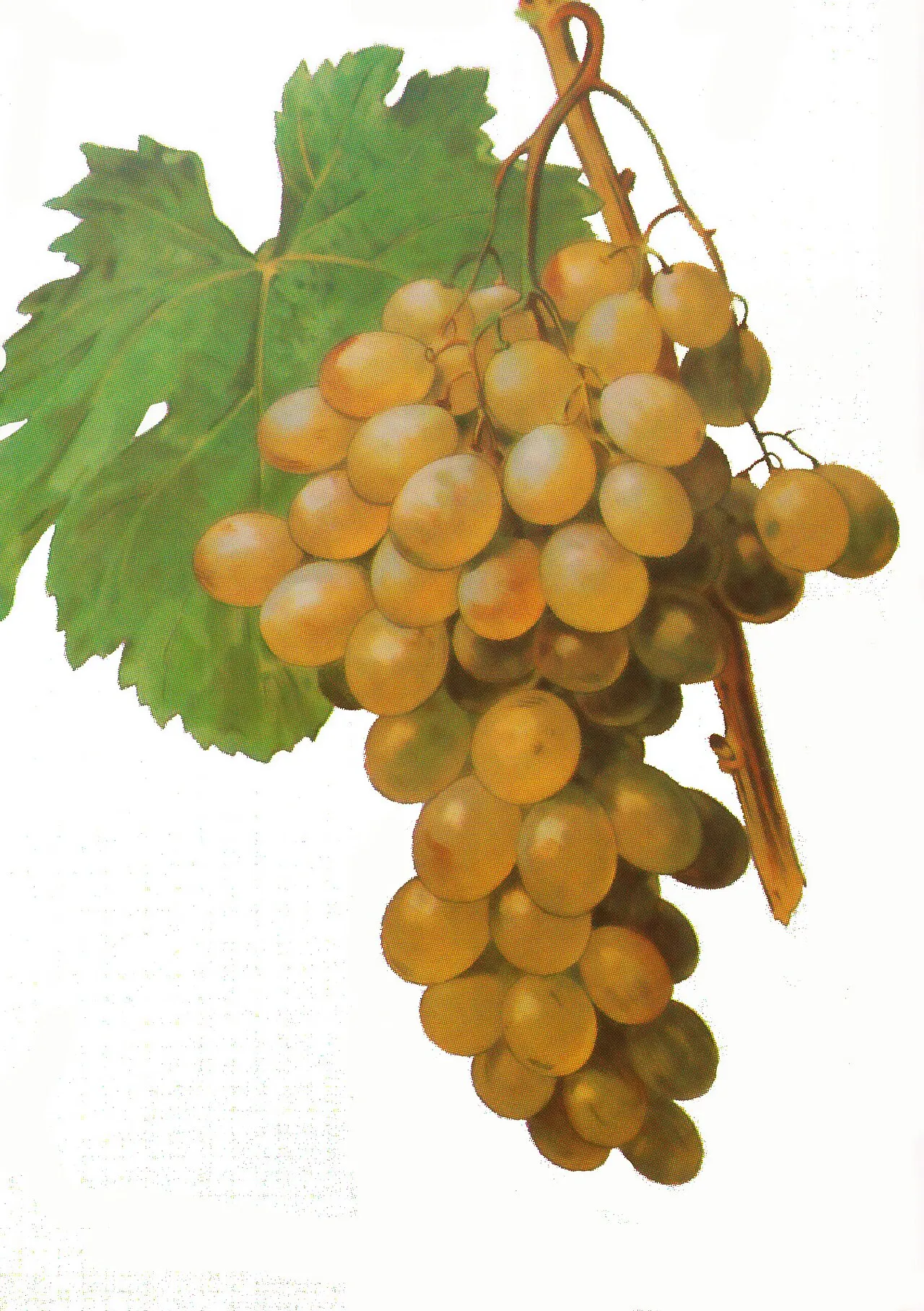
Profile: Muscat d'Alexandrie
| Berry colour | White grape (B) |
|---|---|
| Species / status | Vitis vinifera |
| Origin | Mediterranean basin (precise origin undetermined) |
| Parentage | Muscat à petits grains × Axina de tres bias (natural cross, DNA analysis) |
| Synonyms | Zibibbo (Italy), Moscatel de Alejandría (Spain), Muscat romain, Hanepoot (South Africa), Lexia (Australia), Gordo blanco (Australia) |
| French regions | Languedoc-Roussillon |
| Grown in | Chile, South Africa, Morocco, Australia, France, Spain, Greece, Turkey, Italy, Portugal |
| Typical aromas | fresh grape, orange blossom, rose, candied orange peel, dried apricot, honey |
| Wine style | Sweet and fortified wines with a powerful nose of grape, more rarely aromatic dry whites; also table grape and raisin. |
| Food pairings | dried-fruit desserts, oriental pastries, blue cheeses, apricot tart, melon (VDN) |
| Identifiers | VIVC no. 8241, Wikidata Q1651827 |
Origin: an Egyptian name, an uncertain origin
Muscat of Alexandria is named after the city of Alexandria, in Egypt, but its exact birthplace cannot be determined. What is known is that it has been grown for a very long time on trellises around the Mediterranean, both for the table and for wine.
Parentage: a child of muscat à petits grains
DNA analysis has shown that muscat of Alexandria comes from a natural cross between muscat à petits grains and axina de tres bias, a table grape that does not belong to the muscat family.
It has descendants of its own. Muscat of Hamburg, a well-known black table grape, comes from a cross between muscat of Alexandria and schiava grossa (trollinger), according to an analysis of 2003. The two great muscats have also been recrossed several times, giving at least fourteen varieties. See DNA parentage of grape varieties.
In the vineyard
Muscat of Alexandria needs heat: it is a grape of Mediterranean or hot climates, with late ripening. Its bunches are large and loose, its berries big, oval, fleshy, with a pronounced musky flavour.
It is sensitive to coulure (flower drop) and millerandage (uneven berry set) in cool weather at flowering, as well as to powdery mildew.
A triple-use grape: the muscat of Alexandria angle
Few grapes have as many outlets. The guide table grape or wine grape explains why most varieties are specialised; muscat of Alexandria is an exception.
| Use | Where | Examples |
|---|---|---|
| Table grape | Mediterranean basin, Southern Hemisphere | Large bunches sold fresh |
| Raisin | Spain, Australia, South Africa, California | Muscat-type raisins |
| Sweet wine | France, Portugal, Italy, Spain | Muscat de Rivesaltes, moscatel de Setúbal, Passito di Pantelleria, moscatel de Málaga |
| Aromatic dry white | Sicily, Chile, Spain | Varietal wines |
| Spirit | South America | Singani (Bolivia), pisco |
It shares this status of versatile grape with chasselas, whereas varieties such as sultanina are mainly intended for the table and for drying.
The wines
In France, muscat of Alexandria is grown mainly in the Pyrénées-Orientales. There it goes, with muscat à petits grains, into muscat de Rivesaltes, a vin doux naturel made by fortification, that is by adding neutral alcohol during fermentation. See the grapes of Languedoc-Roussillon.
In Portugal, the Setúbal peninsula produces moscatel de Setúbal, a long-lived sweet fortified wine. In Italy, under the name zibibbo, it gives dry wines in Sicily and on the island of Pantelleria, and Passito di Pantelleria, made from sun-dried grapes. In Spain, it is found notably around Málaga and Valencia.
Its wines have a very assertive muscat nose (grape, orange blossom, rose), often judged less fine than that of muscat à petits grains, but more generous.
In the Southern Hemisphere
Muscat of Alexandria is very present outside Europe:
- in Chile, where it is a base for pisco;
- in Bolivia, where it has been used since at least the 18th century for the grape spirit called singani;
- in South Africa, under the name hanepoot, for the table, raisins and sweet wines;
- in Australia, under the names lexia (a diminutive of Alexandria) and gordo blanco.
These many names make muscat of Alexandria a good example of a grape with regional identities, detailed in the guide synonyms and homonyms.
Genealogy of Muscat d'Alexandrie
Identified parents (Wikidata): Muscat à petits grains and Heptakilo noir.
Offspring profiled on this site: Muscat de Hambourg.
Further reading
Frequently asked questions
Is muscat of Alexandria a table grape or a wine grape?
Both. Its large, fleshy berries make it a popular table grape, and it is also dried to make raisins. It is also made into wine, mainly sweet wines, such as muscat de Rivesaltes or moscatel de Setúbal.
What is zibibbo?
Zibibbo is the Italian name of muscat of Alexandria, grown notably in Sicily and on the island of Pantelleria. There it gives Passito di Pantelleria, a sweet wine made from sun-dried grapes, and aromatic dry wines.
Where does the name muscat of Alexandria come from?
The name refers to the city of Alexandria, in Egypt, but no evidence makes it possible to place the grape's origin precisely. The exact birthplace of muscat of Alexandria remains undetermined.
What is the link between muscat of Alexandria and muscat of Hamburg?
Muscat of Hamburg, a black table grape, comes from a cross between muscat of Alexandria and schiava grossa (trollinger), according to a DNA analysis of 2003. Muscat of Alexandria is therefore one of its parents.
Related grapes
- Muscat à petits grains (white, Mediterranean basin (precise origin unknown))
- Muscat de Hambourg (black, United Kingdom, England (Wrest Park, Bedfordshire))
- Grenache noir (black, Spain, Aragon (origin disputed with Sardinia))
- Macabeu (white, Spain, north-east (exact origin debated))
- Dattier de Beyrouth (white, Near East (brought to France from the Beirut area))
- Sultanine (white, Asia Minor or Afghanistan (origin debated))