Dattier de Beyrouth: the white grape with date-shaped berries
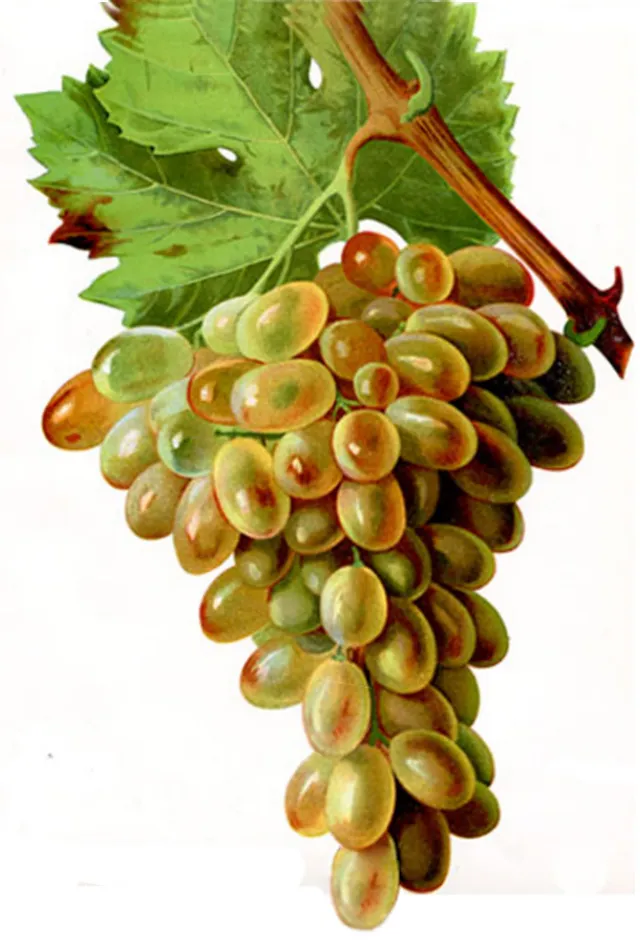
Profile: Dattier de Beyrouth
| Berry colour | White grape (B) |
|---|---|
| Species / status | Table grape |
| Origin | Near East (brought to France from the Beirut area) |
| Synonyms | Rosaki, Rhazaki, Afus Ali, Afouz Ali, Regina bianca, Waltham Cross, Raisin de Constantinople |
| Grown in | Italy, Turkey, Greece, Spain, Bulgaria, France |
| Typical aromas | fresh grape, sweet, crisp flesh |
| Wine style | Late-ripening table grape with very large elongated berries and firm, crisp flesh. |
| Food pairings | cheese board, autumn fruit baskets, desserts |
| Identifiers | VIVC no. 122, Wikidata Q514378 |
Origin: a grape brought back from the Orient in 1883
Dattier de Beyrouth is a white table grape of oriental origin. It was brought to France in 1883, from the Beirut area, by a silk merchant named Uffren, and first propagated in Cavaillon, in the Vaucluse. The name “dattier” refers to the elongated shape of its berries, which recalls a date.
It is now known to be the same variety as the rosaki (or rhazaki) of Greece. Its genetic parentage is not reliably documented.
A grape with a thousand names
Dattier de Beyrouth is a good example of how synonyms multiply for table grapes that have travelled:
| Name | Country or use |
|---|---|
| Dattier de Beyrouth | France |
| Rosaki, rhazaki | Greece |
| Regina, regina bianca | Italy |
| Afus ali, afouz ali | Widespread international name |
| Waltham cross | English-speaking countries |
| Raisin de Constantinople | Old French name |
These many names long made the variety hard to identify. See the guide on synonyms and homonyms and the one on ampelography.
In the vineyard
Dattier de Beyrouth is a late variety: it ripens in the third period, about 25 days after chasselas. It therefore needs a warm climate and a long season, which explains its Mediterranean distribution.
Its bunches are large, conical and fairly loose. Its berries are very large and elongated, with firm, crisp flesh.
A table grape, not a wine grape
Dattier de Beyrouth is meant to be eaten fresh. Its large firm berries, good keeping quality and appearance make it a sought-after grape on the European market. The criteria that separate table grapes from wine grapes (berry size and firmness, sugar-acidity balance, suitability for transport) are explained in the guide table grape or wine grape.
Where it is grown
According to Pierre Galet, the world area of Dattier de Beyrouth was between 120,000 and 150,000 hectares, which made it the second most widely grown table grape in the world, behind sultanine. The breakdown he gave was:
- Italy: about 50,000 ha, under the name regina;
- Turkey: about 30,000 ha;
- Greece and Spain: about 10,000 ha each;
- Bulgaria: about 9,000 ha.
These figures date from the late 1990s and should be read as an order of magnitude. In France, its history remains linked to the Vaucluse, where it was first propagated. See the table grapes page, which also covers muscat de Hambourg and cardinal.
Further reading
Frequently asked questions
Why is it called dattier?
Because of the shape of its berries, very large and elongated, which recall a date (datte in French). The words "de Beyrouth" refer to the area it was brought from to France in 1883.
Dattier de Beyrouth, rosaki, regina and afus ali: are they the same grape?
Yes, these are different names for the same variety depending on the country: rosaki or rhazaki in Greece, regina (regina bianca) in Italy, afus ali as a widespread international name, waltham cross in English-speaking countries. The variety has a long list of synonyms.
Is Dattier de Beyrouth a late grape?
Yes. It ripens in the third period, about 25 days after chasselas, which makes it an end-of-season grape. It takes over from the early varieties on market stalls.
Where is it grown most?
Italy is by far the leading producer, ahead of Turkey, Greece, Spain and Bulgaria. Pierre Galet ranked it second among the world's table grapes, behind sultanine.
Related grapes
- Muscat de Hambourg (black, United Kingdom, England (Wrest Park, Bedfordshire))
- Cardinal (pink, United States, California)
- Sultanine (white, Asia Minor or Afghanistan (origin debated))
- Chasselas (white, Switzerland, west of the country (Lake Geneva region))
- Muscat d'Alexandrie (white, Mediterranean basin (precise origin undetermined))