Ampelography: how a grape variety is recognised in the vineyard
Definition
Ampelography is the science that describes and identifies vine varieties from their visible characters. The word comes from the Greek ampelos, the vine, and graphein, to describe. An ampelographer can tell, in front of a vine, which variety it is, or at least which one it is not.
It meets a practical need: grape varieties have been propagated by cuttings for centuries, names change from one region to another (see synonyms and homonyms) and planting errors are frequent. Objective criteria are therefore needed to know what is being planted.
A discipline born of the crises of the 19th century
Modern ampelography developed in the 19th century, when European vineyards had to be rebuilt after powdery mildew and then phylloxera (see rootstocks and phylloxera). Grape varieties had to be inventoried, American rootstocks and hybrids described, and confusion in nurseries avoided.
The great work of that period is the Ampélographie edited by Pierre Viala and Victor Vermorel, published in several volumes at the start of the 20th century, with colour plates that remain famous.
In the 20th century, Pierre Galet (1921-2019), in Montpellier, systematised the method. He proposed an identification based on measurements of the adult leaf (ampelometry) and described thousands of varieties. His dictionary of grape varieties remains a reference work.
The organs observed
Identification never rests on a single character. Several organs are examined, at precise stages of the cycle.
| Organ | Stage of observation | What is looked at |
|---|---|---|
| Tip of the young shoot | In spring, growing shoot | Opening, hairiness (density of prostrate or erect hairs), pigmentation |
| Young leaf | First unfolded leaves | Colour, hairiness, bronzed or green appearance |
| Adult leaf | Summer, leaf from the middle of the shoot | Shape, lobes, sinuses, teeth, hairiness, blistering |
| Shoot | Summer and winter (cane) | Colour, cross-section, internodes |
| Flower | Flowering | Sex of the flower (hermaphrodite or female) |
| Bunch | Ripeness | Size, compactness, shape, wings |
| Berry | Ripeness | Shape, size, colour, skin thickness, flavour, flesh colour |
| Seed | Ripeness | Shape, size, number |
The tip of the young shoot
This is one of the most discriminating criteria. The tip of the shoot can be hairless, cottony or downy, more or less tinged with pink or bronze. Pinot meunier is the illustration: its very downy tip, as if dusted with flour, gave it its name.
The adult leaf
The leaf is the most studied organ. The main criteria:
- the number of lobes: entire leaf, or three, five or seven lobes;
- the lateral sinuses: more or less deep, open or closed;
- the petiolar sinus: the notch where the petiole attaches, open in a V or a U, closed, or with overlapping edges;
- the teeth: straight, convex, pointed;
- the underside: hairless or covered in hairs, which can be felt by touch.
The deeply cut leaf of cabernet sauvignon, with deep sinuses often pierced by rounded “holes”, is easily told apart from the more entire leaf of chardonnay, whose petiolar sinus has a characteristic base that is bare along the veins.
The bunch and the berry
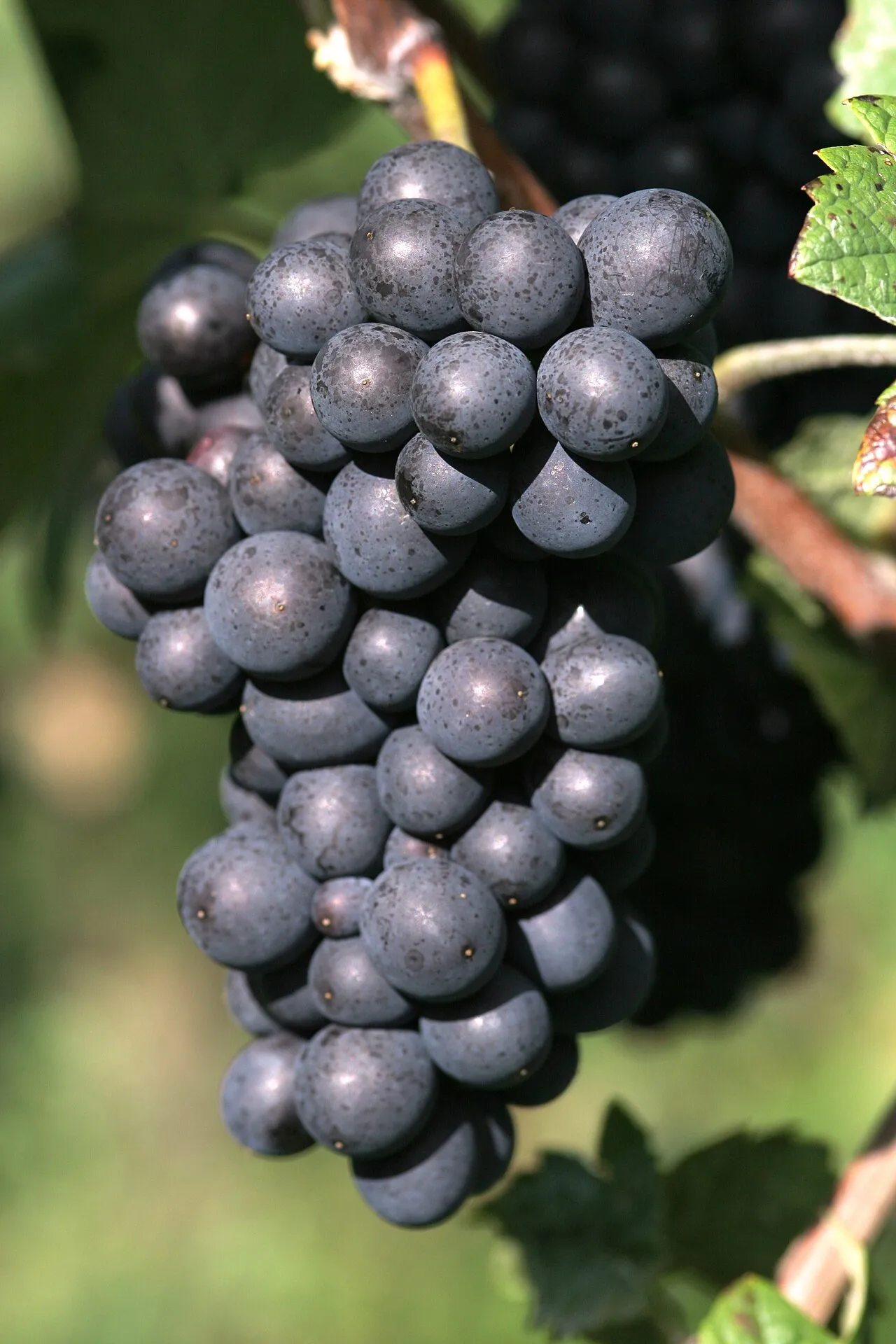
The bunch and the berry confirm identification at harvest. A small, compact bunch, a round or ellipsoid berry, a thin or thick skin, a neutral, muscat or foxy flavour (the taste of American hybrids, see hybrids banned in 1934): each character narrows the field of possibilities. The colour of the flesh immediately distinguishes a teinturier.
The OIV descriptors
So that descriptions can be compared from one country to another, the International Organisation of Vine and Wine (OIV) publishes a list of coded descriptors. Each character receives a code and a scale of scores (for example, hairiness absent, low, medium, high, very high).
These descriptors are used:
- to describe varieties in collections and conservatories;
- to register a new variety in the official catalogue, which requires it to be distinct, uniform and stable;
- to feed international databases such as VIVC.
Classic confusions
Some pairs of grape varieties are hard to tell apart by eye:
| Pair | Difficulty | What helps |
|---|---|---|
| Merlot and carménère | Similar leaves; massive confusion in Chile until 1994 | Young leaves and later ripening of carménère |
| Chardonnay and pinot blanc | Long mixed up in Burgundy | Petiolar sinus of chardonnay, veins bare at the base |
| Colour forms (pinot noir, gris, blanc) | Identical leaves | Only the ripe berry tells them apart (see colour mutations) |
| Clones of the same variety | Minimal differences | Agronomic observations, no reliable visual identification |
The merlot-carménère confusion, identified by the ampelographer Jean-Michel Boursiquot, shows that a trained eye can correct errors more than a century old.
Ampelography and DNA
Since the 1990s, DNA analysis with microsatellite markers has made it possible to identify a grape variety with great certainty from a leaf fragment (see DNA parentage of grape varieties). It has solved many puzzles, but it does not make ampelography useless:
- in the field, it is observation that spots an atypical vine in an old vineyard and decides that it should be sampled;
- in nurseries, visual inspection remains the first filter;
- for clones and mutations, conventional DNA does not always distinguish almost identical variants, whereas berry colour or an agronomic character separates them;
- for agronomy, earliness, vigour or susceptibility to disease cannot be read from an identification profile.
The two approaches complement each other: ampelography formulates a hypothesis, DNA confirms it, and the conservatories keep the reference vines used by both.
To practise
Observing a known grape variety over a season is the best school: note the appearance of the young shoot in May, draw an adult leaf in July, compare the bunch at harvest. By comparing two neighbouring varieties, for example sauvignon blanc and chasselas, the criteria quickly become familiar.
Grapes mentioned in this guide
- Pinot meunier (black, France, north-east (pinot mutation))
- Cabernet sauvignon (black, France, Bordeaux area)
- Merlot (black, France, Bordeaux (Libournais))
- Carménère (black, France, Bordeaux area)
- Chardonnay (white, France, Burgundy)
- Pinot blanc (white, France, Burgundy (pinot mutation))
- Chasselas (white, Switzerland, west of the country (Lake Geneva region))
- Sauvignon blanc (white, France, Loire Valley or South-West France)
Frequently asked questions
What is ampelography?
It is the discipline that describes and identifies vine varieties from their morphological characters: leaves, shoots, bunches, berries, seeds. The word comes from the Greek ampelos, the vine. It is used to check the identity of vines, to describe new varieties and to rediscover forgotten grapes.
How do you recognise a grape variety from its leaf?
You look at the adult leaf, taken from the middle of the shoot: number of lobes, depth of the lateral sinuses, shape of the petiolar sinus (open, closed, overlapping), shape and size of the teeth, hairiness of the underside. One leaf is not enough: several leaves and other organs are examined.
Who was Pierre Galet?
Pierre Galet (1921-2019) was a French ampelographer who taught in Montpellier. He developed an identification method based on measurements of the leaf. His books, including an encyclopaedic dictionary of grape varieties, are world references.
Has DNA replaced ampelography?
No. DNA gives a reliable identity from a sample, but you first need to know what to sample and to spot suspect vines in the vineyard. Ampelography remains essential in the field, in nurseries and for describing the agronomic characters that DNA does not show.