Cabernet sauvignon: the child of cabernet franc and sauvignon blanc
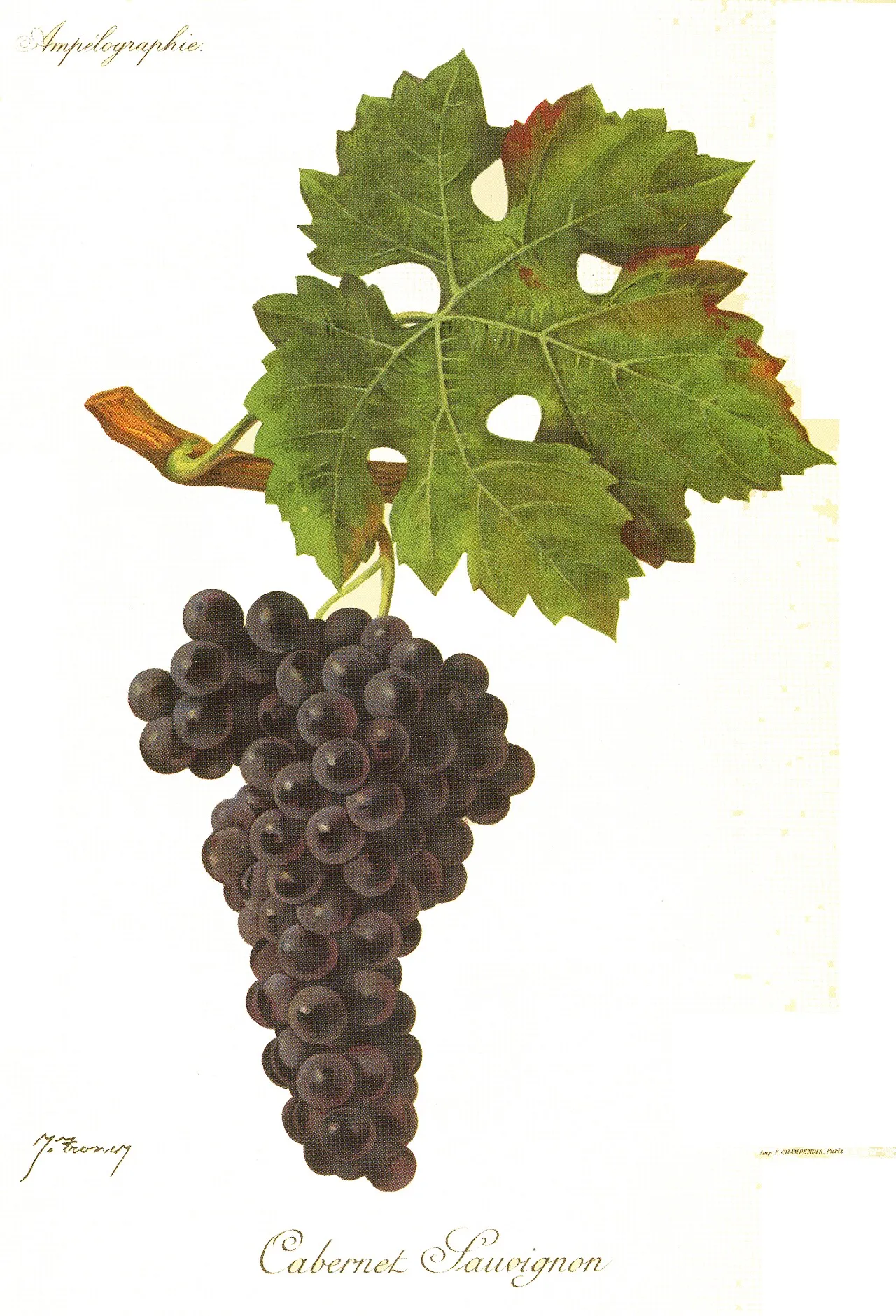
Profile: Cabernet sauvignon
| Berry colour | Black grape (N) |
|---|---|
| Species / status | Vitis vinifera |
| Origin | France, Bordeaux area |
| Parentage | Cabernet franc × Sauvignon blanc (natural cross, DNA analysis of 1997) |
| Synonyms | Vidure, Petite vidure |
| French regions | Bordeaux, Languedoc-Roussillon, Loire Valley, Provence, South-West France |
| Grown in | France, Chile, United States, Australia, Italy, South Africa, Argentina, China, Spain |
| Typical aromas | blackcurrant, blackberry, green pepper (pyrazines), mint and eucalyptus, cedar and cigar box (ageing), graphite |
| Wine style | Coloured reds, structured by firm tannins and good acidity, often blended and barrel-aged for long keeping. |
| Food pairings | roast lamb, grilled rib steak, feathered game, aged pressed-curd cheeses |
| Identifiers | VIVC no. 1929, Wikidata Q207310 |
Origin: a spontaneous cross in the Bordeaux area
Cabernet sauvignon is a Bordeaux grape that is relatively recent on the scale of vine history. It appears in Bordeaux documents in the 18th century, at a time when the great estates of the Médoc were structuring their plantings.
Its exact origin long remained mysterious, surrounded by fanciful hypotheses about an ancient ancestry. Genetics provided a simple and verifiable answer.
Parentage revealed by DNA in 1997
In 1997, John Bowers and Carole Meredith, of the University of California, Davis, published in Nature Genetics an analysis of microsatellite markers showing that cabernet sauvignon comes from a natural cross between cabernet franc and sauvignon blanc.
It was one of the first demonstrations of the parentage of a great grape by DNA. It opened the way to a whole series of studies, summarised in our guide on DNA parentage of grapes.
Cabernet franc is also a parent of merlot and carménère. Cabernet sauvignon is therefore the half-sibling of these two grapes.
| Grape | Parent 1 | Parent 2 | Link with cabernet sauvignon |
|---|---|---|---|
| Cabernet sauvignon | Cabernet franc | Sauvignon blanc | - |
| Merlot | Cabernet franc | Magdeleine noire des Charentes | Half-sibling |
| Carménère | Cabernet franc | Gros cabernet | Half-sibling |
| Cabernet franc | Not established | Not established | Parent |
| Sauvignon blanc | Not established | Not established | Parent |
In the vineyard: a late and robust grape
Cabernet sauvignon buds and ripens late. It needs warmth at the end of the season, which explains its preference, in the Médoc, for the gravel rises that warm up and drain well.
Its bunches are small, with small, thick-skinned berries. This high ratio of skin to juice explains the intense colour and tannic richness of its wines. The thick skin also gives it fairly good resistance to grey rot. It remains susceptible, however, to certain wood diseases, such as esca and eutypiosis.
The angle to know: pyrazines, the aromatic signature of the cabernets
Methoxypyrazines are the molecules responsible for the green pepper note sometimes perceived in cabernet sauvignon. They are detectable at extremely low concentrations.
These compounds are abundant in green grapes and break down during ripening, especially when the bunches receive light. Several practical consequences follow:
- cool years or excessive yields more often give vegetal wines;
- leaf removal in the bunch zone reduces their level;
- in warm climates, the note almost disappears, replaced by ripe black fruits, sometimes minty or eucalyptus notes (in Australia notably).
This sensitivity to vintage makes cabernet sauvignon a good indicator of ripeness. It is shared with cabernet franc and carménère, two grapes of the same family.
The wines: structure, blackcurrant and ageing
Cabernet sauvignon makes coloured, tannic wines with sustained acidity, with aromas of blackcurrant, blackberry and graphite. Barrel ageing adds notes of cedar, vanilla and tobacco.
On its own, it can seem austere in its youth. This is why it is traditionally blended with merlot, which brings flesh, and in small proportion with petit verdot or cabernet franc. To compare the two great Bordeaux grapes, see merlot or cabernet sauvignon.
Where it is grown
In France, it is found mainly:
- in the Bordeaux area, in particular on the Left Bank (Médoc, Graves). See the grapes of Bordeaux;
- in the South-West (Bergerac, Buzet, Côtes de Duras);
- in Languedoc and Provence, for single-varietal wines or IGP blends;
- in the Loire Valley, in a few appellations of Anjou and Touraine, as a complement to cabernet franc.
Outside France, it has been planted on every wine-growing continent: Napa Valley in California, Chile, Coonawarra in Australia, Bolgheri in Tuscany, South Africa, China. Its ability to keep its aromatic signature under very different climates has made it one of the most planted black grapes in the world.
Genealogy of Cabernet sauvignon
Identified parents (Wikidata): Sauvignon blanc and Cabernet franc.
Offspring profiled on this site: Marselan.
Further reading
- Cabernet franc or cabernet sauvignon: 10 differences to know
- Merlot or cabernet sauvignon: 10 differences to know
- Grape DNA parentage: how genetics rewrote history
- Ampelography: identifying a grape variety by its leaves and bunches
- Grape name on the label: the 85% rule
- Single-varietal or blend: two philosophies of wine
- Table grapes or wine grapes: what are the differences?
Frequently asked questions
Who are the parents of cabernet sauvignon?
A DNA analysis published in 1997 by John Bowers and Carole Meredith (University of California, Davis) showed that cabernet sauvignon comes from a spontaneous cross between cabernet franc, a black grape, and sauvignon blanc. Its name thus faithfully combines those of its two parents. This cross most likely took place in the Bordeaux area.
Why do some cabernet sauvignons smell of green pepper?
This note comes from molecules called methoxypyrazines, naturally present in grapes of the cabernet family. Their level falls as the grape ripens and is exposed to the sun. A marked vegetal note therefore often points to grapes picked insufficiently ripe or to a cool year.
What is the difference between cabernet sauvignon and merlot?
Cabernet sauvignon ripens later, gives firmer tannins and wines that take longer to open, with aromas of blackcurrant and cedar. Merlot, which ripens earlier, gives rounder, fleshier wines. In Bordeaux, cabernet sauvignon traditionally dominates on the Left Bank (Médoc, Graves) and merlot on the Right Bank (Saint-Émilion, Pomerol).
Should cabernet sauvignon be drunk young?
Simple versions, from warm climates or made for fruit, are drunk in the first few years. The great wines of the Médoc or Napa, rich in tannins, benefit instead from ageing for several years, sometimes several decades, before expressing their forest-floor and cedar notes.
Related grapes
- Cabernet franc (black, France, South-West (Libournais probable))
- Merlot (black, France, Bordeaux (Libournais))
- Petit verdot (black, France, South-West (Bordeaux))
- Carménère (black, France, Bordeaux area)
- Sauvignon blanc (white, France, Loire Valley or South-West France)
- Malbec (Côt) (black, France, Quercy (Lot))