Table grapes or wine grapes: two uses of the same species
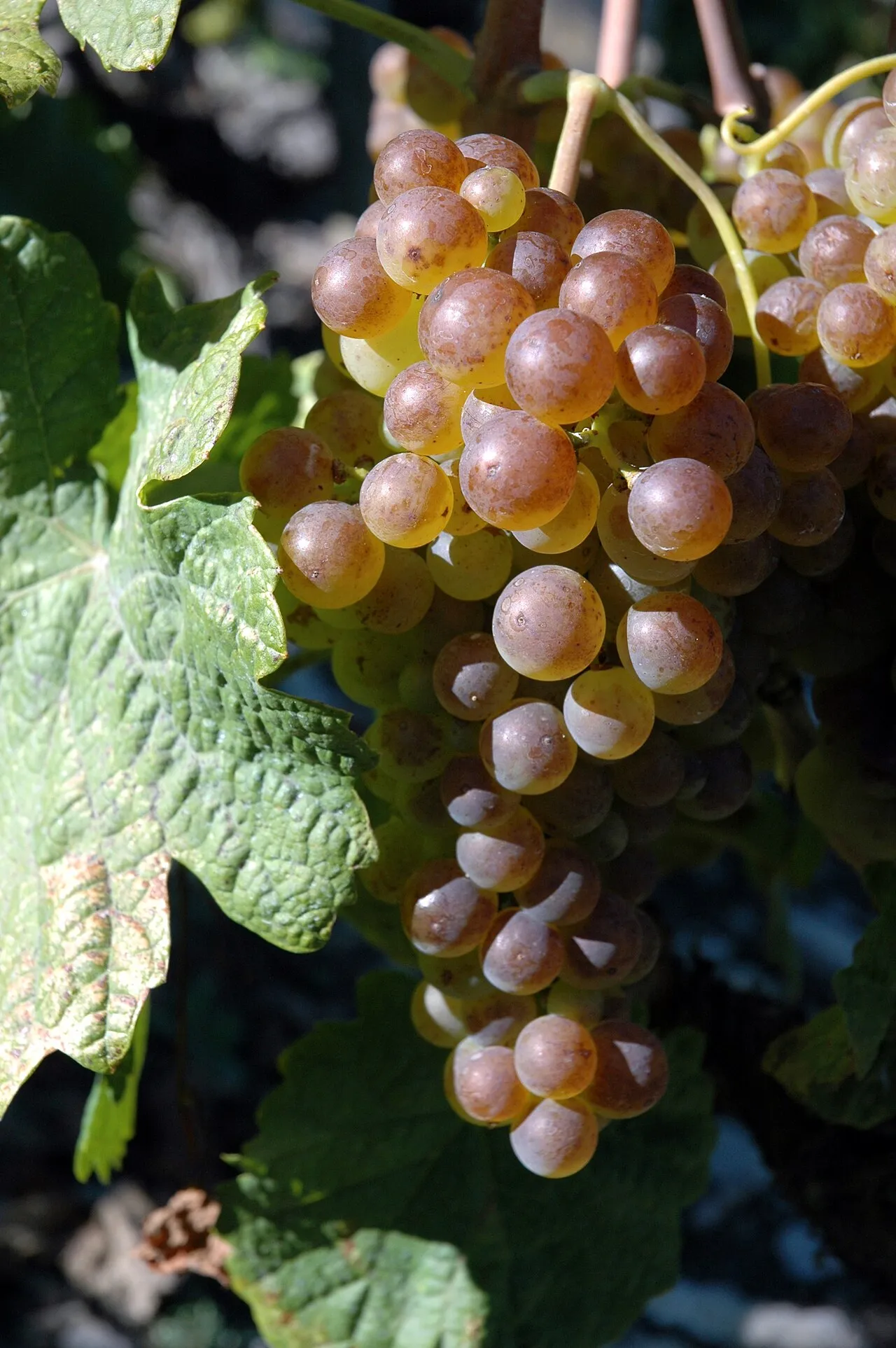
One species, two selections
Almost all the grapes consumed in Europe, whether eaten or drunk, belong to the species Vitis vinifera. The difference between table grapes and wine grapes lies not in the species but in centuries of selection aimed at different uses.
For wine, grapes were kept whose juice is rich and balanced and whose skin supplies aromas, colour and tannins. For the table, appearance, size, crunchiness and ease of eating were favoured.
The criteria that separate them
| Criterion | Table grape | Wine grape |
|---|---|---|
| Berry size | Large | Small to medium |
| Skin-to-pulp ratio | Low | High |
| Skin | Thin, tender | Thicker, rich in aromas and phenolic compounds |
| Pulp | Firm, crunchy | Juicy, melting |
| Sugar | Moderate | High at ripeness |
| Acidity | Low, for a mild flavour | Higher, essential to the balance of the wine |
| Seeds | Few or absent in many varieties | Present |
| Bunch | Loose, attractive presentation | Often compact |
| Keeping and transport | Sought after | Irrelevant |
The key point is the ratio between skin and pulp. Aromas, the colour of red wines and tannins are found mostly in the skin. A small berry of cabernet-sauvignon has proportionally much more skin than a large table grape: its wine is more coloured, more aromatic and more structured.
The great table grapes
| Grape | Colour | Particularity |
|---|---|---|
| Chasselas | White | Grape of the Chasselas de Moissac AOP; also a major wine grape in Switzerland |
| Muscat of Hamburg | Black | Grape of the muscat du Ventoux AOC; also vinified in several countries |
| Cardinal | Red | Bred in California in 1939, large, firm, early berries |
| Dattier de Beyrouth | White | Very large, elongated berries, introduced into France in 1883 |
| Muscat of Alexandria | White | Table grape, raisin and sweet wines around the Mediterranean |
| Sultanine | White | Seedless, the first grape dried in the world |
In France, two table grapes benefit from a designation of origin: the chasselas de Moissac, in Tarn-et-Garonne, and the muscat du Ventoux, in Vaucluse.
Dual-purpose grapes
Some grapes escape the separation:
- chasselas is both a renowned table grape and the main white grape of French-speaking Switzerland, as well as a wine grape in Savoie, at Pouilly-sur-Loire and in Alsace;
- muscat of Hamburg is vinified in Greece, Eastern Europe and China;
- muscat of Alexandria gives sweet wines such as muscat de Rivesaltes, raisins and fresh grapes;
- sultanine is mainly a grape for drying, but also a table grape and, more marginally, a wine grape;
- cardinal is vinified in some countries of South-East Asia.
A grape’s status also depends on regulation: in France, the official catalogue distinguishes wine varieties, table varieties and rootstocks, and a variety must be registered in the right category for its intended use.
Raisins
The dried grape forms a third category. It needs sweet, thin-skinned berries, preferably seedless: sultanine, called Thompson seedless in the United States, dominates world production. Muscat of Alexandria and the Corinth grape, a small seedless black grape from Greece, are other traditional grapes for drying.
Seedless grapes
The absence of seeds (apyrenia) comes from a natural mutation. In sultanine, the flower is fertilised but the seeds abort early and remain as traces. This trait has been passed on by conventional crossing to many modern table grape varieties.
These grapes do not produce viable seeds: they are multiplied by cuttings, like all grape varieties. To obtain new varieties, breeders use embryo culture techniques in the laboratory.
And hybrids?
American hybrids, such as isabelle, have a characteristic foxy taste and a pulp that separates from the skin. Banned for commercial wine production in France (see banned hybrids (1934)), they are still grown on pergolas in some gardens for their eating grapes, and concord is used for juice and jelly production in the United States.
Can wine be made from table grapes?
It is possible, but rarely satisfying:
- the must is diluted: large berries bring a lot of water for little sugar and few aromas;
- acidity is low: the wine lacks freshness and keeps poorly;
- colour and tannins are lacking for reds;
- regulation limits the use of table varieties for wine put on the market.
Conversely, wine grapes are very good to eat when ripe, and pickers know it: they are often sweeter than table grapes, but their seeds and thick skin make them less convenient.
Key points
- Table grapes and wine grapes are almost all Vitis vinifera selected for different uses.
- Wine grapes have smaller berries, more skin, more sugar and more acidity.
- Table grapes favour size, crunchiness, mildness and the absence of seeds.
- A few grapes, such as chasselas or muscat of Hamburg, serve both uses.
Grapes mentioned in this guide
- Chasselas (white, Switzerland, west of the country (Lake Geneva region))
- Muscat de Hambourg (black, United Kingdom, England (Wrest Park, Bedfordshire))
- Cardinal (pink, United States, California)
- Dattier de Beyrouth (white, Near East (brought to France from the Beirut area))
- Sultanine (white, Asia Minor or Afghanistan (origin debated))
- Muscat d'Alexandrie (white, Mediterranean basin (precise origin undetermined))
- Cabernet sauvignon (black, France, Bordeaux area)
- Isabella (black, United States, South Carolina (probable origin))
Frequently asked questions
Can wine be made from table grapes?
Technically yes, but the result is generally disappointing: very large, juicy berries give a diluted must, low in sugar for its volume, low in acidity and poor in aromas, since these are found mostly in the skin. Some dual-purpose grapes, such as chasselas or muscat of Hamburg, are exceptions.
Can wine grapes be eaten?
Yes, and many winegrowers do so at harvest. Wine grapes are often very sweet and tasty, but their berries are small, their skin thick and their seeds numerous, which makes them less pleasant to eat than table grapes.
What is a dual-purpose grape?
It is a grape used both as a table grape and for wine production, sometimes also for raisins. Chasselas, muscat of Hamburg, muscat of Alexandria and sultanine are examples. They are registered in the catalogue in the corresponding categories.
Are seedless grapes GMOs?
No. The absence of seeds comes from a natural mutation, present for a long time in grapes such as sultanine, then passed on by conventional crossing to many modern varieties. Since these grapes do not produce viable seeds, they are multiplied by cuttings, like all grape varieties.