Isabella: the raspberry grape, banned for wine but grown everywhere
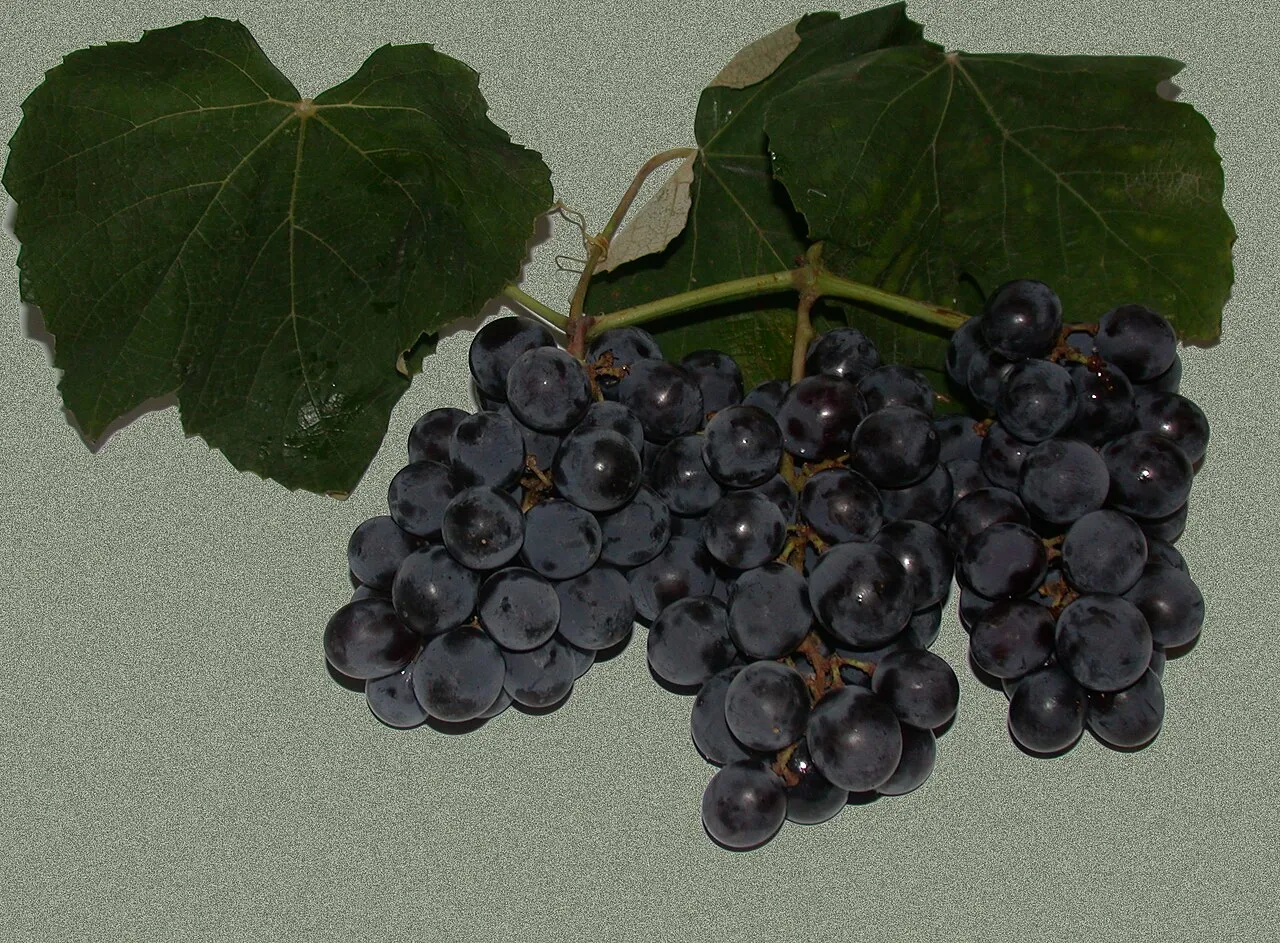
Profile: Isabella
| Berry colour | Black grape (N) |
|---|---|
| Species / status | Direct producer hybrid |
| Origin | United States, South Carolina (probable origin) |
| Parentage | Vitis labrusca × Petit meslier (DNA analysis) |
| Synonyms | Isabelle, Izabella, Raisin framboise, Raisin de cassis, Fragola, Odessa |
| Grown in | Brazil, Georgia, Moldova, Ukraine, India, Colombia, Italy, Switzerland, France |
| Typical aromas | strawberry, raspberry, foxy, blackcurrant |
| Wine style | Red or rosé with a foxy taste, strongly marked by strawberry and raspberry notes; often eaten as a table grape. |
| Food pairings | red berry desserts, roasted chestnuts, afternoon snack (as fresh grapes) |
| Identifiers | VIVC no. 5560, Wikidata Q393040 |
Origin: a vine found in South Carolina
Isabella is a black grape of American origin. The most widespread tradition has it arising as a chance seedling in a garden in South Carolina. Around 1816, George Gibbs is said to have given a cutting to the nurseryman William Robert Prince, who named it after Gibbs’s wife, Isabella. Other accounts place it in Virginia or Delaware: its exact origin remains uncertain.
Parentage: an unexpected parent from Champagne
As early as 1909, the ampelographer Thomas Munson saw it as a cross between Vitis labrusca and a European vine. Genetic analyses confirmed this and identified the vinifera parent: petit meslier, a rare white grape of Champagne. The cross is thought to result from spontaneous pollination between a European vine grown in America and a local wild vine.
For the method, see the guide on DNA parentage of grape varieties.
In the vineyard and at the table
Isabella is vigorous, fertile and productive. It resists phylloxera, tolerates cold and adapts to tropical and subtropical climates. Its berries, an almost black purple, have a thick skin that slips easily from the pulp (a so-called “slip-skin” grape) and a very distinctive taste of strawberry or raspberry, hence its popular names “raspberry grape” and “blackcurrant grape”.
The French ban
Isabella is one of the six grapes banned in France by the legislation of 1934-1935, along with noah, clinton, jacquez, othello and herbemont. The official reason cited a “detestable” taste and health concerns; the real aim was mostly to curb wine overproduction, since these hardy vines allowed small growers to make their own wine without spraying. See the guide on the hybrids banned in 1934.
Italian fragolino
In Italy, Isabella and other labrusca type grapes are called uva fragola (“strawberry grape”). They are used to make fragolino, a still or sparkling fermented drink with a very marked strawberry scent.
| Aspect | Fragolino |
|---|---|
| Grapes | Vitis labrusca and hybrids (Isabella in particular) |
| Name “wine” | Prohibited for sale in the European Union |
| Personal consumption | Production not prohibited |
| Commercial products | Often flavoured drinks based on other fruits |
| European exception | Uhudler of Burgenland (Austria), specific regime |
European regulation largely takes over earlier national bans. “Authentic” fragolino therefore circulates mostly within families or outside the European Union.
Where it is grown
Isabella is one of the most widespread American hybrids in the world. It is very present in Brazil, Colombia, India, Ukraine, Moldova and Georgia (where it is sometimes called “Odessa”), and it was very popular in the former USSR. In Switzerland, it is grown in Ticino for grappa.
In France, it remains present in gardens and family vineyards: in La Réunion (Cilaos), in the Cévennes, the Hérault and the Alpes-Maritimes. See the page on direct-producer hybrids.
Status and debate
The French wine code was relaxed in 2003, but Regulation (EU) No 1308/2013 still prohibits classifying Isabella as a wine grape variety. Supporters of its rehabilitation point to its hardiness; the question was debated in the European Parliament in 2025, with no confirmed lifting of the ban at the date of the last update.
Further reading
Frequently asked questions
What is fragolino?
Fragolino is an Italian fermented drink, still or sparkling, made from Vitis labrusca type grapes and their hybrids, called uva fragola, including Isabella. European law prohibits selling it under the name "wine". Production for personal consumption is not prohibited, and products sold under this name are often flavoured drinks based on other fruits.
Why is it called the raspberry grape?
Because its berries have a very marked taste of strawberry or raspberry, linked to the "foxy" character of labrusca type vines. In the Alpes-Maritimes, it is simply called "framboise". Elsewhere it is also known as blackcurrant grape.
Can you plant Isabella in your garden?
Yes. Isabella is sold as an ornamental or table grape vine, and growing it is not prohibited as such. What remains prohibited in the European Union is its classification as a wine grape variety, and therefore the sale of its wine under the name "wine".
Who are the parents of Isabella?
Genetic analyses carried out in particular by Erika Maul's team at the Julius Kühn-Institut identified petit meslier, a white grape from Champagne, as the vinifera parent. The other parent is a Vitis labrusca type vine, probably the result of spontaneous pollination.