Jacquez: the "jacquet" of the Cévennes, a banned hybrid
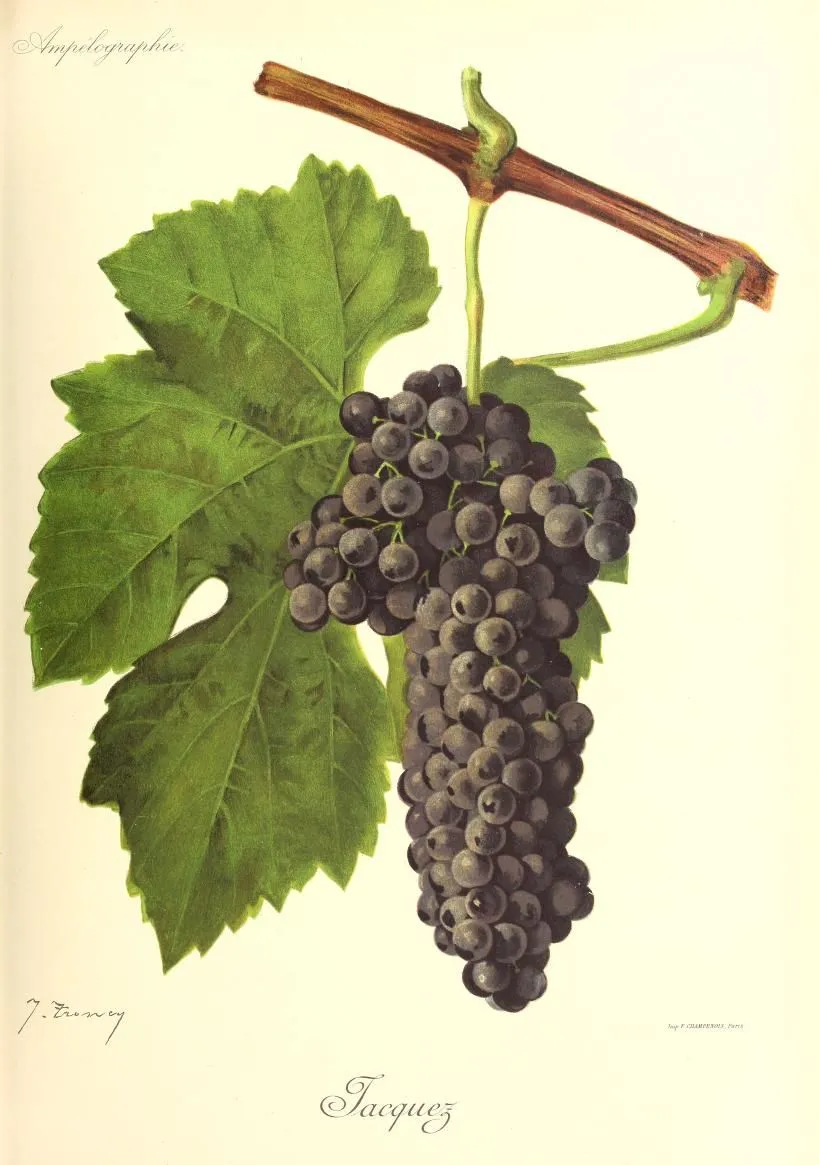
Profile: Jacquez
| Berry colour | Black grape (N) |
|---|---|
| Species / status | Direct producer hybrid |
| Origin | Southern United States (exact origin uncertain) |
| Parentage | American vine (Vitis aestivalis according to tradition, Vitis berlandieri according to recent genetic analyses) × Vitis vinifera |
| Synonyms | Jacquet, Lenoir, Black Spanish, El Paso, Ohio |
| Grown in | United States, France, Portugal (Madeira), Peru |
| Typical aromas | black fruit, earthy notes |
| Wine style | Very deeply coloured red with earthy notes; in Texas, port-style wines and dry varietal wines. |
| Food pairings | grilled meats, spicy Tex-Mex dishes, strong cheeses |
| Identifiers | VIVC no. 5627, Wikidata Q1325860 |
Origin: a natural hybrid from the southern United States
Jacquez is a black grape born in the southern United States, probably from a spontaneous pollination between a wild American vine and a cultivated European vine. Ampelographic tradition saw it as a cross between Vitis aestivalis and Vitis vinifera. More recent genetic marker analyses point instead to Vitis berlandieri as the wild parent. The question is not entirely settled, and the exact geographical origin remains uncertain.
This grape has had several names depending on the country: jacquez or jacquet in France, lenoir, black spanish or el paso in the United States.
From Madeira to the Midi
Jacquez reached Europe by several routes. It is recorded in Madeira under the names jaqué or jacquet, then in France in the 19th century. During the phylloxera crisis (from 1873 in the Midi), it played a double role:
| Use | Period | Benefit |
|---|---|---|
| Direct producer | 19th century to 1934 | Wine without grafting, disease resistance |
| Rootstock | After the phylloxera crisis | Resistance to phylloxera, powdery mildew and downy mildew |
| Family grape | After 1935 | Kept illegally in a few communes, until the 1960s at the foot of the Lure mountain |
The role of American vines in rebuilding the vineyard is explained in the guide on rootstocks and phylloxera.
The 1934-1935 ban
Jacquez is one of the six grapes banned in France by the legislation of 1934-1935, alongside noah, clinton, isabelle, othello and herbemont. The official argument was about methanol: wines from these grapes were said to contain more of it than those from vinifera. This argument is now disputed; other explanations stress the fight against overproduction and the defence of the image of French wines. See the guide on the hybrids banned in 1934.
Articles 95 and 96 of the wine code were repealed in 2003, but Regulation (EU) No 1308/2013 still excludes jacquez from the wine grape varieties that can be classified in the European Union. The debate on rehabilitating these six grapes was relaunched in the European Parliament in 2025, with no confirmed lifting of the ban at the date of the last update.
The wine
Jacquez gives very deeply coloured wines with earthy notes. In Texas, it is often recommended to decant them before serving. Its deep colour made it a valued blending grape for colour, a role comparable to that of teinturier grapes. Some studies also report a high resveratrol content.
Texas’s Black Spanish
In the United States, the grape built a career under the name Black Spanish:
- the ampelographer Thomas Volney Munson studied it in Denison, Texas, in the late 19th century;
- it is grown in the Texas Hill Country, the Rio Grande valley and north Texas;
- it has long been used for port-style wines and in blends, and a few estates now make dry varietal wines from it;
- its tolerance to Pierce’s disease, a serious threat in the American South, is attributed to its berlandieri ancestry.
It is also found in Peru. In France, it survives only in family vineyards, mainly in the Cévennes where it is called jacquet. See the page on direct-producer hybrids.
Further reading
Frequently asked questions
Are jacquez, jacquet, lenoir and black spanish the same grape?
These names designate the same grape or very closely related forms. Jacquez and jacquet are the names used in France (jacquet in the Cévennes) and in Madeira; lenoir, black spanish and el paso are American names, the last being used mainly in Texas. Some authors nevertheless distinguish related seedlings under these different names.
Was jacquez used as a rootstock?
Yes. After the phylloxera crisis, from the 1870s, jacquez was used in the Midi not only as a direct producer but also as a rootstock, thanks to its resistance to phylloxera, powdery mildew and downy mildew. Vines grafted onto jacquez still exist.
Why is jacquez banned?
It is one of the six grapes (with noah, clinton, isabelle, othello and herbemont) banned by French legislation in 1934-1935, officially because of the quality and methanol content of their wines. European Regulation No 1308/2013 still prohibits classifying them as wine grape varieties.
Where can you drink jacquez today?
Legally, mostly in the United States: Texas (Hill Country, Rio Grande valley, north Texas) uses it under the name Black Spanish for port-style wines, blends and a few dry varietal wines. In France, it survives only in family vineyards.