Herbemont: the hybrid of the American South, banned in 1934-1935
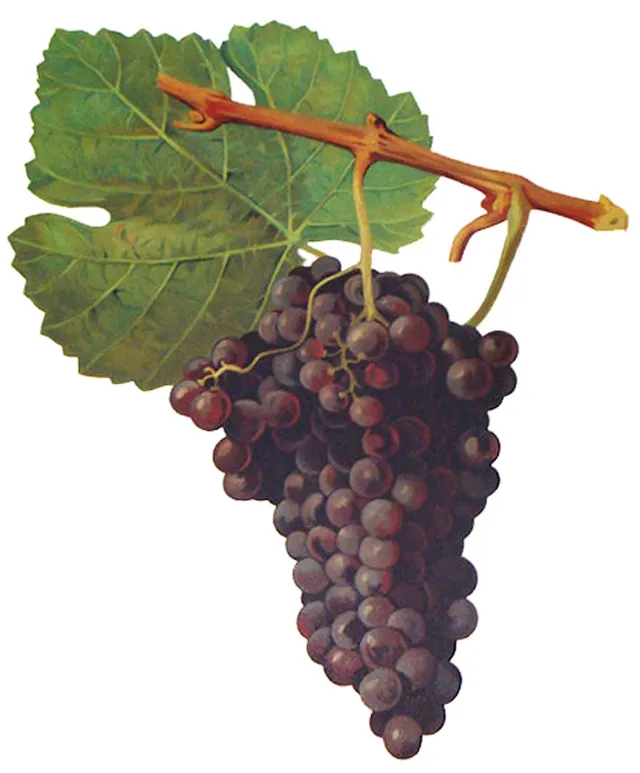
Profile: Herbemont
| Berry colour | Black grape (N) |
|---|---|
| Species / status | Direct producer hybrid |
| Origin | United States, South Carolina |
| Parentage | Vitis aestivalis var. bourquiniana × Vitis vinifera (natural hybrid, exact origin unknown) |
| Synonyms | Warren, Brown French, Herbemont Madeira |
| Grown in | United States, France |
| Typical aromas | juicy fruit, notes reminiscent of Madeira (fortified wines) |
| Wine style | Pale red or white wines, and formerly fortified Madeira-style wines in the American South. |
| Food pairings | dried fruit, desserts (fortified wines), everyday cooking |
| Identifiers | VIVC no. 5356, Wikidata Q112254905 |
Origin: a grape of the American South
Herbemont is a hybrid born in the south-eastern United States. Its exact origin is unknown: it is said to have been propagated from an old vine in Columbia, South Carolina, before being popularised in the 1820s by Nicholas Herbemont (1771-1839), a grower and advocate of American viticulture, who left it his name. The grape previously circulated under other names, including Warren and Brown French.
A parentage still debated
Herbemont is generally described as a natural hybrid between Vitis aestivalis (in its so-called bourquiniana form, native to the south-eastern United States) and Vitis vinifera, perhaps with a share of Vitis cinerea. Specialists do not fully agree on this ancestry, as with its close neighbour jacquez.
| Trait | Herbemont |
|---|---|
| Origin | South Carolina, before the 1820s |
| Presumed parentage | V. aestivalis var. bourquiniana × V. vinifera (+ possible V. cinerea) |
| Bunches | Compact, winged |
| Berries | Small, spherical, very thin skin, juicy flesh |
| Berry colour | Described from pale brownish red to almost white depending on sources |
| Assets | Resistance to phylloxera and diseases, tolerance of heat and drought |
| Status in the EU | Excluded from the classification of wine grape varieties |
Berry colour is described differently depending on sources and selections; the code used here follows the site’s inventory.
In the vineyard
Herbemont is very vigorous, able to climb very high, and productive. It flowers and ripens late. It tolerates heat and drought well, and stands out above all for its resistance to phylloxera and to several diseases, which explains its appeal to European growers at the end of the 19th century.
The wines
In the United States, herbemont was one of the renowned grapes of the South. From South Carolina, it spread through the south and east of the country, and became important in Missouri and Texas. It was mainly used to make pale red or white wines. Some producers used it for fortified wines inspired by Madeira, to the point that it was nicknamed “Herbemont Madeira”: its flavour was compared to that of verdelho.
In France: direct producer, then ban
Like other American vines, herbemont was sent to Europe during the phylloxera crisis. In France, it was planted as a direct-producer hybrid (HPD, hybride producteur direct), mainly in areas of smallholder viticulture. It is one of the six grapes banned by the 1934-1935 legislation, with noah, clinton, isabelle, jacquez and othello. The context of this decision is presented in the guide on the hybrids banned in 1934.
Articles 95 and 96 of the wine code (code du vin), which targeted these grapes, were repealed in 2003. But Regulation (EU) No 1308/2013 still prohibits classifying herbemont as a wine grape variety: its wine cannot be marketed under the name “wine”. Family production remains tolerated.
A grape on borrowed time
In the United States, the massive shipment of vines to Europe during the phylloxera crisis, then the Prohibition of the 1920s, caused a large part of the herbemont plantings to disappear. The grape is now listed in the Ark of Taste of the Slow Food Foundation, which records products threatened with extinction.
In France, it survives in a few family vineyards, notably in the Gard. The debate on rehabilitating the six banned grapes was brought to the European Parliament in 2025, with no confirmed lifting of the ban at the update date. For the role of American vines in the reconstitution of the vineyard, see the guide on rootstocks and phylloxera and the page direct-producer hybrids.
Genealogy of Herbemont
Identified parents (Wikidata): Chasselas.
Frequently asked questions
Where does the name herbemont come from?
The grape bears the name of Nicholas Herbemont (1771-1839), a grower from Columbia, South Carolina, who cultivated and popularised it in the 1820s. It was previously known under other names, such as Warren or Brown French.
Is herbemont in the same family as jacquez?
Both grapes are natural hybrids of the southern United States, combining a wild American vine and Vitis vinifera, and they were grown by the same pioneers. Nicholas Herbemont also made wine from lenoir, one of the American names of jacquez. Their exact relationship remains under discussion.
Why is herbemont banned in France?
It is one of the six grapes (noah, clinton, isabelle, jacquez, othello, herbemont) banned by the 1934-1935 legislation, officially because of the quality and methanol content of their wines, in a context of overproduction. Regulation (EU) No 1308/2013 still prohibits classifying it as a wine grape variety.
Did herbemont make good wines?
In the United States in the 19th century, it was renowned for the quality of its wines and spread as far as Missouri and Texas. Some used it for fortified wines imitating Madeira, hence the nickname "Herbemont Madeira".