Muscat of Hamburg: the black table grape with a muscat taste
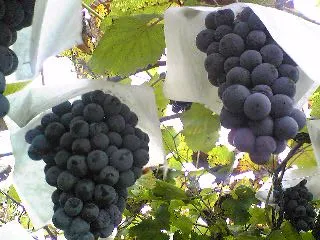
Profile: Muscat de Hambourg
| Berry colour | Black grape (N) |
|---|---|
| Species / status | Table grape |
| Origin | United Kingdom, England (Wrest Park, Bedfordshire) |
| Parentage | Frankenthal (schiava grossa) × Muscat of Alexandria (according to the VIVC); breeding attributed to Seward Snow around 1850 |
| Synonyms | Black Hamburg, Black Muscat, Moscato d'Amburgo, Muscat du Ventoux, Zibibbo nero, Hambro |
| French regions | Rhône Valley |
| Grown in | France, Greece, Romania, Uruguay, United States, China, India |
| Typical aromas | muscat, rose, fresh grape |
| Wine style | Crunchy, musky table grape; as wine, light dry reds or very aromatic sweet wines. |
| Food pairings | cheese platter, fruit desserts, foie gras (sweet wines) |
| Identifiers | VIVC no. 8226, Wikidata Q737081 |
Origin: a muscat born in an English greenhouse
Despite its name, muscat of Hamburg is not German. According to the Vitis International Variety Catalogue (VIVC), it was bred around 1850 in England by Seward Snow, head gardener to the Earl de Grey at the Wrest Park estate, in Bedfordshire. At the time, the great English estates grew vines under glass to obtain prestigious table grapes.
Its name comes from one of its parents, frankenthal, which the English called “black hamburg”. This name is, moreover, a source of confusion, as it sometimes also designates muscat of Hamburg itself. See the guide on synonyms and homonyms.
Parentage
| Parent | Nature | Contribution |
|---|---|---|
| Frankenthal (schiava grossa, trollinger) | Black table and wine grape | Large bunches, colour, juicy flesh |
| Muscat of Alexandria | Old white muscat grape | Musky taste |
This parentage is the one retained by the VIVC and by the Italian ampelographer Pirovano; some sources consider that it deserves more complete genetic confirmation. Muscat of Hamburg has itself served as a parent: crossed with raboso Piave between 1930 and 1935, it gave the Italian grape manzoni moscato.
In the vineyard
Muscat of Hamburg is a grape of good vigour, medium fertility and fairly good productivity. It needs long pruning and a sunny climate. It buds about five days after chasselas and ripens 15 to 18 days after it. It is sensitive to downy mildew, powdery mildew and winter frost.
Its bunches are large, its berries big, with juicy, fairly musky flesh. Colouring is sometimes uneven: some of the bunches take on a dark blue shade, others stay a light purplish pink.
The muscat du Ventoux AOC
In France, muscat of Hamburg is the grape of the muscat du Ventoux AOC, recognised in 1997. It is an appellation for a table grape, not for wine.
- Zone: foot of Mont Ventoux, in the Vaucluse, across nearly fifty communes;
- Producers: in the order of a few hundred;
- Requirements: minimum bunch weight and minimum sugar content, for a well-ripened grape.
This AOC table grape is also known under the trade name “muscat du Ventoux”. For the differences between sectors, see the guide table grape or wine grape and the grapes of the Rhône Valley.
A wine grape abroad
Outside France, muscat of Hamburg is also a wine grape. It is widely planted in Greece, Romania and Uruguay. In Eastern Europe, it gives light dry reds; in California’s Central Valley, very aromatic and deeply coloured dessert wines. It is also gaining ground in China as a wine grape. For the other table grapes presented on the site, see the page on table grapes, notably cardinal.
Genealogy of Muscat de Hambourg
Identified parents (Wikidata): Frankenthal and Muscat d'Alexandrie.
Further reading
Frequently asked questions
Does muscat of Hamburg come from Germany?
No, despite its name. It is said to have been bred in England around 1850 by Seward Snow, head gardener of the Wrest Park estate (Bedfordshire). Its name comes from its parent, frankenthal, called "black hamburg" in England, where it was grown under glass.
What is the muscat du Ventoux AOC?
It is an appellation d'origine contrôlée recognised in 1997 for a table grape: muscat of Hamburg grown at the foot of Mont Ventoux, in the Vaucluse. The specification requires in particular a minimum bunch weight and a minimum sugar content, to guarantee a well-ripened, well-formed grape.
Can wine be made from muscat of Hamburg?
Yes. It is a dual-purpose grape. It is made into wine in Greece, Romania, Eastern Europe (often as light dry reds), California (aromatic sweet wines) and increasingly in China. In France, it is mainly eaten as a table grape.
What is the difference between muscat of Hamburg and muscat of Alexandria?
Muscat of Alexandria is an old white grape, one of the presumed parents of muscat of Hamburg. Muscat of Hamburg is black and inherits from its other parent, frankenthal, large bunches and juicy flesh.
Related grapes
- Muscat d'Alexandrie (white, Mediterranean basin (precise origin undetermined))
- Muscat à petits grains (white, Mediterranean basin (precise origin unknown))
- Cardinal (pink, United States, California)
- Dattier de Beyrouth (white, Near East (brought to France from the Beirut area))
- Chasselas (white, Switzerland, west of the country (Lake Geneva region))
- Sultanine (white, Asia Minor or Afghanistan (origin debated))