Petit verdot: from the spice of Médoc blends to single-variety wines
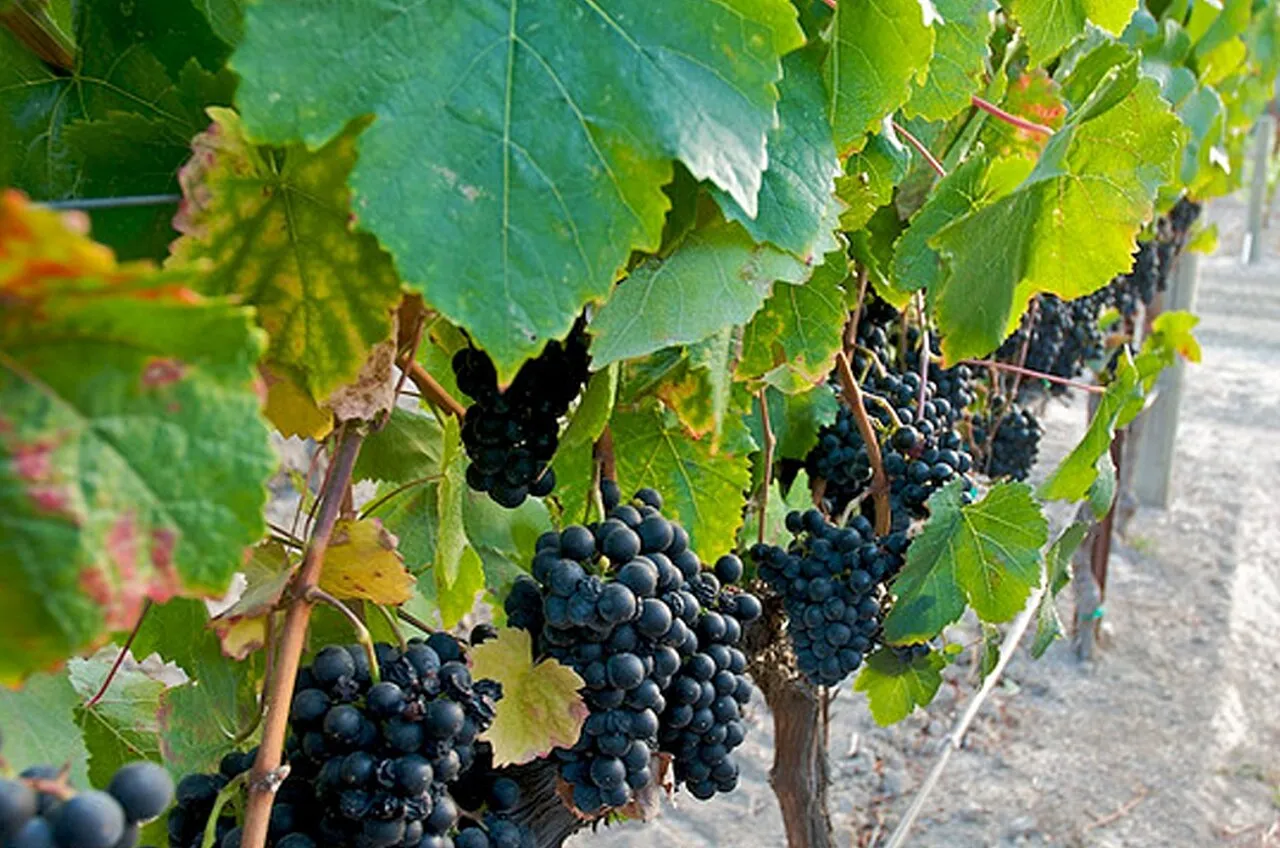
Profile: Petit verdot
| Berry colour | Black grape (N) |
|---|---|
| Species / status | Vitis vinifera |
| Origin | France, South-West (Bordeaux) |
| Synonyms | Verdot, Petit verdot noir, Verdot rouge |
| French regions | Bordeaux, Languedoc-Roussillon |
| Grown in | France, Spain, Australia, United States, Argentina, Chile, Italy, Portugal |
| Typical aromas | violet, blackberry, blackcurrant, spices, liquorice, woody and pencil-shaving notes |
| Wine style | Deeply coloured, tannic and spicy wines, used in small proportions in Bordeaux blends or made on their own in warm climates. |
| Food pairings | game, rib of beef, spiced lamb, aged hard cheeses |
| Identifiers | VIVC no. 12974, Wikidata Q637453 |
Origin: an old Bordeaux grape
Petit verdot is a black grape from South-West France. It is attested in Bordeaux in the 18th century, and is probably older than cabernet sauvignon in the region, although its precise origin is unknown.
Some authors think it may have been domesticated in the Pyrenean foothills, which its need for heat would suggest, being better suited to a warmer climate than that of the Gironde. This hypothesis has not been proven.
Its name means “little green one”, in reference to its ripening difficulties.
Parentage: a parent of tressot
Petit verdot is known to be one of the parents of tressot, an old grape of the Yonne, the other parent being duras, a grape of the Gaillac area. Its own parents have not been established. See DNA parentage of grape varieties.
In the vineyard
Petit verdot is a very late-ripening grape, later even than cabernet sauvignon. In Bordeaux, it does not reach satisfactory ripeness every year, and the crop can be lost in cool vintages.
It also suffers from fruit-set problems at flowering, which reduce its yields and make them irregular. Growing it therefore requires warm, well-drained plots.
The wines
Petit verdot makes deeply coloured, tannic wines, with aromas of violet, blackberry, blackcurrant and spices. When ripe, it also brings freshness and sustained acidity.
The angle to know: from minor blending grape to single-variety wine
Petit verdot has two faces depending on the climate.
| Context | Role of petit verdot | Profile sought |
|---|---|---|
| Médoc and Graves | Minor blending grape, a few per cent of the blend | Colour, tannins, spice, freshness |
| Spain, Australia, California, Argentina | Often made on its own | Dense, coloured, floral and spicy wine |
| Languedoc (IGP) | Complementary grape or single variety | Structure in southern blends |
In Bordeaux, it is used in small proportions with cabernet sauvignon, merlot and cabernet franc. It plays the role of a “seasoning” there: a small share is enough to change the colour and structure of the wine. See the grapes of Bordeaux and single variety or blend.
In the New World and in Spain, where it ripens reliably, it is increasingly made on its own. Australia, where it was introduced in the 19th century, has made it a speciality of certain warm regions.
Global warming could also make it easier to ripen in the Gironde, and it is attracting renewed interest for this reason. See grapes and climate change.
Where it is grown
In France, it is found mainly in the Médoc, in small proportions, and in Languedoc for IGP wines. Outside France, it is found in Spain, Australia, the United States (California, Virginia), Argentina, Chile, Italy and Portugal.
Frequently asked questions
Why is petit verdot little used in Bordeaux?
It is a very late-ripening grape that does not always reach good ripeness in the Gironde climate. Médoc growers therefore use it in small proportions, to bring colour, tannins and spicy notes to blends, rather than as a main grape.
What does "petit verdot" mean?
The name means "little green one". It is said to refer to the grape's ripening difficulties, its grapes sometimes staying green when other varieties are ripe, as well as its fruit-set problems.
Can you drink petit verdot made on its own?
Yes. In warmer regions such as Spain, Australia, California or Argentina, it ripens reliably and is often made as a single-variety wine. It then gives deeply coloured, tannic wines, with notes of violet and spice.
Does petit verdot benefit from global warming?
Its late ripening, long a handicap in Bordeaux, becomes easier to manage when seasons are warmer. The grape is therefore attracting renewed interest for bringing freshness and structure to blends, although the trend remains to be confirmed in the long term.
Related grapes
- Cabernet sauvignon (black, France, Bordeaux area)
- Merlot (black, France, Bordeaux (Libournais))
- Cabernet franc (black, France, South-West (Libournais probable))
- Carménère (black, France, Bordeaux area)
- Malbec (Côt) (black, France, Quercy (Lot))
- Duras (black, France, Tarn (Gaillac))