Pinot blanc: the white mutation of pinot noir
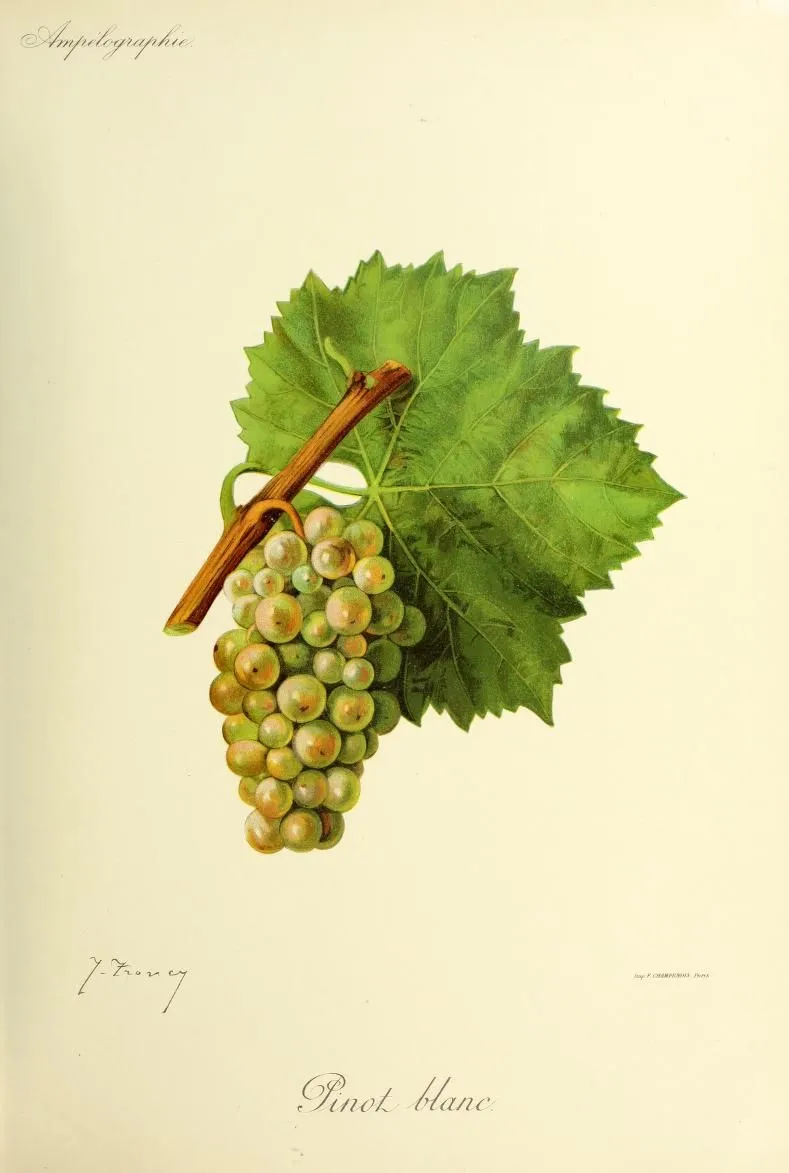
Profile: Pinot blanc
| Berry colour | White grape (B) |
|---|---|
| Species / status | Vitis vinifera |
| Origin | France, Burgundy (pinot mutation) |
| Parentage | Colour mutation of pinot (same variety as pinot noir and pinot gris) |
| Synonyms | Weissburgunder (Germany, Austria), Pinot bianco (Italy), Klevner (Alsace) |
| French regions | Alsace, Burgundy, Champagne |
| Grown in | France, Germany, Austria, Italy, Slovenia, United States, Canada |
| Typical aromas | apple, pear, white flowers, almond, soft citrus, brioche notes (crémant) |
| Wine style | Supple, fruity dry whites with moderate acidity, and a very common base for Crémant d'Alsace. |
| Food pairings | onion tart, quiche lorraine, grilled fish, fine charcuterie, fresh cheeses |
| Identifiers | VIVC no. 9272, Wikidata Q950514 |
Origin: a mutation of pinot
Pinot blanc is not a grape born of a cross: it is a colour mutation of pinot. Pinot noir, gris and blanc share practically the same DNA; they differ only in a few genes that control skin colour. Pinot blanc is thought to derive from pinot gris, itself a mutation of pinot noir.
It appeared in Burgundy, where it was long grown mixed with other white grapes. To understand the phenomenon, see the guide colour mutations.
Pinot blanc and chardonnay: a historical confusion
For centuries, pinot blanc and chardonnay were confused in Burgundy, to the point that chardonnay was called “pinot chardonnay”. The two grapes look alike in the vineyard.
Genetics has clarified their relationship:
- pinot blanc is a form of pinot;
- chardonnay is an offspring of pinot and gouais blanc.
Pinot blanc is therefore a version of the parent, chardonnay one of its children. In Burgundy, pinot blanc remains marginal today, present here and there in certain plots.
In the vineyard
Pinot blanc is an early to mid-ripening grape, a little more productive and more consistent than pinot noir. It does well in cool climates. Its compact bunches make it susceptible to grey rot.
The wines: suppleness and fruit
Pinot blanc makes dry, supple wines with moderate acidity, with aromas of apple, pear, white flowers and sometimes almond. Less aromatic than pinot gris, it is valued for its versatility at the table.
| Country or region | Name | Dominant style |
|---|---|---|
| Alsace | Pinot blanc, klevner | Fruity dry wines, base of Crémant d’Alsace |
| Germany (Baden, Pfalz) | Weissburgunder | Dry, sometimes barrel-aged |
| Austria | Weissburgunder, pinot blanc | Dry, sometimes lusciously sweet |
| Italy (Alto Adige, Friuli) | Pinot bianco | Dry, lively, and in some sparkling wines |
Alsace: auxerrois under the name pinot blanc
The angle specific to pinot blanc lies in an Alsace rule that often surprises. In Alsace, a wine labelled “pinot blanc” can be made from pinot blanc, from auxerrois, or from a blend of the two. The term klevner is also used for these wines.
Yet auxerrois is not a pinot: it is a distinct grape, also born of the cross between pinot and gouais blanc, and therefore a sibling of chardonnay and melon de Bourgogne. Richer and less acidic, it brings roundness to blends.
Pinot blanc is also the main grape of Crémant d’Alsace, the region’s traditional-method sparkling wine. See the grapes of Alsace and the guide grape names on the label, which explains this kind of tolerance.
Where it is grown
In France, pinot blanc is mainly found in Alsace. It is also permitted in Champagne, where very little is planted, and survives in Burgundy.
Outside France, it is widespread in Germany (Weissburgunder), Austria, northern Italy (pinot bianco, notably in Alto Adige), Slovenia and Central Europe. It is also found in Oregon, California and Canada.
In California, some of the vines sold as pinot blanc turned out to be melon de Bourgogne, an ampelographic confusion that was later corrected. See synonyms and homonyms.
Further reading
Frequently asked questions
Is pinot blanc a chardonnay?
No. Pinot blanc is a colour mutation of pinot, whereas chardonnay is an offspring of pinot and gouais blanc. The two were long confused in Burgundy vineyards, hence the old, mistaken name "pinot chardonnay" for the latter.
Is an Alsace pinot blanc always 100% pinot blanc?
Not necessarily. In Alsace, the pinot blanc designation can cover wines made from pinot blanc, auxerrois or a blend of the two. The term klevner is also used for these wines.
What is the difference between pinot blanc, pinot gris and pinot noir?
They are three forms of the same variety, which differ in the colour of the grape skin as a result of mutations. Pinot noir has black berries, pinot gris pinkish-grey berries, pinot blanc white berries. Their wines are different, but their DNA is almost identical.
Related grapes
- Pinot noir (black, France, Burgundy)
- Pinot gris (grey, France, Burgundy (pinot mutation))
- Chardonnay (white, France, Burgundy)
- Pinot meunier (black, France, north-east (pinot mutation))
- Melon de Bourgogne (white, France, Burgundy)
- Sylvaner (white, Central Europe, probably Austria)