Sylvaner: the easy-drinking white that became an Alsace grand cru
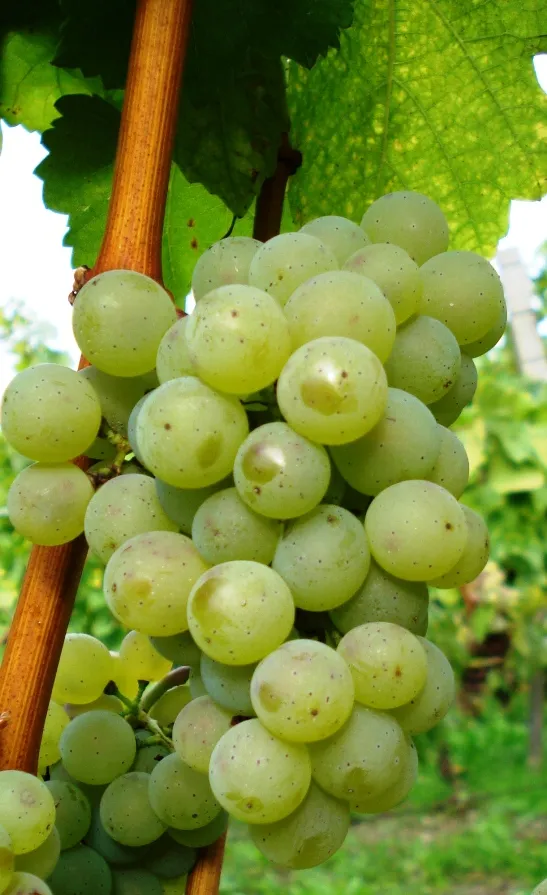
Profile: Sylvaner
| Berry colour | White grape (B) |
|---|---|
| Species / status | Vitis vinifera |
| Origin | Central Europe, probably Austria |
| Parentage | Traminer (savagnin) × Österreichisch Weiss (DNA analysis) |
| Synonyms | Silvaner (Germany), Grüner Silvaner, Johannisberg (Valais) |
| French regions | Alsace |
| Grown in | Germany, France, Switzerland, Austria, Italy |
| Typical aromas | green apple, citrus, fresh herbs, white flowers, earthy and mineral notes |
| Wine style | Light to medium-bodied dry whites, fresh and understated, with more depth on the best limestone or marl terroirs. |
| Food pairings | asparagus, tarte flambée, Alsace charcuterie, seafood, river fish |
| Identifiers | VIVC no. 11805, Wikidata Q1133517 |
Origin: Central Europe and Austria
Sylvaner is a grape from Central Europe. Its name was long linked to Transylvania or to the Latin silva (forest), without proof. Genetics has shed firmer light: an origin in the former Austrian Empire is now considered the most likely.
It then spread to Germany, where it long ranked among the most planted grapes, and then to Alsace.
Parentage: traminer × österreichisch weiss
DNA analysis has shown that sylvaner comes from a cross between traminer and österreichisch weiss, an old white grape of Central Europe which, like gouais, belongs to the group of so-called “Hunnic” grapes.
As traminer is the Germanic form of savagnin, sylvaner joins the long list of descendants of this Jura grape, alongside sauvignon blanc and chenin. It is thus related to gewurztraminer, the aromatic form of traminer. See the guide on DNA parentage of grape varieties.
In the vineyard
Sylvaner is a productive and fairly early grape. It is susceptible to powdery mildew, grey rot and chlorosis on very calcareous soils.
Its productivity made its success, but also its reputation as a volume wine: at high yields, its wines are neutral. With controlled yields, it gains concentration and expression of terroir.
The wines: restraint and expression of the soil
Sylvaner makes dry, fresh, light to medium-bodied wines, with understated aromas of green apple, citrus and fresh herbs, sometimes with earthy notes. It is often considered a grape that reveals the soil more than it imposes its fruit.
| Region | Local name | Style |
|---|---|---|
| Franconia (Germany) | Silvaner | Dry, structured, earthy notes; often in the Bocksbeutel bottle |
| Rheinhessen (Germany) | Silvaner | Dry, often volume wines, sometimes ambitious |
| Alsace (France) | Sylvaner | Dry, fresh; grand cru at Zotzenberg |
| Valais (Switzerland) | Johannisberg | Fuller, dry or slightly sweet |
| Alto Adige (Italy) | Sylvaner | Dry, lively, high-altitude vineyards |
Alsace: from carafe wine to the Zotzenberg grand cru
The most striking angle on sylvaner is its recognition as a grand cru. In Alsace, the grands crus were historically reserved for riesling, gewurztraminer, pinot gris and muscat.
In 2006, the Zotzenberg, in Mittelbergheim (Bas-Rhin), obtained the admission of sylvaner: it is the first sylvaner recognised as an Alsace grand cru, and this grand cru remains the only one to accept it. This decision consecrated a local tradition of terroir sylvaners. See the grapes of Alsace and the guide how to read an AOC specification.
Sylvaner has otherwise declined in Alsace in favour of the so-called noble grapes, even though some producers champion it from old vines.
Franconia: the benchmark terroir
In Germany, Franconia (Franken) is the region where sylvaner enjoys the best reputation. Its wines, often presented in the round, flattened bottle called the Bocksbeutel, are dry and structured there. The grape has declined in Germany since the 20th century, notably in favour of Müller-Thurgau, before growers revived quality cuvées.
Genealogy of Sylvaner
Identified parents (Wikidata): Oesterreichisch Weiss and Savagnin.
Offspring profiled on this site: Portugais bleu.
Frequently asked questions
Is sylvaner a great grape?
It long had the image of an easy-drinking wine, simple and refreshing. On certain terroirs, however, it makes wines of character: in Franconia, it is the benchmark white grape, and in Alsace, the Zotzenberg grand cru has admitted it since 2006, making it the first sylvaner recognised as a grand cru.
What are the parents of sylvaner?
DNA analysis has shown that sylvaner comes from a cross between traminer, that is savagnin, and österreichisch weiss, an old white grape of Central Europe. This result supports an Austrian origin.
What is the johannisberg of Valais?
In Valais, in Switzerland, the name johannisberg refers to sylvaner. There it makes dry or slightly sweet whites, fuller than in Alsace. This name has nothing to do with the American Johannisberg Riesling, which is a riesling.
Related grapes
- Savagnin (white, Europe, precise origin debated (Jura and Central Europe))
- Riesling (white, Germany, Rhine Valley)
- Gewurztraminer (pink, Central Europe, South Tyrol (traminer lineage))
- Pinot blanc (white, France, Burgundy (pinot mutation))
- Müller-Thurgau (white, Germany, Geisenheim (bred by Hermann Müller in 1882))
- Chasselas (white, Switzerland, west of the country (Lake Geneva region))
- Trousseau (black, France, Jura)
- Duras (black, France, Tarn (Gaillac))