Müller-Thurgau (rivaner): a famous cross with poorly known parents
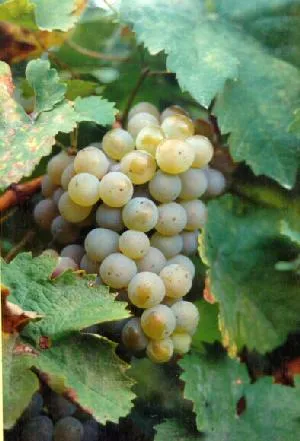
Profile: Müller-Thurgau
| Berry colour | White grape (B) |
|---|---|
| Species / status | Vitis vinifera |
| Origin | Germany, Geisenheim (bred by Hermann Müller in 1882) |
| Parentage | Riesling × Madeleine royale (bred by Hermann Müller in 1882, parentage corrected by DNA analysis) |
| Synonyms | Rivaner, Riesling-Silvaner, Rizlingszilváni (Hungary), Rizvanac (Croatia), Rizvanec (Slovenia) |
| Grown in | Germany, Austria, Hungary, Italy (Alto Adige, Trentino), Switzerland, Luxembourg, Czech Republic, England, New Zealand |
| Typical aromas | white flowers, peach, apple, sweet citrus, light muscat, herbs |
| Wine style | Light, fruity, supple white with low acidity, to drink young; more taut at altitude in Alto Adige. |
| Food pairings | asparagus, lake fish, mixed salads, mildly spiced Asian cuisine, fresh cheeses |
| Identifiers | VIVC no. 8141, Wikidata Q681670 |
A Geisenheim cross
Müller-thurgau is one of the first modern grapes to come from a deliberate cross. It was bred in 1882 at the Geisenheim research institute, in the Rhineland, by Hermann Müller, a Swiss botanist from the canton of Thurgau, hence the grape’s name.
The aim was to combine the finesse and intensity of riesling with the early ripening of sylvaner, to obtain a reliable grape for cool climates.
The niche angle: a parentage corrected by DNA
For more than a century, müller-thurgau was presented as a riesling × sylvaner cross. In Switzerland, it is still called riesling-silvaner, and in Luxembourg rivaner, which derives from it.
Genetic analyses rewrote this story in several steps:
| Step | Hypothesis on the second parent |
|---|---|
| Breeding (1882) | Sylvaner, according to the breeder’s intention |
| 1990s | Sylvaner ruled out; chasselas then admirable de Courtiller proposed |
| 2000 | The reference vine of “admirable de Courtiller” turns out to be madeleine royale |
| Current conclusion | Riesling × madeleine royale |
Madeleine royale is an old table grape. Müller-thurgau therefore has no parentage link with sylvaner. The story illustrates the fragility of parentages “on paper” and the contribution of genetic markers, explained in the guide DNA parentage of grape varieties. On the links between table and wine grapes, see also table grape or wine grape.
The German golden age and the decline
Thanks to its early ripening and high yields, müller-thurgau became in the 1970s the most planted grape in Germany. It went widely into mass-market wines, such as Liebfraumilch, sold in bulk for export.
On 1 January 1979, a severe frost damaged many recent grapes, while riesling, more resistant to cold, fared better. Winemakers then diversified their plantings. Müller-thurgau declined markedly from the 1980s but still ranked second in Germany in 2019, behind riesling.
In the vineyard
Müller-thurgau adapts to very varied soils and climates and is less demanding than riesling about the choice of plots. It ripens early, but is less resistant to winter frost than riesling and sensitive to downy mildew and rot. Its high productivity must be controlled to avoid diluted wines.
The wines: lightness and fruit
Müller-thurgau makes light, supple, fruity whites of moderate acidity, with aromas of white flowers, peach and apple, sometimes with a slight muscat note. They are made to be drunk young.
In high-altitude terroirs, such as Alto Adige and Trentino in Italy, it makes more taut and more aromatic wines. In Switzerland, it shares the vineyard with chasselas.
Where it is grown
| Country | Usual name | Note |
|---|---|---|
| Germany | Müller-Thurgau, sometimes rivaner | Second grape of the country in 2019 |
| Luxembourg | Rivaner | Important grape of the Luxembourg Moselle |
| Switzerland | Riesling-Silvaner, Müller-Thurgau | Mainly in German-speaking Switzerland |
| Austria, Hungary, Czech Republic | Various local names | Light wines |
| Italy | Müller-Thurgau | Alto Adige, Trentino, at altitude |
| England, New Zealand | Müller-Thurgau | Historical role, declining |
It has also served as a parent to several German crosses of the 20th century, such as bacchus. For its Central European neighbours, see grüner veltliner.
Genealogy of Müller-Thurgau
Identified parents (Wikidata): Riesling and Madeleine royale.
Frequently asked questions
Who are the parents of müller-thurgau?
Hermann Müller thought he had crossed riesling and sylvaner, hence the name riesling × sylvaner still used in Switzerland. DNA analyses first ruled out sylvaner, then established in the early 2000s that the second parent is madeleine royale, an old table grape, the first being indeed riesling.
What is the difference between müller-thurgau and rivaner?
None as far as the grape is concerned: rivaner is the name used in Luxembourg, and sometimes in Germany, for müller-thurgau. The word evokes the supposed riesling × sylvaner cross.
Why did müller-thurgau decline in Germany?
Widely planted in the 1970s, it suffered in a severe frost on 1 January 1979, which spared riesling more. Winemakers then diversified their plantings, and the image of the mass-market wines it was associated with contributed to its decline. It nevertheless remains one of the most planted grapes in Germany.
Is müller-thurgau grown in France?
Marginally. It has no significant place in French appellations, unlike its neighbours Luxembourg, Germany and Switzerland.
Related grapes
- Riesling (white, Germany, Rhine Valley)
- Sylvaner (white, Central Europe, probably Austria)
- Chasselas (white, Switzerland, west of the country (Lake Geneva region))
- Welschriesling (white, Central Europe (uncertain origin))
- Grüner veltliner (white, Austria, Lower Austria)