Gewurztraminer: the aromatic traminer, star of Alsace
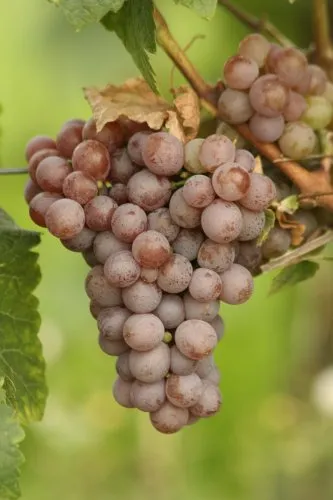
Profile: Gewurztraminer
| Berry colour | Pink grape (Rs) |
|---|---|
| Species / status | Vitis vinifera |
| Origin | Central Europe, South Tyrol (traminer lineage) |
| Parentage | Aromatic form of savagnin rose (traminer), within the savagnin family |
| Synonyms | Aromatic traminer, Aromatic savagnin rose, Gewürztraminer (Germany), Traminer musqué |
| French regions | Alsace |
| Grown in | France, Germany, Italy, Austria, New Zealand, United States, Australia |
| Typical aromas | lychee, rose, sweet spices (ginger, cinnamon), candied citrus, mango and exotic fruit, honey (late harvests) |
| Wine style | Very aromatic whites, ample and low in acidity, from dry to sweet, with a slight bitterness on the finish. |
| Food pairings | munster, spicy Asian cuisine, foie gras (sweet versions), mild curry, exotic fruit desserts (late harvests) |
| Identifiers | VIVC no. 12609, Wikidata Q756654 |
One name, two roots: Tramin and spice
Gewurztraminer takes its name from two elements. Traminer refers to the village of Tramin (Termeno in Italian), in Alto Adige (South Tyrol), long presented as the cradle of the family, without definitive genetic proof. Gewürz means “spice” in German and underlines the very aromatic character of the grape.
In Alsace, the name is written without an umlaut: gewurztraminer.
Parentage: a form of savagnin rose
Gewurztraminer is not an independent grape in the strict sense. It belongs to the traminer family, which corresponds to the Jura’s savagnin. This family is considered a set of related clones rather than distinct varieties:
| Form | Berry colour | Aromas | Example of use |
|---|---|---|---|
| Savagnin (white) | Green-white | Discreet | Vin jaune of the Jura |
| Savagnin rose (non-aromatic) | Pink | Discreet | Klevener de Heiligenstein (Alsace) |
| Gewurztraminer (aromatic savagnin rose) | Pink | Very intense (lychee, rose) | Wines of Alsace, Germany, Alto Adige |
The change from one form to another comes from mutations (colour, aroma) within a single lineage. See the guide on colour mutations and the one on grape colour codes, which explains why a white wine grape carries the code Rs here.
In the vineyard
Gewurztraminer is an early grape, with early budburst, and is therefore exposed to spring frosts. It is susceptible to poor fruit set (coulure) and its yields are irregular. Its small pink berries accumulate sugar quickly, while acidity drops fast: choosing the harvest date is delicate.
It succeeds in cool to continental climates, on soils that retain water well.
The wines: aromatic intensity and low acidity
Gewurztraminer is one of the easiest grapes to recognise in a blind tasting. Its lychee and rose aromas are linked to terpene compounds and to rose oxide, a molecule it contains in particularly high quantity.
On the palate, the wines are ample, often high in alcohol and low in acidity, with a slight bitterness on the finish. There are:
- dry or almost dry wines, rare but sought after at the table;
- wines with residual sugar, the most common;
- late harvests (vendanges tardives) and selections of noble berries (sélections de grains nobles), Alsatian designations for wines made from overripe or botrytised grapes.
Where it is grown
Alsace is its homeland: it is among the grapes admitted in grand cru, alongside riesling, pinot gris and muscat. See the grapes of Alsace.
It is also grown in Germany (Palatinate, Baden), in Italian Alto Adige, in Austria, in Eastern Europe and, in the New World, in New Zealand, the United States and Australia.
Gewurztraminer, klevener and savagnin: untangling the names
The names of the traminer family are confusing, and this is a point on which many sources contradict one another.
- Klevener de Heiligenstein: this Alsatian designation, around Heiligenstein (Bas-Rhin), refers to a wine made from non-aromatic savagnin rose. It is not a gewurztraminer, even though both come from the same lineage.
- Klevner (without a central “e”): in Alsace, this term on the contrary designates the family of the pinots blancs, hence frequent confusion.
- Traminer: in Germany and Austria, the word can refer to both the aromatic and the non-aromatic form.
To place these names in a wider context, see the guide on synonyms and homonyms. The comparison riesling or gewurztraminer sets the two great Alsatian grapes against each other.
Further reading
Frequently asked questions
Is gewurztraminer a white or a rosé wine?
It is a white wine, but made from a grape with pink skin, hence its code Rs in the official catalogue. The juice is colourless and the wine is made as a white, giving golden yellow wines, sometimes with deeper tints.
What does Gewurztraminer mean?
The word combines the German Gewürz, "spice", and Traminer, the Germanic name of the savagnin family, itself linked to the village of Tramin (Termeno) in Alto Adige. In Alsace the name is written without an umlaut, in Germany with one (Gewürztraminer).
Is gewurztraminer always sweet?
No. Dry gewurztraminers exist, but the grape easily reaches high ripeness and many wines keep some sugar. Alsace also produces late harvests (vendanges tardives) and selections of noble berries (sélections de grains nobles), which are distinctly sweet.
What is the difference between gewurztraminer and klevener de Heiligenstein?
Klevener de Heiligenstein, produced around this village in the Bas-Rhin, is made from non-aromatic savagnin rose. Gewurztraminer is the aromatic, musky form of the same savagnin rose. The two are therefore close, but klevener is much more discreet on the nose.
Related grapes
- Savagnin (white, Europe, precise origin debated (Jura and Central Europe))
- Riesling (white, Germany, Rhine Valley)
- Pinot gris (grey, France, Burgundy (pinot mutation))
- Muscat à petits grains (white, Mediterranean basin (precise origin unknown))
- Sylvaner (white, Central Europe, probably Austria)