Chardonnay: the Burgundy white grape that went global
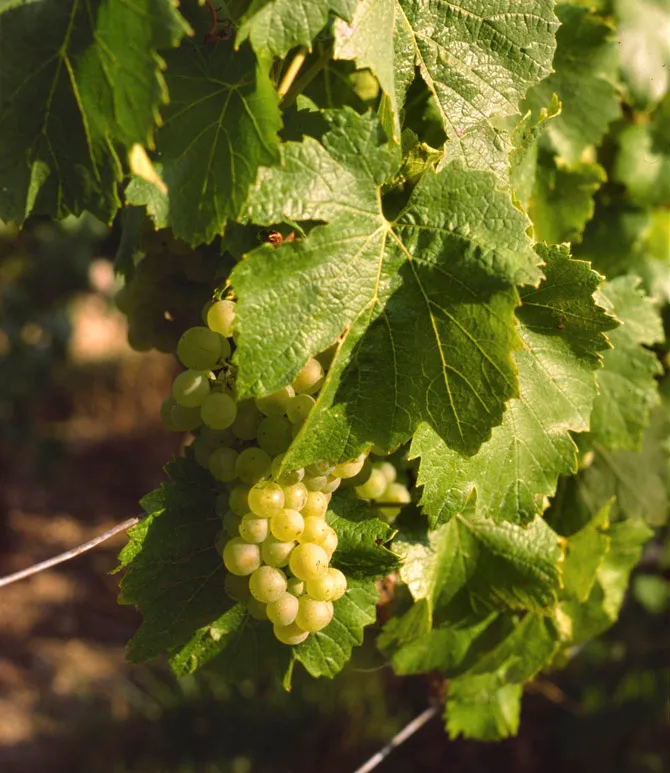
Profile: Chardonnay
| Berry colour | White grape (B) |
|---|---|
| Species / status | Vitis vinifera |
| Origin | France, Burgundy |
| Parentage | Pinot × Gouais blanc (natural cross, DNA analysis of 1999) |
| Synonyms | Beaunois, Aubaine, Melon d'Arbois, Gamay blanc, Morillon (Styria) |
| French regions | Alsace, Beaujolais, Burgundy, Champagne, Jura, Languedoc-Roussillon, Loire Valley, Savoie |
| Grown in | France, United States, Australia, Italy, Chile, South Africa, Argentina, New Zealand |
| Typical aromas | apple, citrus, white flowers, fresh butter (malolactic fermentation), hazelnut and brioche (ageing), gunflint |
| Wine style | From taut, saline dry white to full, barrel-aged white, by way of sparkling wines (blanc de blancs, crémants). |
| Food pairings | oysters and seafood (Chablis style), chicken in cream sauce, fish in sauce, pressed-curd cheeses such as comté |
| Identifiers | VIVC no. 2455, Wikidata Q213332 |
Origin: a natural child of medieval Burgundy
Chardonnay was born in Burgundy, most probably in north-east France where its two parents were grown side by side in the Middle Ages. Its name is linked to the village of Chardonnay, in Saône-et-Loire, in the Mâconnais, although it cannot be said that the grape appeared there.
For a long time it was believed to be related to pinot blanc, to the point of being called “pinot chardonnay”. Ampelography, then genetics, settled the matter: they are two different grapes.
Parentage revealed by DNA: pinot × gouais blanc
In 1999, a study published in the journal Science compared the genetic profiles (microsatellite markers) of several hundred vines. The result: chardonnay comes from a spontaneous cross between pinot and gouais blanc.
Gouais blanc was a peasant grape, productive and judged mediocre, long banned by the dukes of Burgundy. Yet it is the parent of a large share of the grapes of north-east France. The same pinot × gouais pair gave, among others:
- gamay;
- aligoté;
- melon de Bourgogne, which became the grape of muscadet.
To understand how these parentages are established, see our guide on DNA parentage of grapes.
How to recognise it in the vineyard
In ampelography, chardonnay is distinguished by a frequently cited detail: the bare petiolar vein at the base of the petiolar sinus of the leaf, meaning the sinus is bounded by the veins themselves, without leaf tissue. Its bunches are small and compact, with small berries that turn golden at ripeness.
In the vineyard, it is an early grape: it buds early, which exposes it to spring frosts, notably in Chablis where growers protect the vines with candles, frost towers or sprinkling. It also ripens early, which explains its ability to give balanced wines in cool climates.
A “transparent” grape: terroir and cellar decide
Chardonnay is not very aromatic in itself, unlike sauvignon blanc or gewurztraminer. This neutrality is its strength: it strongly expresses place and winemaking choices.
| Style | Where | What characterises it |
|---|---|---|
| Taut, saline, mineral | Chablis, Jura (topped-up), cool climates | Lively acidity, citrus, stony notes, little or no oak |
| Full, buttery, oaky | Côte de Beaune (Meursault, Puligny-Montrachet), California | Malolactic fermentation, barrel ageing, hazelnut, brioche |
| Fruity, supple | Mâconnais, IGP Pays d’Oc, New World | White and yellow fruits, drunk young |
| Sparkling | Champagne (blanc de blancs), crémants | Finesse, brioche notes after ageing on lees |
| Oxidative | Jura (under flor, in blends or alone) | Walnut, curry, spices, long keeping |
Where it is grown
In France, chardonnay is present in most northern vineyards and beyond:
- Burgundy: its cradle, from Chablis to the Mâconnais. See the grapes of Burgundy.
- Champagne: one of the three main grapes. See the grapes of Champagne.
- Jura: made in a topped-up (ouillé) or oxidative style. See the grapes of the Jura.
- Languedoc: widely planted for single-varietal IGP wines and for crémant de Limoux.
- Loire Valley: allowed as a complement in several appellations, notably for sparkling wines.
Outside France, it is grown on every wine-growing continent. Its international success, from the 1970s and 1980s, has made it one of the most planted white grapes in the world.
Chardonnay and pinot blanc: do not confuse them
The two grapes resemble each other in the vineyard and were long mixed in Burgundian plots. Pinot blanc is a colour mutation of pinot, whereas chardonnay is a child of pinot and gouais. In other words, pinot blanc is a “clone” of pinot noir, while chardonnay is its descendant.
Genealogy of Chardonnay
Identified parents (Wikidata): Pinot noir and Gouais.
Further reading
- Chardonnay or sauvignon blanc: 10 differences to know
- Official catalogue of vine varieties: registration and classification
- Grape DNA parentage: how genetics rewrote history
- Clones and mass selection: how a grape variety is propagated
- Ampelography: identifying a grape variety by its leaves and bunches
- Grape name on the label: the 85% rule
- Single-varietal or blend: two philosophies of wine
- Reading an AOC specification: grapes, yields, rules
Frequently asked questions
Is chardonnay a grape or a wine?
It is first of all a grape, that is, a vine variety. By extension the word also designates the wines made from it when the grape is named on the label, a common practice outside France and in French IGPs. In Burgundian AOCs the grape is often not stated: a Meursault or a white Chablis is nonetheless 100% chardonnay.
Who are the parents of chardonnay?
The genetic analysis published in 1999 by the team of Carole Meredith (University of California, Davis) and their French colleagues showed that chardonnay descends from a natural cross between pinot and gouais blanc. The same pair of parents gave about fifteen other grapes, including gamay, aligoté and melon de Bourgogne.
Why do some chardonnays taste of butter?
The buttery note comes mainly from malolactic fermentation, which turns malic acid into lactic acid and produces diacetyl. Ageing in oak barrels then adds notes of vanilla, hazelnut or toast. A chardonnay aged in stainless steel without malolactic fermentation, like many Chablis, does not have this profile.
Is chardonnay used in Champagne?
Yes. It is one of the three main grapes of Champagne, with pinot noir and meunier. A "blanc de blancs" champagne is generally made from chardonnay alone, in particular on the Côte des Blancs.
Related grapes
- Pinot noir (black, France, Burgundy)
- Aligoté (white, France, Burgundy)
- Gamay (black, France, Burgundy)
- Melon de Bourgogne (white, France, Burgundy)
- Pinot blanc (white, France, Burgundy (pinot mutation))
- Savagnin (white, Europe, precise origin debated (Jura and Central Europe))
- Aramon noir (black, France, Languedoc)
- Blaufränkisch (black, Central Europe, probably Lower Styria (present-day Slovenia))
Sources
- VIVC, Vitis International Variety Catalogue: entry no. 2455
- Wikidata: Q213332 (open data, CC0)
- Wikipedia: Chardonnay
- Bowers J. et al., "Historical genetics: the parentage of Chardonnay, Gamay, and other wine grapes of northeastern France", Science, 1999
- Plantgrape, catalogue of grapevine varieties grown in France (IFV, INRAE, Institut Agro Montpellier)