Aramon noir: the rise and decline of the king of the Midi vineyards
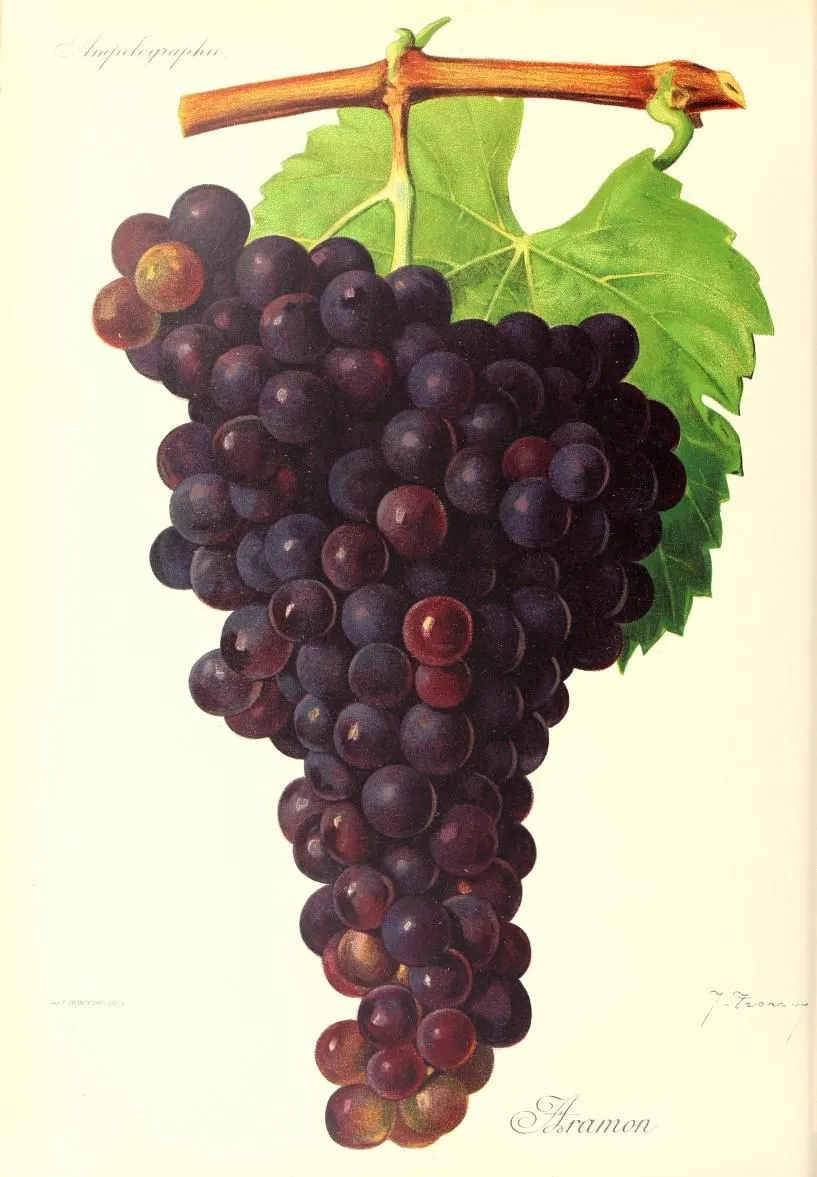
Profile: Aramon noir
| Berry colour | Black grape (N) |
|---|---|
| Species / status | Vitis vinifera |
| Origin | France, Languedoc |
| Parentage | Gouais blanc × unknown parent (DNA analysis) |
| Synonyms | Aramon, Ugni noir, Pisse-vin |
| French regions | Languedoc-Roussillon |
| Grown in | France |
| Typical aromas | fresh red fruits, redcurrant, floral notes, light pepper |
| Wine style | Pale, light, low-alcohol reds at high yields; more concentrated and fruity from old hillside vines. |
| Food pairings | charcuterie, grilled meats, everyday cooking, picnics |
| Identifiers | VIVC no. 544, Wikidata Q625777 |
Origin: a grape of the Midi, child of gouais
Aramon noir is a traditional grape of the Languedoc. Some authors have attributed a Spanish origin to it, but the south of France is still regarded as its most likely cradle.
DNA analysis has shown that it descends from gouais blanc, the peasant grape of central Europe that is also a parent of chardonnay, gamay and many varieties of north-eastern France. The other parent has not been identified. To understand these relationships, see our guide on DNA parentage of grapes.
The most planted grape in France
Aramon is the symbol of an era. In the 19th century, the railway linked the Midi to the big cities of the North. The Languedoc became an immense plain vineyard intended for everyday wine.
After phylloxera, growers replanted en masse on American rootstocks, with one priority: quantity. Aramon took hold. From the late 19th century to the 1960s, it was the most planted grape in France, before being overtaken by carignan.
Its wine, the “petit rouge” or the “gros rouge” of the bars, is pale and light. It was therefore often blended with more deeply coloured wines: wines from Algeria in the colonial era, or wines from teinturier grapes such as alicante Bouschet.
A rapid decline
Several factors hastened its decline:
- the frosts of 1956 and 1963, to which aramon, an early-budding grape, was very exposed;
- the policy of vine pulling and restructuring of the Languedoc vineyard from the 1970s, geared towards grapes judged to be of higher quality;
- the collapse in table wine consumption.
Today it remains mainly in the Hérault, on far smaller areas than in the past.
In the vineyard: a yield champion
| Trait | Aramon noir |
|---|---|
| Vigour and fertility | Very high |
| Yield | Among the highest of the vat-wine grapes, reaching several hundred hectolitres per hectare on irrigated plains |
| Budbreak | Early, hence susceptibility to spring frosts |
| Ripening | Late, suited only to hot climates |
| Resistance | Fairly good tolerance of powdery mildew |
| Wines | Pale, low in alcohol, low in tannin |
This combination of early budbreak and late ripening explains why it never left the Midi.
The little-known angle: aramon, parent of rootstocks and teinturiers
Aramon left an unexpected line of descendants.
- The Bouschet teinturiers. Louis Bouschet crossed it with teinturier du Cher to create petit Bouschet, a parent of alicante Bouschet. See teinturier grapes.
- Hybrids. The first French hybridisers crossed it with American vines to obtain direct producers.
- The AxR1 rootstock. A cross of aramon and Vitis rupestris, this rootstock was widely planted in California. Its insufficient resistance to phylloxera caused serious damage in Californian vineyards in the late 20th century. On this subject, see our guide on rootstocks and phylloxera.
The wines today
At high yields, aramon gives a pale wine with discreet red fruit aromas. From old bush vines, on slopes and poor soils, it can produce light but more concentrated, fresh and easy-drinking reds, with notes of redcurrant and pepper.
A few estates in the Languedoc-Roussillon now champion it, often as vin de France or IGP, as a testimony to regional wine heritage rather than as a mass-market wine.
Aramon, carignan, cinsault: the grapes of Languedoc table wine
In the 20th century, the everyday wine of the Midi relied on a small number of productive grapes, often blended to correct each other’s faults.
| Grape | Role in the traditional blend | Change |
|---|---|---|
| Aramon noir | Volume, lightness, pale wines | Most planted grape in France until the 1960s, then sharp decline |
| Carignan | Colour, structure, acidity | Overtook aramon in the 1960s, then declined in turn |
| Cinsault | Fruit, suppleness, rosés | Still present, notably for rosés |
| Alicante Bouschet | Colour (teinturier grape) | Sharp decline since the 1950s |
This model disappeared with the restructuring of the vineyard and the rise of appellations and IGPs. The old aramon vines that survive are now seen as a genetic and landscape heritage, and sometimes as an asset in the face of heat, thanks to the grape’s late ripening.
Further reading
Frequently asked questions
Why was aramon planted so widely?
After the phylloxera crisis, Languedoc growers replanted massively on the plains with a grape capable of very high yields. Aramon met the demand of a market opened up by the railway: cheap wine for the cities and workers of the North. It thus became the most planted grape in France until the 1960s.
Can aramon make good wine?
Grown on fertile plains at very high yields, it gives a pale, low-alcohol and dilute wine. On poor soils, with severe pruning and old vines, it can produce more concentrated, fruity and easy-drinking reds. A few Languedoc growers now make vin de France or IGP cuvées from it.
What is the link between aramon and alicante Bouschet?
Aramon is the grandparent of alicante Bouschet. Louis Bouschet crossed it with teinturier du Cher to obtain petit Bouschet, which his son Henri then crossed with grenache. The aim was to colour aramon wines, which were too pale.
Is there a white aramon?
Yes. Aramon blanc and aramon gris are colour mutations of aramon noir. They survive on very small areas, mainly in the Hérault.
Related grapes
- Alicante Bouschet (black, France, Hérault (Languedoc))
- Carignan (black, Spain, Aragon (Cariñena region))
- Cinsault (black, France, Languedoc (probable))
- Grenache noir (black, Spain, Aragon (origin disputed with Sardinia))
- Ugni blanc (white, Italy, central Italy)
- Gamay (black, France, Burgundy)
- Blaufränkisch (black, Central Europe, probably Lower Styria (present-day Slovenia))
- Chardonnay (white, France, Burgundy)