Ugni blanc: the Italian trebbiano that became the cognac grape
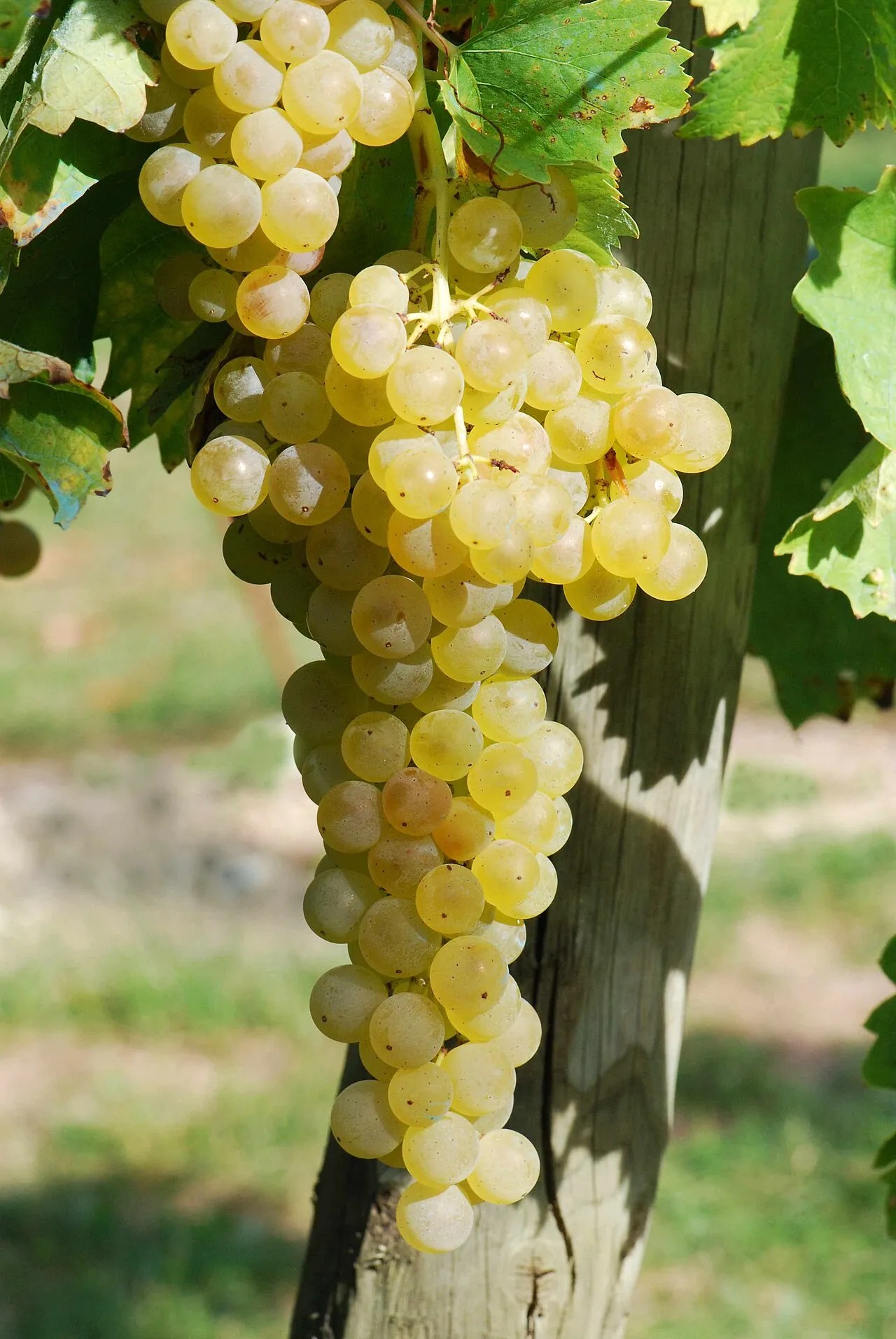
Profile: Ugni blanc
| Berry colour | White grape (B) |
|---|---|
| Species / status | Vitis vinifera |
| Origin | Italy, central Italy |
| Synonyms | Trebbiano toscano (Italy), Saint-Émilion des Charentes, Clairette ronde, Procanico (Italy) |
| French regions | Bordeaux, Corsica, Languedoc-Roussillon, Provence, Rhône Valley, South-West France |
| Grown in | France, Italy, Argentina, Brazil, Uruguay, Australia |
| Typical aromas | lemon, green apple, discreet white flowers, almond, light herbaceous notes |
| Wine style | Light, acidic and neutral dry white wines, intended mainly for distillation or blending. |
| Food pairings | aperitif, seafood, grilled fish, light Provençal cooking |
| Identifiers | VIVC no. 12628, Wikidata Q967934 |
Origin: the trebbiano of central Italy
Ugni blanc is of Italian origin. It corresponds to trebbiano toscano, grown in central Italy for a very long time. Its name is sometimes linked to the vinum trebulanum mentioned by Pliny the Elder, but this connection has not been demonstrated: the term may refer to a place or a practice rather than a grape.
It is thought to have reached France via Provence and the Rhône Valley, where it has been grown for several centuries. In the Charentes, it was long called saint-émilion des Charentes.
Be careful: in Italy, the name trebbiano covers several distinct varieties, not all of which are ugni blanc. See the guide synonyms and homonyms.
In the vineyard
Ugni blanc is a very productive grape with late budburst, which protects it from spring frosts, and late ripening. It needs a long season to ripen.
It resists grey rot fairly well, but is susceptible to powdery and downy mildew, as well as to certain trunk diseases. In southern France, its high acidity is used to make up for the lack of freshness of other white grapes.
The cognac angle: why ugni blanc took over
Ugni blanc owes its importance to a crisis: phylloxera, at the end of the 19th century.
Before that crisis, the Charentes vineyard relied largely on folle blanche. During replanting on American rootstocks, folle blanche proved difficult: finding a good rootstock for it was complicated, and it was very susceptible to grey rot. See the guide rootstocks and phylloxera.
Ugni blanc, by contrast, offered the qualities sought for the still:
| Trait | Benefit for distillation |
|---|---|
| Low alcohol | Concentrates the aromas more during double distillation |
| Very high acidity | The wine keeps all winter without sulphur, before distillation |
| Aromatic neutrality | Lets the aromas of distillation and cask ageing come through |
| Productivity and consistency | Sufficient volumes for the spirit |
| Late budburst | Lower risk of spring frost |
It has become the overwhelmingly dominant grape of cognac, where the specification also permits colombard, folle blanche and montils, among others, in minimal proportions in practice.
In Armagnac, ugni blanc is also the main grape, alongside colombard, folle blanche and baco blanc, a permitted hybrid. See the grapes of South-West France.
The wines
As a still wine, ugni blanc makes dry, light, lively and not very aromatic whites: lemon, green apple, sometimes almond. It is found:
- under IGP Côtes de Gascogne, often blended with colombard;
- in Provence, notably in the whites of Cassis and Côtes de Provence as part of a blend, with clairette or vermentino. See the grapes of Provence;
- in Languedoc and Corsica, as a supporting grape.
Its area in France is large but declining outside the distillation zones.
In Italy and elsewhere
In Italy, trebbiano toscano goes into many white wines from the centre of the country. It was also long permitted in the blend of red Chianti with sangiovese, a practice now abandoned in Chianti Classico.
Outside Europe, it is grown notably in Argentina, Brazil, Uruguay and Australia, often for base wines or distillation.
Frequently asked questions
Which grape is cognac made from?
Cognac is overwhelmingly made from ugni blanc. Other grapes are permitted by the specification, such as colombard, folle blanche or montils, but they occupy only a minimal place. Ugni blanc took over after the phylloxera crisis.
Are ugni blanc and trebbiano the same grape?
Yes, ugni blanc corresponds to Italy's trebbiano toscano. Be careful, though: in Italy, the name trebbiano refers to several distinct grapes (trebbiano d'Abruzzo, trebbiano di Soave, etc.), not all of which are ugni blanc.
Why is ugni blanc suited to distillation?
It makes wines that are low in alcohol, very acidic and not very aromatic. This acidity protects the wine through the winter before distillation, without added sulphur, and the aromatic neutrality lets the aromas born of distillation and cask ageing come through.
Can ugni blanc be drunk as a wine?
Yes. It goes into dry whites under IGP Côtes de Gascogne, in Languedoc and in Provence, often in blends. These are light, lively wines to drink young. In Italy, trebbiano toscano goes into many whites from the centre of the country.
Related grapes
- Colombard (white, France, Charentes)
- Baco blanc (white, France, Landes (Bélus))
- Sémillon (white, France, Bordeaux region)
- Clairette (white, France, Midi)
- Vermentino (white, Western Mediterranean (exact origin unknown))
- Sangiovese (black, Italy, Tuscany)