Clairette: a southern white grape with many homonyms
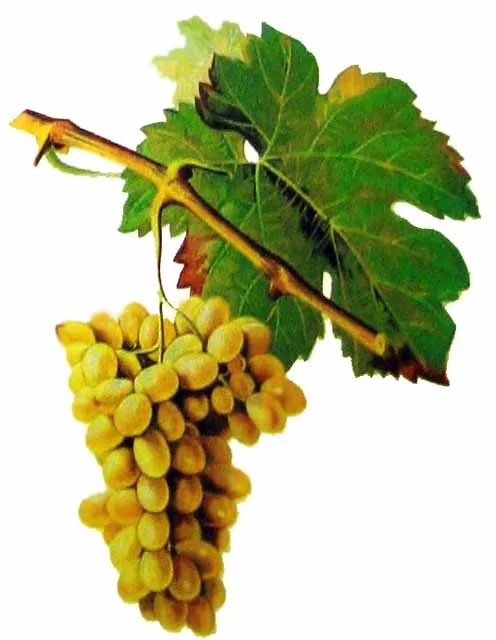
Profile: Clairette
| Berry colour | White grape (B) |
|---|---|
| Species / status | Vitis vinifera |
| Origin | France, Midi |
| Synonyms | Clairette blanche, Blanquette, Clairette verte, Petite clairette |
| French regions | Languedoc-Roussillon, Provence, Rhône Valley |
| Grown in | France, South Africa, Australia, Italy (Sardinia) |
| Typical aromas | white flowers, apple, fennel, white peach, almond, oxidative notes (rancio) with ageing |
| Wine style | Full-bodied, low-acid dry white, base of sparkling wines at Die, and formerly of oxidative rancio-style wines. |
| Food pairings | shellfish and tielle sétoise, grilled fish, brandade de morue, goat's cheeses |
| Identifiers | VIVC no. 2695, Wikidata Q456763 |
Clairette, an old white grape of the Midi
Clairette is one of the oldest white grapes grown in southern France. It is found in the Rhône Valley, in Provence and in Languedoc-Roussillon. Its name is said to evoke the clarity of its berries or its wines.
Its plantings have fallen markedly over recent decades, in favour of more aromatic or more acidic grapes. It nevertheless remains an important part of southern grape varieties.
One name, many confusions
The word “clairette” is a homonym trap. It names the grape, but it also appears in regional synonyms of other varieties with no direct link to it, such as bourboulenc or ugni blanc. Conversely, clairette has synonyms such as “blanquette”, which also names mauzac in Limoux.
These overlaps are analysed in the guide on synonyms and homonyms.
The niche angle: Clairette de Die is not always made from clairette
The most famous of the “clairettes” is a sparkling wine from the Drôme, Clairette de Die. Yet its best-selling version, the méthode ancestrale known as “tradition”, is mostly made from muscat à petits grains. It is the muscat that gives it its aromas of fresh grapes and flowers.
| Wine | Grapes | Method | Profile |
|---|---|---|---|
| Clairette de Die méthode ancestrale | Muscat à petits grains in the majority, clairette as a complement | A single fermentation, finished in the bottle | Sweet, low in alcohol, muscat-scented |
| Clairette de Die brut | Clairette | Traditional method | Dry, more neutral |
| Crémant de Die | Clairette in the majority, with aligoté and muscat | Traditional method | Dry, fresh |
| Coteaux de Die | Clairette | Still wine | Dry white |
The pure clairette appellations
Two appellations bear the name of the grape and use it on its own:
- Clairette du Languedoc, in the Hérault, which produces dry whites, sweet wines and rancio-type wines, from deliberate oxidative ageing;
- Clairette de Bellegarde, a small appellation of the Gard, at the gates of the Camargue.
Clairette also goes into many whites of the southern Rhône and Provence. At Châteauneuf-du-Pape, it is one of the permitted grapes and is among the most planted whites of the appellation.
In the vineyard and the cellar: a grape that oxidises
Clairette enjoys heat and drought. It gives musts rich in sugar and low in acidity, hence high-alcohol wines that can seem heavy. It is best known for its strong susceptibility to oxidation.
This apparent flaw was long exploited: oxidative clairettes and rancios drew their character from it. Modern winemaking, protected from air and at low temperature, makes it possible instead to obtain floral dry whites. It is readily blended with more acidic grapes, such as piquepoul.
The wines: flowers, fennel and roundness
Clairette whites are full and round, with notes of white flowers, apple, white peach and sometimes fennel. They are generally drunk young. Oxidative cuvées develop notes of walnut, toasted almond and dried fruit.
Outside France, clairette is grown in South Africa, notably for sparkling wines, as well as in Australia and Sardinia.
Frequently asked questions
Is Clairette de Die made with clairette?
Not mainly, in its best-known version. Clairette de Die méthode ancestrale (known as "tradition") is made mostly from muscat à petits grains, with clairette playing only a secondary role. Clairette de Die brut and Crémant de Die, on the other hand, give a large place to clairette.
What is Clairette du Languedoc?
It is an AOC of the Hérault département, made only from clairette blanche. It produces dry whites, but also sweet wines and rancio-style wines, from prolonged oxidative ageing.
Is clairette used in Châteauneuf-du-Pape?
Yes, clairette is one of the grapes permitted in Châteauneuf-du-Pape, in whites and as a complement in reds. It is even one of the most planted white grapes there, alongside grenache blanc, roussanne and bourboulenc.
Is there a pink clairette?
Yes, clairette rose is a colour mutation of clairette blanche. It is much less widespread and is used in blends, like clairette blanche.
Related grapes
- Muscat à petits grains (white, Mediterranean basin (precise origin unknown))
- Piquepoul blanc (white, France, Languedoc)
- Ugni blanc (white, Italy, central Italy)
- Vermentino (white, Western Mediterranean (exact origin unknown))
- Roussanne (white, France, northern Rhône Valley)
- Grenache noir (black, Spain, Aragon (origin disputed with Sardinia))