Roussanne: the fine, fragile white of the Rhône and Savoie
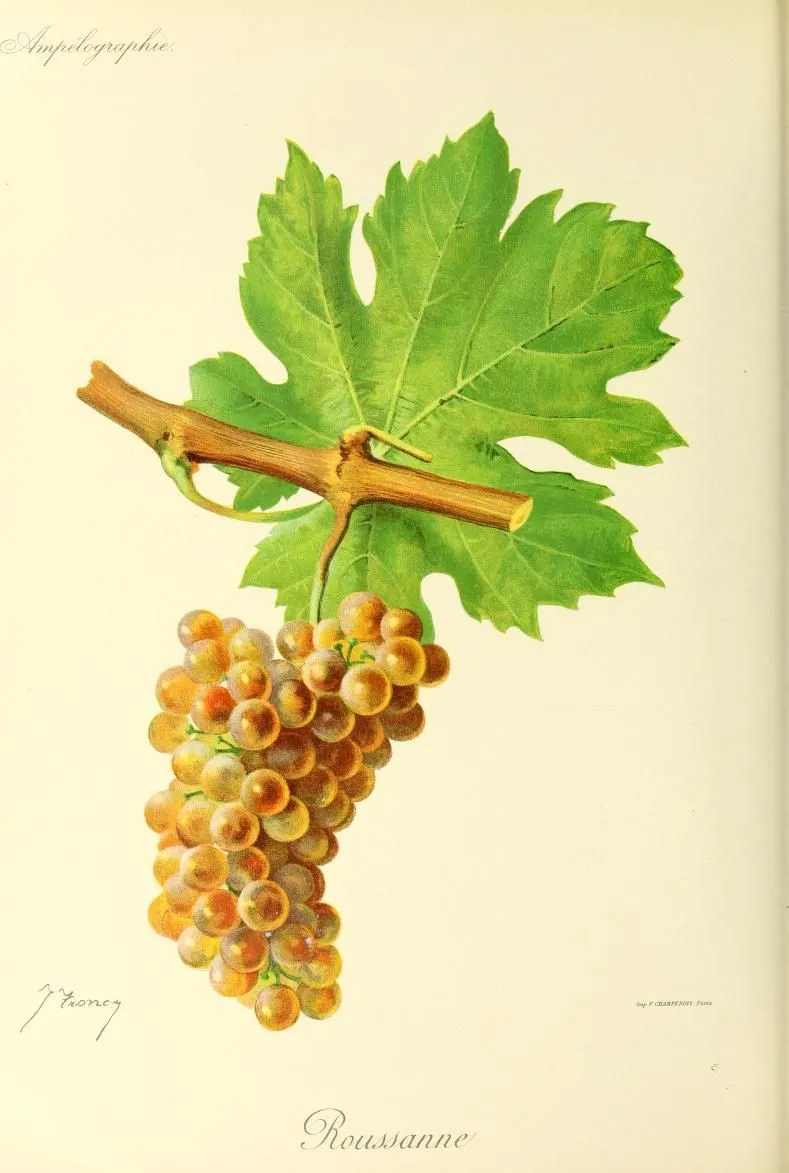
Profile: Roussanne
| Berry colour | White grape (B) |
|---|---|
| Species / status | Vitis vinifera |
| Origin | France, northern Rhône Valley |
| Synonyms | Bergeron (Savoie) |
| French regions | Languedoc-Roussillon, Provence, Rhône Valley, Savoie |
| Grown in | France, United States, Australia, Italy |
| Typical aromas | pear, lime blossom and verbena, white flowers, apricot, honey and wax (with age), herbal tea notes |
| Wine style | Fine, fragrant dry whites, with more tension than marsanne, capable of ageing well. |
| Food pairings | lake fish (féra, Arctic char), roast poultry, Savoie cheeses (Beaufort), dishes with herbs, shellfish |
| Identifiers | VIVC no. 10258, Wikidata Q1414052 |
Origin: a name taken from the colour of the berries
Roussanne is a grape of the northern Rhône Valley, long grown on the slopes of Hermitage and the surrounding area. Its name comes from the russet tint its berries take on when ripe. It should not be mistaken for a grey or pink grape: it is indeed a white grape, coded B in the official catalogue (see grape colour codes).
In the vineyard: a demanding grape
Roussanne is reputed to be difficult. The traits most often cited:
- a marked susceptibility to powdery mildew, rot and wind;
- irregular yields from one year to the next;
- late ripening, sometimes uneven within the same bunch.
These shortcomings explain why, in the 20th century, many northern Rhône growers preferred the more reliable marsanne. Selection work then made healthier plant material available, and roussanne regained a place, notably in the southern Rhône and the Languedoc.
The wines: finesse and tension
Compared with marsanne, roussanne makes more fragrant and taut wines: pear, lime blossom, white flowers, sometimes apricot. With age, they develop towards honey, wax and dried fruit. It takes well to barrel ageing.
| Where | Appellations | Use of roussanne |
|---|---|---|
| Northern Rhône | Hermitage, Crozes-Hermitage, Saint-Joseph, Saint-Péray | Blended with marsanne |
| Southern Rhône | Châteauneuf-du-Pape, Côtes du Rhône | Blended whites; also permitted as a supporting grape in Châteauneuf reds |
| Savoie | Vin de Savoie Chignin-Bergeron | Sole grape, under the name bergeron |
| Languedoc, Provence | Various AOCs and IGPs | Blended whites, varietal wines as IGP |
Châteauneuf-du-Pape: what sets it apart from marsanne
In the southern Rhône, roussanne has a regulatory advantage: it is among the permitted grapes of Châteauneuf-du-Pape, alongside notably clairette, grenache blanc and bourboulenc, whereas marsanne is not permitted there. Some estates make white cuvées in which it dominates. See the grapes of the Rhône Valley.
Savoie: roussanne becomes bergeron
Roussanne’s most original angle is in Savoie. Around the village of Chignin, in the Combe de Savoie, it goes by the name bergeron and makes Chignin-Bergeron, a designation of the Vin de Savoie AOC reserved for this grape.
Planted on well-exposed slopes of limestone scree, it makes richer and more fragrant whites there than those of jacquère, the most common white grape in Savoie. Altesse, another white Savoie grape, shares with it a reputation for age-worthy wines. See the grapes of Savoie.
This case clearly illustrates the logic of regional names: the same grape, two names depending on the vineyard (see synonyms and homonyms).
Elsewhere in the world
Outside France, roussanne is grown in small quantities in California, Australia and Italy (Tuscany, Liguria). In California, some of the vines imported as roussanne turned out to be viognier, a confusion confirmed by DNA analysis in the late 1990s.
To compare the two white grapes of the northern Rhône, see the comparison marsanne or roussanne.
Further reading
Frequently asked questions
Why is roussanne called that?
Its name comes from the colour of its berries, which take on a russet, coppery tint when fully ripe. The grape is nevertheless classified as white (B): the juice is colourless and it makes only white wines.
What is Chignin-Bergeron?
It is a designation within the Vin de Savoie AOC, around the village of Chignin, reserved for wines made from roussanne, locally called bergeron. These wines are richer and more fragrant than the jacquère whites of the same area.
Is roussanne permitted in Châteauneuf-du-Pape?
Yes. Roussanne is among the permitted grapes of the Châteauneuf-du-Pape appellation, in whites and as a supporting grape in the reds. Marsanne, on the other hand, is not permitted there.
What is the difference between roussanne and marsanne?
Roussanne is finer, more aromatic and livelier, but irregular and susceptible to disease. Marsanne is more productive, rounder and easier to grow. Blending them aims to combine the finesse of the one with the breadth of the other.