Altesse: roussette, Savoie's great age-worthy white
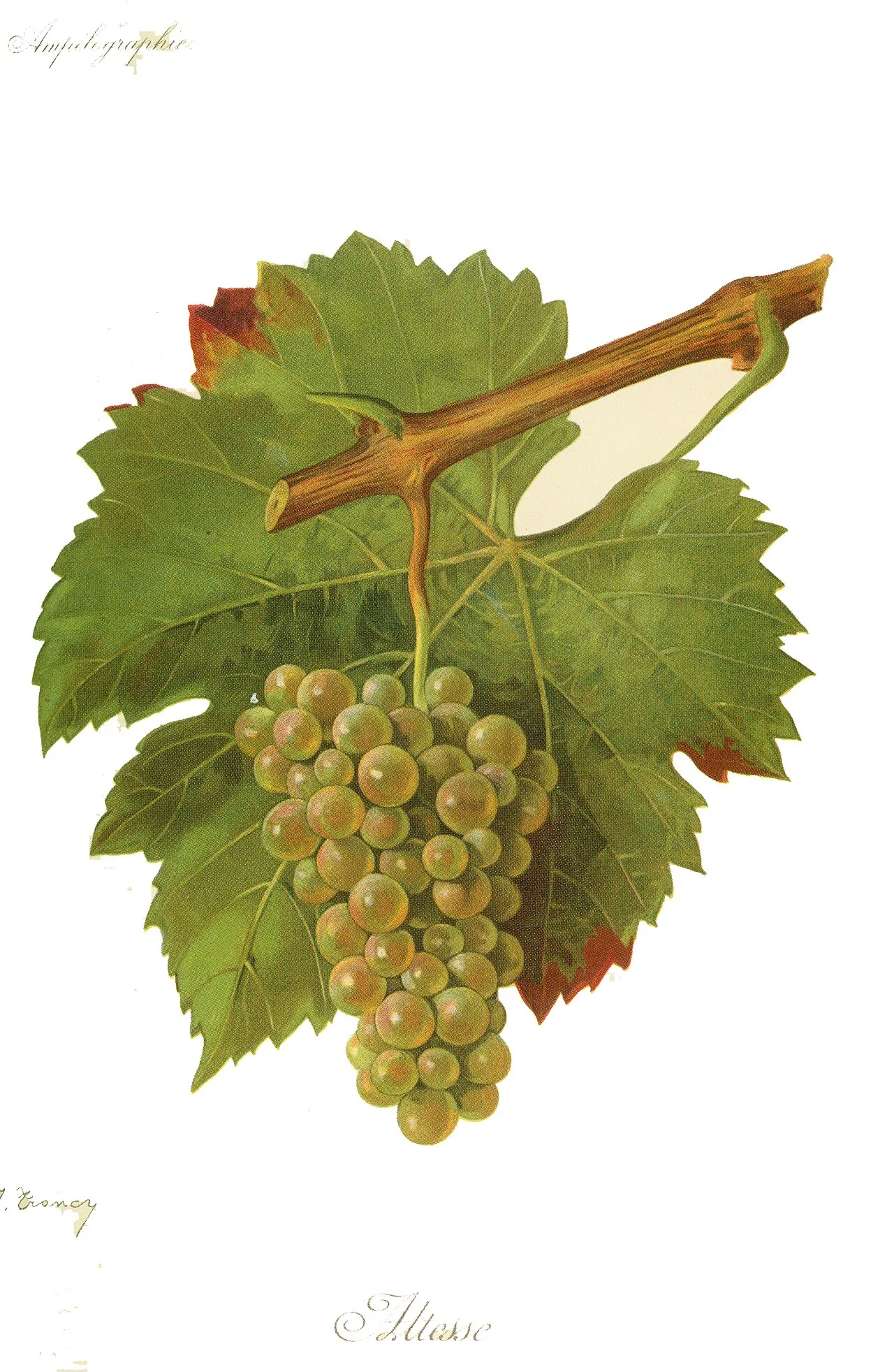
Profile: Altesse
| Berry colour | White grape (B) |
|---|---|
| Species / status | Vitis vinifera |
| Origin | France, Savoie (origin disputed) |
| Synonyms | Roussette, Altesse verte, Fusette, Prin blanc |
| French regions | Savoie |
| Grown in | France |
| Typical aromas | citrus, bergamot, aromatic herbs, exotic fruits, almond, honey and hazelnut (with age) |
| Wine style | Lively, aromatic dry white that ages well, made with or without oak; also used in sparkling wines. |
| Food pairings | lake fish with beurre blanc, Bresse poultry in cream, mature beaufort and comté, crayfish |
| Identifiers | VIVC no. 354, Wikidata Q439808 |
Altesse, or roussette: Savoie’s great white
Altesse is a white grape grown in Savoie and in Bugey. It is the sole grape of the Roussette de Savoie and Roussette du Bugey appellations. Less widespread than jacquère, it is considered the highest-quality white grape of these Alpine vineyards.
The name “roussette” is said to come from the golden, almost russet colour its berries take on at ripeness.
A disputed origin and a Cypriot legend
The origin of altesse is the subject of conflicting accounts. The most widespread legend in Savoie says it was brought back from Cyprus in the Middle Ages, on the occasion of the marriage of a Cypriot princess to a prince of Savoy. The name “altesse” (highness) is said to echo this princely ancestry.
Nothing confirms this story. A French, regional origin is now judged more likely. An ampelographic resemblance to Hungarian furmint has also been noted in the past, although no genetic relationship has been established to date. On the use of such resemblances, see the guide ampelography: recognising a grape variety.
Regulations that have become strict
Altesse illustrates a movement to refocus appellations on their signature grape:
| Appellation | Current rule | Change |
|---|---|---|
| Roussette de Savoie | 100% altesse | Since the 2001 vintage; blending with chardonnay was previously possible |
| Roussette du Bugey | 100% altesse | Since the 2009 vintage |
| Seyssel | Altesse for still whites | Old Haut-Rhône appellation |
| Vin de Savoie, Bugey (whites and sparkling) | Blending possible | Supporting role |
To read this kind of rule in the official texts, see the guide reading an AOC specification.
The four crus of Roussette de Savoie
The Roussette de Savoie name can be completed by one of four geographical designations: Frangy, Marestel, Monthoux and Monterminod. These slopes, often steep and well exposed, allow altesse to ripen fully.
Marestel, at Jongieux, is probably the best known: its vines, planted on very steep slopes, overlook the Rhône valley.
In the vineyard: late-ripening and low-yielding
Altesse is a late-ripening grape with low yields. It therefore needs good exposures in the cool climate of the Alps. In return, it has good resistance to grey rot, which is valuable in this damp vineyard.
These characteristics explain its limited area: a few hundred hectares in France, far less than jacquère.
The wines: liveliness, aromas and ageing
Roussette de Savoie is a dry white with lively acidity and more pronounced aromas than those of jacquère: citrus, bergamot, aromatic herbs, sometimes exotic fruits. It is made in tank or in barrel depending on the estate.
Its great quality is its ageing ability: after a few years, it develops notes of honey, almond and hazelnut, while remaining taut. It pairs with lake fish in sauce, poultry in cream and mature Alpine cheeses.
To place altesse among its neighbours, see the grapes of Savoie, where mondeuse noire and chasselas are also found.
Frequently asked questions
What is the difference between altesse and roussette?
They are the same grape. Altesse is the name of the grape, Roussette is the traditional name of the wine and appellation, as in "Roussette de Savoie" or "Roussette du Bugey". The term roussette is also used locally to refer directly to the grape.
Does altesse come from Cyprus?
A Savoyard legend says the grape was brought back from Cyprus in the Middle Ages, on the occasion of a princely wedding. No evidence supports this story, and a French, Savoyard origin is judged more likely.
What are the crus of Roussette de Savoie?
Four designations can be added to the name Roussette de Savoie: Frangy, Marestel, Monthoux and Monterminod. They correspond to slopes renowned for altesse. Marestel, on steep slopes overlooking the Rhône at Jongieux, is often cited as the most prestigious.
Does Roussette de Savoie age well?
Yes, it is one of the few Savoie whites reputed for ageing ability. With a few years in bottle, altesse develops notes of honey, hazelnut and dried fruit, while keeping its liveliness.
Related grapes
- Jacquère (white, France, Savoie)
- Chasselas (white, Switzerland, west of the country (Lake Geneva region))
- Roussanne (white, France, northern Rhône Valley)
- Mondeuse noire (black, France, Dauphiné (probable), Savoie)
- Chardonnay (white, France, Burgundy)
- Furmint (white, Hungary, Tokaj (probable origin))