Viognier: the Condrieu grape saved from extinction
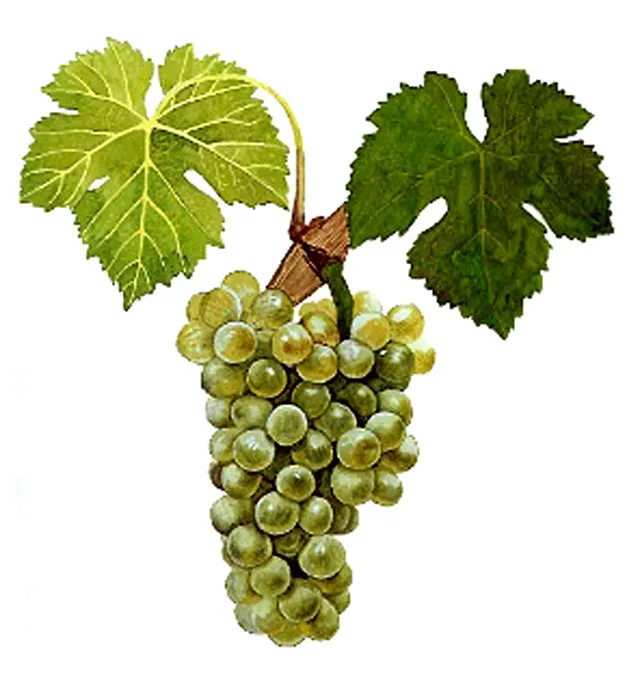
Profile: Viognier
| Berry colour | White grape (B) |
|---|---|
| Species / status | Vitis vinifera |
| Origin | France, northern Rhône Valley |
| Parentage | Not established; genetically close to Piedmont's freisa (DNA analysis, UC Davis) |
| French regions | Languedoc-Roussillon, Rhône Valley |
| Grown in | France, United States, Australia, South Africa, Chile, Argentina |
| Typical aromas | apricot, yellow peach, violet, acacia flowers, sweet spices, musk |
| Wine style | Full, rich, fragrant dry whites with moderate acidity, best drunk fairly young to enjoy their fruit. |
| Food pairings | poultry in cream sauce, dishes with sweet spices, shellfish (langoustines, lobster), mature goat's cheeses (rigotte de Condrieu) |
| Identifiers | VIVC no. 13106, Wikidata Q965255 |
Origin: a grape of the northern Rhône
Viognier is a historical grape of the right bank of the Rhône, south of Vienne, around Condrieu. Stories that it came from Dalmatia in Roman times belong to legend and have not been demonstrated.
Its parentage remains unknown. DNA analyses carried out at the University of California, Davis showed it to be genetically close to freisa, a red grape from Piedmont, without the exact nature of the link being settled. For the methods, see DNA parentage of grape varieties.
A spectacular revival
Viognier is a textbook case of a grape saved just in time. In the mid-1960s, only a few hectares remained in France, mainly in Condrieu and Château-Grillet. The terraced slopes, hard to work, were being abandoned, and the grape, with its low and irregular yields, no longer appealed.
Growing interest in Condrieu wines from the 1980s, followed by the fashion for varietal wines, reversed the trend. Viognier was replanted in the Rhône Valley, then massively in Languedoc as IGP, before reaching California, Australia, South Africa and South America.
It is now the example often cited of a variety that went from near extinction to worldwide spread. See also the guide on grape conservatories, which explains how the genetic heritage of threatened varieties is preserved.
In the vineyard
Viognier is a difficult grape: susceptible to coulure, it gives low and irregular yields. It tolerates heat and drought well.
The timing of the harvest is crucial: its characteristic aromas appear only at full ripeness, while acidity falls quickly. Picked too early, it lacks perfume; too late, it becomes heavy and alcoholic.
The wines: apricot, violet and texture
Viognier makes full, rich white wines, often high in alcohol and low in acidity, with a very expressive nose: apricot, peach, violet, white flowers, sometimes sweet spices. Together with muscat à petits grains and gewurztraminer, it is one of the so-called aromatic white grapes.
| Appellation or use | Role of viognier |
|---|---|
| Condrieu (AOC) | Sole grape, dry white (sometimes with residual sugar) |
| Château-Grillet (AOC) | Sole grape, small appellation enclosed within Condrieu |
| Côte-Rôtie (AOC, red) | Co-fermented with syrah, in a proportion limited by the specification |
| Côtes du Rhône and southern Rhône | Supporting grape in whites, with marsanne, roussanne, grenache blanc |
| IGP Pays d’Oc | Varietal wines, often named on the label |
Viognier in Côte-Rôtie
Viognier’s most unusual feature is its role in a red wine. The Côte-Rôtie specification allows viognier to be added to syrah, provided it is vinified at the same time (co-fermentation), within a limit set by the text.
The explanations put forward: co-fermentation is said to stabilise the colour through co-pigmentation and to add a floral note. In practice, the actual proportion varies widely between estates, and many Côte-Rôties are pure syrah. The principle has been taken up elsewhere, notably in Australia, with shiraz-viognier blends.
To read this type of rule, see reading an AOC specification.
Where it is grown
In France, viognier is found in the northern and southern Rhône Valley, and widely in Languedoc-Roussillon, mainly as IGP. It often accompanies marsanne and roussanne in southern French white blends.
Abroad, it is found in California (where it was championed by a group of producers nicknamed the “Rhône Rangers”), Virginia, Australia, South Africa, Chile and Argentina.
Further reading
Frequently asked questions
Which grape is Condrieu made from?
Condrieu is made exclusively from viognier. This northern Rhône appellation, on the right bank of the river south of Vienne, is the world reference for the grape. Château-Grillet, a small appellation enclosed within Condrieu, is also a viognier wine.
Why is viognier put into Côte-Rôtie?
The specification for Côte-Rôtie, a red wine based on syrah, allows viognier to be added in a limited proportion, provided it is vinified together with the syrah. This co-fermentation is said to stabilise the colour and add floral notes. Many producers use little or none.
Did viognier almost disappear?
Yes. In the mid-1960s, only a few hectares of viognier remained in France, concentrated around Condrieu. Demand from wine lovers in the following decades revived its cultivation, first in France and then worldwide.
Does viognier age well?
Most viogniers are drunk young, in their first few years, when their fruit is most expressive, because their acidity is moderate. Some Condrieu and Château-Grillet wines develop for longer, but it is not a grape known for very long ageing.
Related grapes
- Syrah (black, France, northern Rhône Valley)
- Marsanne (white, France, northern Rhône valley)
- Roussanne (white, France, northern Rhône Valley)
- Muscat à petits grains (white, Mediterranean basin (precise origin unknown))
- Chardonnay (white, France, Burgundy)