Colombard: the distilling grape that became a Gascon white
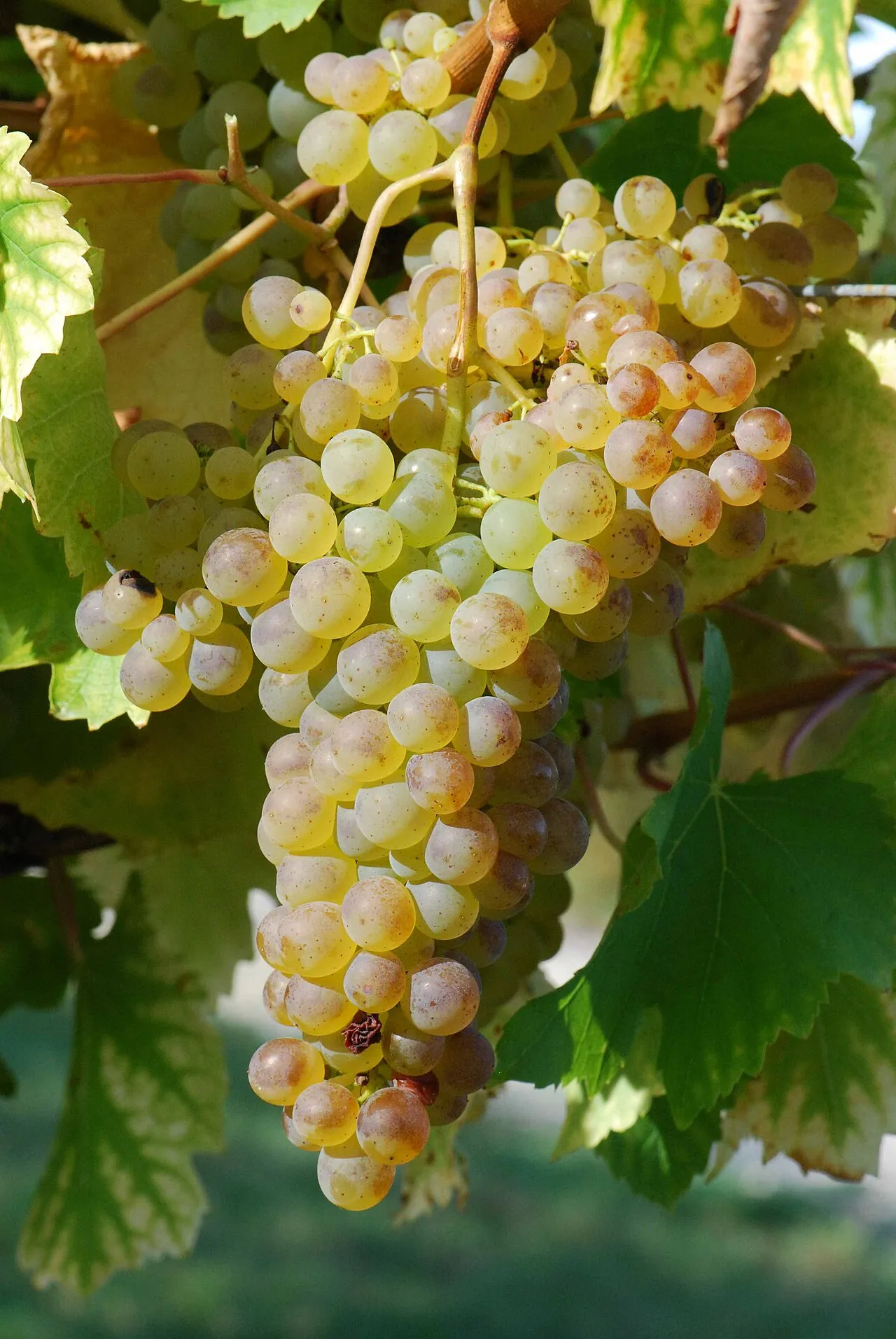
Profile: Colombard
| Berry colour | White grape (B) |
|---|---|
| Species / status | Vitis vinifera |
| Origin | France, Charentes |
| Parentage | Chenin blanc × Gouais blanc (natural cross, DNA analysis) |
| Synonyms | French Colombard (United States) |
| French regions | Bordeaux, South-West France |
| Grown in | France, South Africa, United States, Australia |
| Typical aromas | citrus (grapefruit), exotic fruit, box tree, white flowers, green apple |
| Wine style | Lively, light, aromatic dry whites to drink young; base for distilling wines. |
| Food pairings | aperitif, seafood, mixed salads, grilled fish, light Asian cooking |
| Identifiers | VIVC no. 2771, Wikidata Q1110390 |
Origin: the Charentes
Colombard is a grape of the Charentes, long grown in western France to produce distilling wines. It has also historically been present in the north of the Bordeaux area (Blayais, Bourgeais).
Parentage: chenin × gouais blanc
DNA analysis has established that colombard comes from a natural cross between chenin blanc and gouais blanc. This same pair of parents gave:
- meslier saint-françois, another old distilling grape of the Charentes and Armagnac;
- balzac blanc.
Colombard is thus a grandchild of savagnin, through chenin. Gouais blanc, present across much of medieval Europe, is a recurring parent of French grapes. See the DNA parentage of grapes.
In the vineyard
Colombard is a vigorous and productive grape of medium ripening. It is susceptible to powdery mildew and, depending on the situation, to grey rot. It keeps a high acidity, a quality sought both for distillation and for fresh whites.
From still to glass: the colombard angle
Colombard went through a conversion that sums up the history of several South-West grapes.
The time of distillation. In the Charentes and in Armagnac, white grapes were mainly used to produce wines low in alcohol and very acidic, destined for the still. Colombard was part of this landscape, alongside folle blanche and then ugni blanc, which became the large majority in cognac.
The Gascon conversion. From the end of the 20th century, part of the Gers vineyards bet on dry white wine rather than on brandy alone. Colombard, picked at good ripeness and vinified at low temperature, revealed a lively, aromatic profile there: grapefruit, exotic fruit, box tree. It became a pillar of the IGP Côtes de Gascogne. See the grapes of the South-West.
| Use | Region | Role of colombard |
|---|---|---|
| Cognac | Charentes | Permitted grape, now very much in the minority against ugni blanc |
| Armagnac | Gers, Landes, Lot-et-Garonne | Permitted grape, with ugni blanc, baco blanc and folle blanche |
| Floc de Gascogne | Gascony | Mistelle (must and armagnac), among the white grapes used |
| Dry white wine | IGP Côtes de Gascogne | Major grape, alone or in blends |
| Dry white wine | Bordeaux (Blaye, Bourg) | Minor grape in whites |
In Armagnac, it sits alongside baco blanc, a hybrid still permitted there, a rare case in an appellation.
French Colombard in the New World
Outside France, colombard is very widely planted in South Africa, where it serves both for white wines and for brandy distillation. In California, under the name French Colombard, it was long one of the most widely grown white grapes, mainly in the Central Valley, for entry-level wines and blends. It is also found in Australia.
This journey, from Charentes stills to varietal wines around the world, illustrates well the logic of the guide on single grape or blend: a supporting grape can find a second life when it is vinified on its own.
Frequently asked questions
Is colombard used to make cognac?
It is permitted in cognac and traditionally was, but it is now very much in the minority there: ugni blanc largely dominates the Charentes vineyard. In armagnac, colombard is also among the permitted grapes.
Who are the parents of colombard?
DNA analysis has shown that colombard comes from a natural cross between chenin blanc and gouais blanc. The same pair of parents gave meslier saint-françois and balzac blanc.
What is a white côtes-de-gascogne?
It is a white wine with an IGP (protected geographical indication) produced in the Gers and surrounding area. It is often made from colombard, alone or blended with ugni blanc, gros manseng or sauvignon, and is characterised by its liveliness and its aromas of citrus and exotic fruit.
Related grapes
- Chenin blanc (white, France, Loire Valley (Anjou-Touraine))
- Ugni blanc (white, Italy, central Italy)
- Baco blanc (white, France, Landes (Bélus))
- Gros manseng (white, France, Pyrenean foothills (Béarn, Basque Country))
- Sauvignon blanc (white, France, Loire Valley or South-West France)
- Sémillon (white, France, Bordeaux region)
- Gamay (black, France, Burgundy)
- Aramon noir (black, France, Languedoc)