Chenin blanc: the most versatile grape of the Loire
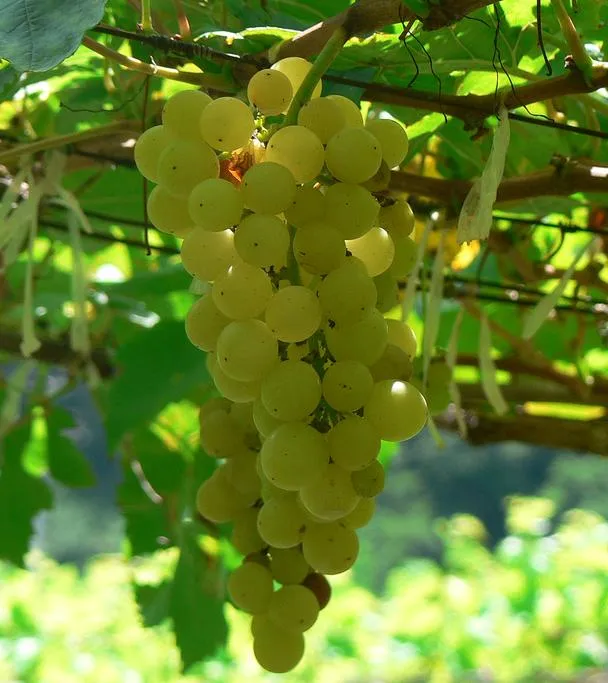
Profile: Chenin blanc
| Berry colour | White grape (B) |
|---|---|
| Species / status | Vitis vinifera |
| Origin | France, Loire Valley (Anjou-Touraine) |
| Parentage | Descendant of savagnin (DNA analysis of 1999); probable half-sibling of sauvignon blanc |
| Synonyms | Chenin, Pineau de la Loire, Steen (South Africa) |
| French regions | Languedoc-Roussillon, Loire Valley |
| Grown in | France, South Africa, United States, Argentina, Australia, New Zealand |
| Typical aromas | apple and quince, pear, white flowers and lime blossom, honey and beeswax, candied fruit (sweet wines), saline notes |
| Wine style | From taut dry whites to noble-rot sweet wines, by way of off-dry wines and fine bubbles, all carried by marked acidity. |
| Food pairings | fish with beurre blanc, rillettes and Loire cuisine, poultry with mushrooms, apple tart (medium-sweet), blue cheeses (sweet wines) |
| Identifiers | VIVC no. 2527, Wikidata Q1070101 |
Origin: Anjou and Touraine
Chenin blanc is a grape of the Loire Valley, grown in Anjou and Touraine since at least the Renaissance. It is also known locally as pineau de la Loire, with no family link to the pinot family.
The origin of its name is often tied to Mont-Chenin, a place in Touraine where a grape called “plant d’Anjou” is said to have been planted in the early 16th century. Ampelographers think this vine resembled chenin, which would have taken its name. This explanation remains a hypothesis based on old descriptions, not a demonstrated fact.
Parentage: a descendant of savagnin
In 1999, a DNA analysis showed that chenin has a parent-offspring relationship with savagnin, the grape of the Jura: chenin is the child. It shares this link with sauvignon blanc and trousseau, which are also thought to be descendants of savagnin.
Chenin has descendants of its own. Crossed naturally with gouais blanc, it gave several grapes, including:
- colombard, a grape of the Charentes and Gascony;
- meslier saint-françois, an old distillation grape;
- balzac blanc.
See the guide on DNA parentage of grapes.
In the vineyard
Chenin buds early, which exposes it to spring frosts, and ripens late. It is vigorous and can be productive: controlling yield determines quality.
Its strength is a high natural acidity, kept even at high ripeness. Its weak point becomes an asset on the damp slopes of the Loire: it is susceptible to botrytis. Depending on conditions, this fungus gives grey rot (harmful) or noble rot, which concentrates sugars and makes the great sweet wines possible. Harvesting is then done by successive passes (tries), picking only the affected berries.
The wines: a complete range
Few grapes cover so wide a spectrum. The table below summarises the main styles in France.
| Style | Representative appellations | Profile |
|---|---|---|
| Dry | Savennières, Anjou blanc, dry Vouvray, Montlouis-sur-Loire, Jasnières, Saumur | Taut, saline, quince, apple, can be aged |
| Off-dry and medium-sweet | Vouvray, Montlouis-sur-Loire, Coteaux de l’Aubance | Sugar-acidity balance, pear, honey |
| Sweet | Coteaux du Layon, Bonnezeaux, Quarts de Chaume | Noble rot, candied fruit, very long keeping |
| Sparkling | Crémant de Loire, Saumur, Vouvray, Montlouis-sur-Loire | Fine bubbles, freshness, apple |
When young, dry chenin evokes apple, quince, pear and white flowers. With age, it develops notes of honey, beeswax and dried fruit. See the grapes of the Loire Valley.
Where it is grown
In France, chenin is concentrated in the Loire Valley, in Anjou, Saumur and Touraine. It is also found in small proportion in the Languedoc, notably in crémant and blanquette de Limoux, alongside mauzac and chardonnay.
Outside France, it is present in California, Argentina, Australia and New Zealand. But it is South Africa that matters most.
The South African angle: from Steen to old-vine chenin
South Africa is the country where chenin is most grown: it is the most planted grape there, with about a fifth of the vineyard in the early 21st century according to data cited by Wikipedia.
For about two centuries, it was grown there under the name Steen, before being identified as chenin blanc. Long used for bulk wines and brandy distillation, it is now also made into ambitious cuvées from old vines, often bush-trained.
This double footing, Loire and Cape, makes chenin a textbook case of synonyms and homonyms: one grape, two names, two winegrowing histories.
Genealogy of Chenin blanc
Identified parents (Wikidata): Savagnin.
Further reading
Frequently asked questions
Is chenin a dry or sweet wine?
Both. Chenin gives dry wines (Savennières, dry Vouvray, Anjou blanc), off-dry, medium-sweet and sweet wines (Coteaux du Layon, Bonnezeaux, Quarts de Chaume, medium-sweet Vouvray), as well as sparkling wines. On the label, the words sec, demi-sec or moelleux show what to expect.
What is Steen?
It is the old South African name for chenin blanc. For about two centuries, the grape was called Steen there before being identified as chenin. It is now the most planted grape in the country.
Who are the parents of chenin blanc?
DNA analyses published in 1999 established a parent-offspring relationship between chenin and savagnin, with chenin the descendant. The second parent has not been identified with certainty. Chenin shares this link with sauvignon blanc and trousseau, which are also thought to be children of savagnin.
Does chenin age well?
Yes, it is one of the white grapes best suited to keeping, thanks to its acidity. The great sweet wines of the Loire and certain dry ones such as Savennières are renowned for evolving over many years, taking on notes of honey, quince and wax.
Related grapes
- Sauvignon blanc (white, France, Loire Valley or South-West France)
- Savagnin (white, Europe, precise origin debated (Jura and Central Europe))
- Colombard (white, France, Charentes)
- Chardonnay (white, France, Burgundy)
- Melon de Bourgogne (white, France, Burgundy)
- Sémillon (white, France, Bordeaux region)
- Trousseau (black, France, Jura)
- Duras (black, France, Tarn (Gaillac))