Sémillon: the grape of Bordeaux's great sweet wines
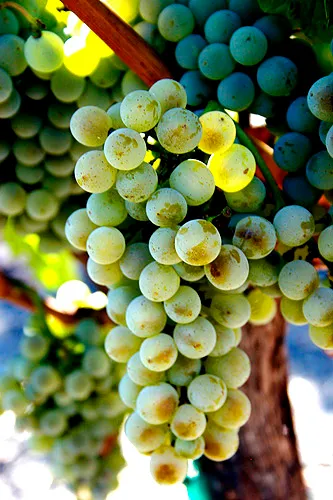
Profile: Sémillon
| Berry colour | White grape (B) |
|---|---|
| Species / status | Vitis vinifera |
| Origin | France, Bordeaux region |
| Synonyms | Sémillon blanc, Semillon (outside France) |
| French regions | Bordeaux, Provence, South-West France |
| Grown in | France, Australia, Chile, South Africa, Argentina, United States |
| Typical aromas | lemon and citrus (young), beeswax, honey, dried apricot and candied fruit, saffron (sweet wines), toast (old Hunter Valley sémillons) |
| Wine style | Broad, waxy dry whites, long-lived botrytised sweet wines, and in Australia light dry wines that transform in bottle. |
| Food pairings | foie gras (sweet wines), Roquefort and blue cheeses (sweet wines), fish in sauce (dry wines), poultry in cream sauce, apricot desserts |
| Identifiers | VIVC no. 11480, Wikidata Q391558 |
Origin: a Bordeaux grape
Sémillon comes from the Bordeaux region, and more precisely, according to tradition, from the Sauternes area. Its name has been linked to the town of Saint-Émilion, a possible but unproven etymology. Its parentage has not been established with certainty.
It was long one of the most widely grown white grapes in Bordeaux and was widely exported in the 19th century, notably to Australia, South Africa and Chile.
In the vineyard
Sémillon is a vigorous and productive grape, with medium bunches and thin-skinned berries. This thin skin has two consequences:
- it is susceptible to grey rot when conditions are unfavourable;
- it is very receptive to noble rot when the alternation of morning humidity and afternoon sun allows it.
It ripens in the second period. It is less acidic than sauvignon blanc, which explains why the two complement each other.
Noble rot: the angle that defines sémillon
Sémillon owes its fame to a fungus, Botrytis cinerea, in its “noble” form. Around the Ciron, a tributary of the Garonne, autumn mists encourage its development on grapes that are already ripe.
The fungus pierces the skin, water evaporates and the grape becomes concentrated in sugars, acids and aromas. Harvesting is manual and done in successive pickings (tries): the pickers go through the same plot several times to pick only the berries that are ready. Yields are very low.
The resulting sweet wines evoke dried apricot, honey, candied orange and saffron. They are among the white wines best suited to ageing.
| Appellation | Region | Role of sémillon |
|---|---|---|
| Sauternes, Barsac | Bordeaux, left bank | Dominant grape of the sweet wines |
| Loupiac, Cadillac, Sainte-Croix-du-Mont | Bordeaux, right bank of the Garonne | Sweet and medium-sweet wines, main grape |
| Monbazillac, Saussignac | Bergerac | Main grape of the sweet wines |
| Graves, Pessac-Léognan | Bordeaux | Dry whites blended with sauvignon |
| Entre-deux-Mers | Bordeaux | Dry whites, with sauvignon and muscadelle |
Dry wines: texture and ageing
As a dry white, sémillon brings richness, roundness and notes of wax and citrus. Blended with sauvignon blanc, it balances the latter’s liveliness. The great whites of Pessac-Léognan, often aged in barrel, are an example. See the grapes of Bordeaux.
In South-West France, it is found in Bergerac, the Côtes de Duras and other neighbouring appellations. See the grapes of South-West France.
Hunter Valley: a sémillon against the grain
In Australia, the Hunter Valley (New South Wales) has developed a style unique in the world. The grapes are picked early, with low alcohol and marked acidity, then vinified without oak.
When young, these wines are discreet, lemony, almost austere. After several years in bottle, they develop notes of toast, honey and hazelnut, without ever having seen a barrel. Historically, sémillon was sometimes sold there under the misleading name “Hunter River Riesling”, a classic example of commercial homonymy (see synonyms and homonyms).
Australia also makes sémillon-sauvignon blends in the Bordeaux style, notably in Margaret River.
Elsewhere in the world
Sémillon was widely planted in Chile and South Africa, where it once held a far more important place than today. It is also found in Argentina, California and Washington State.
To compare with other great sweet-wine grapes, see chenin from the Loire and petit manseng from Jurançon, which achieves its concentration by drying on the vine (passerillage) rather than by botrytis.
Further reading
Frequently asked questions
What is the grape of Sauternes?
Sauternes is made mostly from sémillon, blended with sauvignon blanc and sometimes a little muscadelle. Sémillon brings richness and texture, sauvignon freshness. Some cuvées are made almost entirely from sémillon.
What is noble rot?
It is a particular form of the fungus Botrytis cinerea. When morning mists are followed by sunny afternoons, it pierces the skin of ripe grapes without spoiling them: water evaporates, sugars and acids become concentrated. Harvesting is then done by hand, in successive pickings.
Can sémillon make dry wines?
Yes. It goes into the dry whites of Bordeaux (Graves, Pessac-Léognan, Entre-deux-Mers) blended with sauvignon. In Australia, the Hunter Valley makes dry sémillons, picked early and low in alcohol, which develop toasty notes with age.
What is the difference between sémillon and sauvignon blanc?
Sauvignon blanc is very aromatic and lively (citrus, boxwood). Sémillon is more discreet on the nose, richer and broader on the palate, with notes of wax and honey. The two complement each other, hence their traditional blending in Bordeaux.
Related grapes
- Sauvignon blanc (white, France, Loire Valley or South-West France)
- Chenin blanc (white, France, Loire Valley (Anjou-Touraine))
- Colombard (white, France, Charentes)
- Ugni blanc (white, Italy, central Italy)
- Muscat à petits grains (white, Mediterranean basin (precise origin unknown))