Petit manseng: the grape of sweet Jurançon
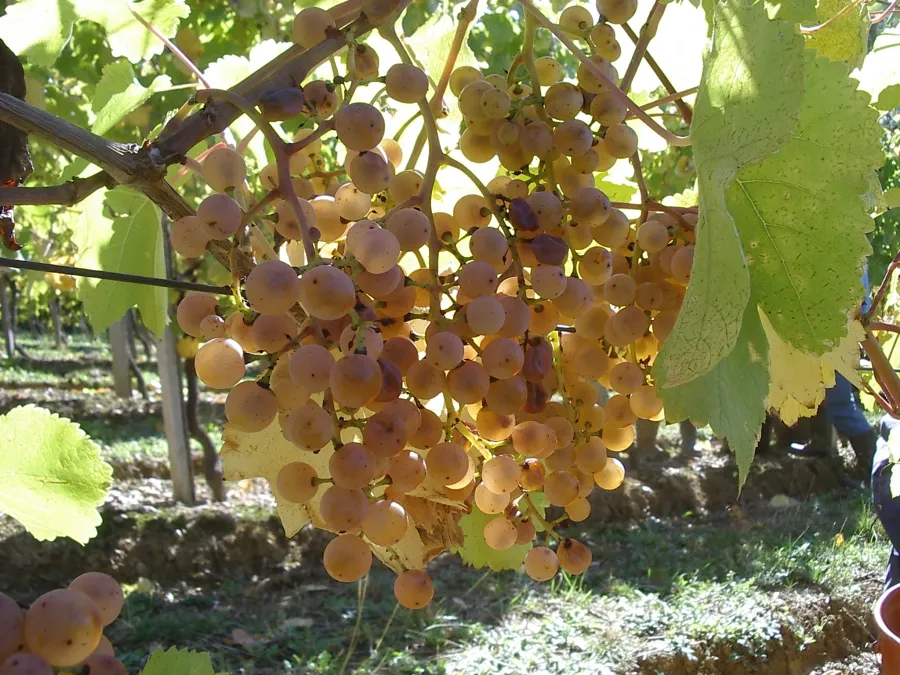
Profile: Petit manseng
| Berry colour | White grape (B) |
|---|---|
| Species / status | Vitis vinifera |
| Origin | France, Pyrenean foothills (Béarn, Basque Country) |
| Parentage | Savagnin |
| Synonyms | Petit mansenc |
| French regions | Languedoc-Roussillon, South-West France |
| Grown in | France, Uruguay, United States |
| Typical aromas | tropical fruit (pineapple, mango), candied citrus, quince, dried apricot, honey, spices (cinnamon, nutmeg) |
| Wine style | Sweet and lusciously sweet wines from dried grapes, with lively acidity and long ageing potential, as well as rich, vibrant dry whites. |
| Food pairings | foie gras, Pyrenean ewe's milk cheese (ossau-iraty), tropical fruit tart, poultry with citrus, mildly spiced cuisine |
| Identifiers | VIVC no. 7339, Wikidata Q462509 |
Origin: Béarn and the Basque Country
Petit manseng is a grape from the Pyrenean foothills, long grown in Béarn and the Basque Country. Its parentage has not been established by consensus. It is close to gros manseng, which bears the same name and shares the same vineyards, but the two are distinct grapes.
Petit manseng long remained a little-known grape, threatened by its low productivity, before being revived with the renewal of Jurançon wines in the 20th century. See the guide forgotten grapes of South-West France.
In the vineyard
Petit manseng is a low-yielding grape, with small bunches and small, thick-skinned berries. This last trait is decisive: the skin resists splitting and rot, which makes it possible to leave the grapes on the vine long after ripeness.
It keeps very high acidity even at high sugar concentration, which gives the sweet wines their freshness. It buds early and is vulnerable to spring frosts.
Drying on the vine: the petit manseng angle
Petit manseng owes its reputation to a technique: drying on the vine (passerillage sur souche). Rather than relying on noble rot, like sémillon in Sauternes or chenin in the Layon, Béarn growers let the grapes dry out on the vine.
The foehn, a warm, dry wind from the south, and late-season sunshine encourage this concentration. Harvests take place late, sometimes in several passes.
| Method of concentration | Mechanism | Examples |
|---|---|---|
| Drying on the vine | Berries dry out on the vine (wind, sun) | Sweet Jurançon and Pacherenc (petit manseng) |
| Noble rot | Botrytis cinerea pierces the skin, water evaporates | Sauternes (sémillon), Coteaux du Layon (chenin) |
| Drying after harvest | Grapes dried on racks or in lofts | Straw wines, passito |
| Freezing on the vine | Grapes harvested frozen, water stays in the ice | Ice wines (Eiswein) |
The wines: sugar and acidity
Sweet petit manseng wines combine sugar and lively acidity. Their aromas recall tropical fruit (pineapple, mango), candied citrus, quince, honey and spices. Their acidity gives them good ageing potential.
| Appellation | Wine type | Role of petit manseng |
|---|---|---|
| Jurançon | Sweet | Main grape of the great dried-grape cuvées |
| Jurançon sec | Dry white | Blended with gros manseng and petit courbu |
| Pacherenc du Vic-Bilh | Dry and sweet | Major grape, with gros manseng, petit courbu and arrufiac |
| Béarn, Irouléguy | Dry white | Blending grape |
| IGP Côtes de Gascogne, IGP of Languedoc | Dry and sweet | Varietal wines |
See the grapes of South-West France and the comparison gros manseng or petit manseng.
The baptism of Henri IV
Through Jurançon, petit manseng is linked to a famous Béarn tradition. According to the account handed down, at the birth of the future Henri IV in Pau, in 1553, his grandfather is said to have rubbed his lips with a clove of garlic and given him a few drops of Jurançon wine to taste. It is a reported tradition, not a precisely documented fact, but it remains attached to the image of the wine.
Outside France
Petit manseng has won over a few foreign vineyards. In Uruguay, it grows alongside tannat, another South-West French grape taken there by Basque emigrants. In the United States, it is grown notably in Virginia, where its thick skin withstands humidity.
In Australia, vines imported in 1979 under the name petit manseng turned out in 2020, after DNA analysis by CSIRO, to be gros manseng. This case is one more example of the usefulness of genetic identification, described in the guide ampelography: identifying a grape variety.
Genealogy of Petit manseng
Identified parents (Wikidata): Savagnin.
Further reading
Frequently asked questions
What is the grape of sweet Jurançon?
Great sweet Jurançon wines are made mainly from petit manseng, sometimes blended with gros manseng and other permitted local grapes. Its grapes are harvested late, after drying on the vine, which concentrates sugars and acids.
What is drying on the vine (passerillage sur souche)?
It is the partial drying of grapes left on the vine beyond ripeness. Petit manseng's thick skin holds up well, the water evaporates and the berry becomes concentrated. Unlike noble rot, the concentration is caused not by a fungus but by the autumn wind and sunshine.
What is the difference between petit manseng and the sémillon of Sauternes?
Both make lusciously sweet wines, but in different ways. Sauternes sémillon becomes concentrated mainly through botrytis (noble rot). Petit manseng becomes concentrated mainly by drying on the vine. Jurançon wines generally keep a more marked acidity.
Does petit manseng make dry wines?
Yes. It goes into dry Jurançon, dry Pacherenc du Vic-Bilh or white Irouléguy, often blended with gros manseng and petit courbu. These wines are both rich and lively. It is also found in IGP wines in Languedoc and Gascony.
Related grapes
- Gros manseng (white, France, Pyrenean foothills (Béarn, Basque Country))
- Sémillon (white, France, Bordeaux region)
- Chenin blanc (white, France, Loire Valley (Anjou-Touraine))
- Manseng noir (black, France, Pyrénées-Atlantiques (Jurançon, Béarn))
- Tannat (black, France, South-West (Pyrenean foothills))
- Colombard (white, France, Charentes)
- Trousseau (black, France, Jura)
- Duras (black, France, Tarn (Gaillac))