Manseng noir: a red grape of Béarn brought back from oblivion
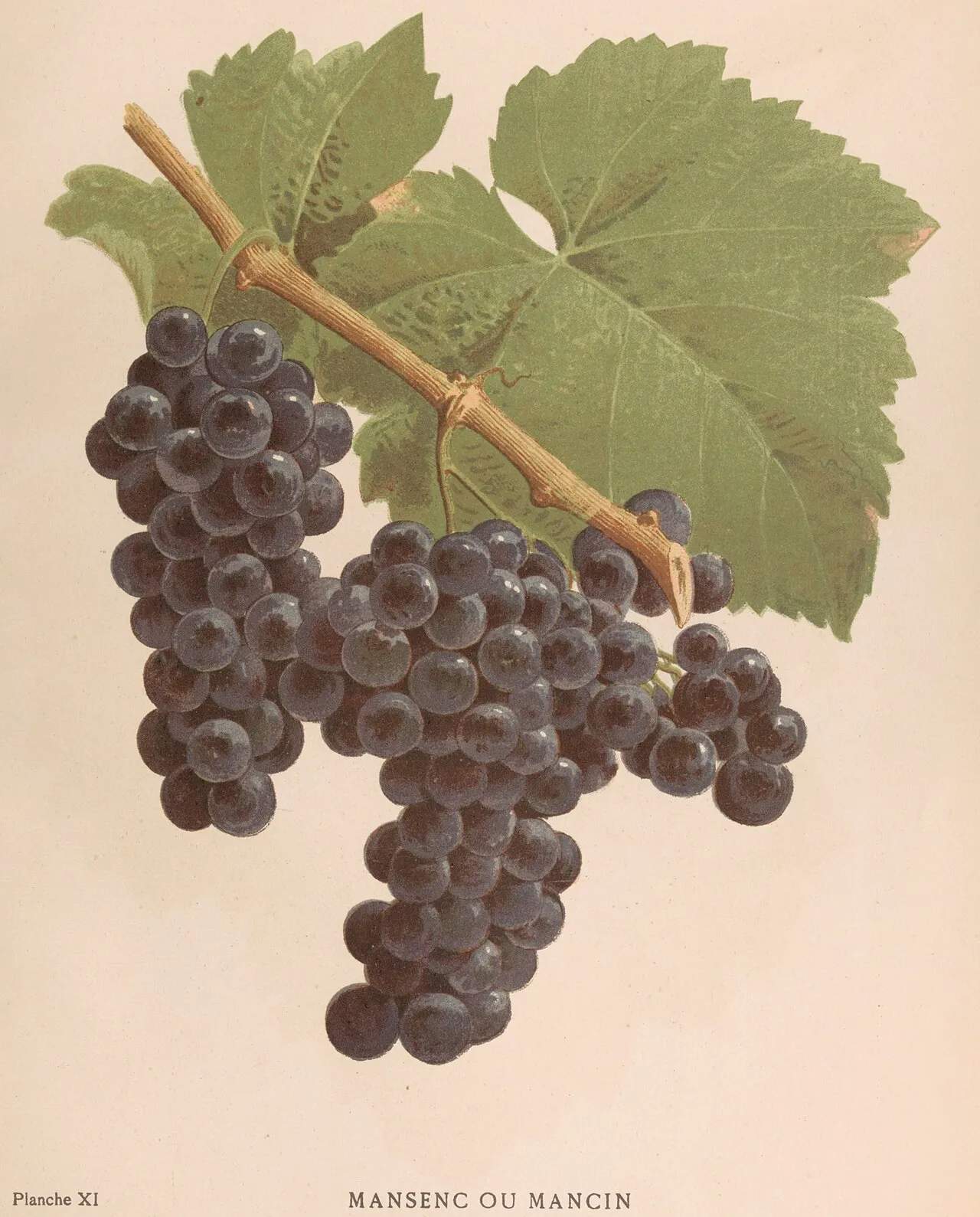
Profile: Manseng noir
| Berry colour | Black grape (N) |
|---|---|
| Species / status | Vitis vinifera |
| Origin | France, Pyrénées-Atlantiques (Jurançon, Béarn) |
| Synonyms | Mansenc noir, Manseng rouge |
| French regions | South-West France |
| Grown in | France |
| Typical aromas | black fruit, tart cherry, spices, floral notes |
| Wine style | Very deeply coloured, lively and tannic reds, fine and able to age, mostly used in blends. |
| Food pairings | garbure, Pyrenean milk-fed lamb, Bayonne ham, Ossau-Iraty sheep's cheese |
| Identifiers | VIVC no. 7340, Wikidata Q1591431 |
Origin: a grape of the western Pyrenees
Manseng noir is a black grape of the western Pyrenees, originating from the Jurançon vineyard and, more broadly, Béarn. It belongs to this Pyrenean viticultural heritage, with Basque influence, which also gave tannat, gros manseng and petit manseng.
Ampelographers place it in the same group of grapes as tannat, which it resembles in its strong colour and tannic structure. No precise genetic parentage between the two has however been published to date.
Manseng noir, gros manseng, petit manseng: misleading names
The name “manseng” brings together three grapes that do not share the same colour or the same history.
| Grape | Colour | Main use |
|---|---|---|
| Manseng noir | Black (N) | Deeply coloured, tannic reds, mostly in blends |
| Gros manseng | White (B) | Dry and medium-sweet whites of Jurançon and Gascony |
| Petit manseng | White (B) | Great sweet wines of Jurançon, raisined on the vine |
Manseng noir is not documented as a colour mutation of gros or petit manseng. The shared name reflects first of all a shared geographical origin. The difference between the two white mansengs is detailed in our comparison gros manseng or petit manseng.
In the vineyard
| Trait | Manseng noir |
|---|---|
| Fertility of basal buds | Low, hence long pruning |
| Yield | Can become high if the vine is not controlled |
| Hardiness | Fairly hardy, suited to varied soils, with no marked sensitivity |
| Budbreak | About 4 days after chasselas |
| Ripening | Third period, about 4 weeks after chasselas |
| Approved clone | Only one, no. 897 |
Its late ripening explains why it was reserved for well-exposed slopes and why it could be neglected in favour of easier grapes. This same late character now gives it an interest in the face of warming, which brings harvests forward. See our guide on grapes and climate change.
The wines
Manseng noir wines are very deeply coloured, lively and astringent in youth, but reputed to be fine and able to age. Their colour and acidity make it an excellent supporting grape for strengthening a blend. The few single-variety cuvées show black fruit, tart cherry and spicy notes.
The little-known angle: a revival through conservation
Manseng noir was abandoned during the 20th century, like many Pyrenean grapes judged difficult or unprofitable. It has been replanted over the past thirty years or so in the movement to rediscover the forgotten grapes of the South-West, driven by growers, cooperative cellars and conservatories.
Replantings have notably been carried out in the Gers, for example at Lectoure. The grape is authorised in the Béarn appellation, but remains very little used there: most cuvées are sold as IGP or vin de France. See also our guide on grape conservatories.
A presence in Galicia?
Several ampelographic catalogues link to manseng noir vines grown in the north-west of the Iberian peninsula, notably the ferrón of Galicia, as well as a variety from the Vinho Verde vineyard in Portugal. These correspondences illustrate the ancient exchanges on both sides of the Pyrenees and along the Atlantic coast, but they still need to be confirmed and clarified by accessible genetic publications.
To place this grape in its vineyard, see the grapes of the South-West.
The red grapes of the Pyrenean foothills
Manseng noir belongs to a group of red grapes of south-western France, all marked by strong tannic structure.
| Grape | Status | Appellations where it is found |
|---|---|---|
| Tannat | Dominant grape | Madiran, Irouléguy, Béarn, Saint-Mont |
| Cabernet franc | Complementary grape | Madiran, Irouléguy, Béarn |
| Fer servadou (pinenc) | Complementary grape | Madiran |
| Manseng noir | Rare grape | Authorised in Béarn, mostly as IGP |
Compared with tannat, a very tannic grape that has become emblematic of Madiran, manseng noir stands out for its liveliness and its ability to colour a blend. Its rarity makes it today a grape for curious growers rather than an appellation grape.
Further reading
Frequently asked questions
Is manseng noir the red version of gros manseng?
There is nothing to support that. Gros manseng and petit manseng are two distinct white grapes, and manseng noir is not documented as a colour mutation of either. The shared name mostly reflects a shared geographical origin, the vineyards of the western Pyrenees.
Where can you find manseng noir wine?
Cuvées are rare. The grape is mainly grown in the South-West, notably in Béarn and the Gers, where it was replanted as part of programmes to save forgotten grapes. It is often made as IGP or vin de France, sometimes in blends.
What does manseng noir taste like?
It gives very deeply coloured wines, lively and astringent in youth, but reputed to be fine and able to age. Its strong colour and acidity make it a good blending partner, notably with suppler grapes.
Related grapes
- Tannat (black, France, South-West (Pyrenean foothills))
- Gros manseng (white, France, Pyrenean foothills (Béarn, Basque Country))
- Petit manseng (white, France, Pyrenean foothills (Béarn, Basque Country))
- Négrette (black, France, South-West (between Toulouse and Albi))
- Fer servadou (black, France, South-West)