Gros manseng: the lively white of Béarn and Gascony
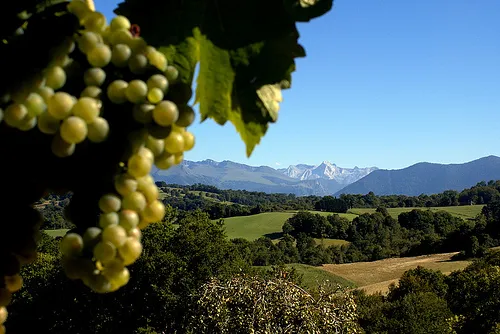
Profile: Gros manseng
| Berry colour | White grape (B) |
|---|---|
| Species / status | Vitis vinifera |
| Origin | France, Pyrenean foothills (Béarn, Basque Country) |
| Synonyms | Gros mansenc, Iskiriota zuri handia (Basque Country) |
| French regions | South-West France |
| Grown in | France, Australia |
| Typical aromas | citrus (grapefruit), exotic fruit (pineapple, passion fruit), quince, apricot, spices, floral notes |
| Wine style | Lively, aromatic dry whites with marked acidity, and sometimes sweet wines lighter than those of petit manseng. |
| Food pairings | seafood, Pyrenean trout, Bayonne ham, Pyrenean sheep's cheeses, citrus-based cooking |
| Identifiers | VIVC no. 7338, Wikidata Q462851 |
Origin: the Pyrenean foothills
Gros manseng is a grape of south-west France, long grown at the foot of the Pyrenees, in Béarn and in the Basque Country, hence its Basque name iskiriota zuri handia. Its exact parentage is not established by consensus. It is described as close to petit manseng, with which it shares its name and its terroir, without being a simple mutation of it.
It belongs to this heritage of Pyrenean grapes that long remained little known, presented in the guide forgotten grapes of the South-West.
In the vineyard
Gros manseng is a vigorous and fairly fertile grape, with early budburst (generally late March), which exposes it to spring frosts. Its ripening is of the third, sometimes fourth period (époque): it is therefore harvested late.
It is suited to the fairly humid and warm climates of the Pyrenean foothills, while also withstanding drought. It is most often trained with long pruning, or short pruning on fertile soils. Its berries are distinctly larger than those of petit manseng, hence its name.
The wines: liveliness and aroma
Gros manseng gives wines with good alcohol potential and high acidity, with aromas of citrus, exotic fruit, apricot, quince and spice. It is mainly made as a dry white, but also goes into sweet wines, generally less concentrated than those of petit manseng.
| Appellation or designation | Type of wine | Role of gros manseng |
|---|---|---|
| Jurançon sec | Dry white | Main grape, with petit manseng and petit courbu |
| Jurançon | Sweet white | Permitted, but petit manseng dominates the great cuvées |
| Pacherenc du Vic-Bilh | Dry and sweet | Major grape, with petit manseng, petit courbu and arrufiac |
| Béarn, Irouléguy | Dry white | Blending grape with petit manseng and petit courbu |
| Tursan | Dry white | Blending grape |
| IGP Côtes de Gascogne | Dry and sweet white | Alone or with colombard, ugni blanc, sauvignon |
| Floc de Gascogne | Mistelle | Among the white grapes used |
See the grapes of the South-West and the guide reading an AOC specification for how the appellations regulate these blends.
Gascony: a grape of conversion
In the Gers, gros manseng accompanied the conversion of part of the vineyard towards dry white wines in IGP Côtes de Gascogne. There it is often blended with colombard and ugni blanc, old Armagnac distillation grapes, to which it brings structure and ripe fruit aromas. Harvested later, it also allows sweet wines in the IGP.
Gros manseng is then frequently mentioned on the label, alone or as a pair. See grape variety on the label.
Manseng, petit, gros, noir: names to untangle
The angle specific to gros manseng is the confusion of names.
- Gros manseng and petit manseng: two distinct white grapes, close but different in berry size, yields and wine styles.
- Manseng noir: a rare red grape of Béarn, with no colour link to the previous two. See the page manseng noir.
- The Australian mix-up: in Australia, vines imported in 1979 as petit manseng turned out, after a DNA analysis carried out by the CSIRO in May 2020, to be gros manseng. The wines concerned were therefore in fact made from gros manseng.
The comparison gros manseng or petit manseng details the differences between the two grapes.
Further reading
Frequently asked questions
What is the difference between gros manseng and petit manseng?
Gros manseng has distinctly larger berries and higher yields. It gives mainly dry whites, such as dry Jurançon. Petit manseng, with small thick-skinned berries, lends itself better to drying on the vine (passerillage) and gives the great sweet Jurançon wines. The two are close in the vineyard but are not mutations of each other.
What is the grape of dry Jurançon?
Dry Jurançon rests mainly on gros manseng, often blended with petit manseng and with other permitted local grapes such as petit courbu. Gros manseng brings liveliness and aromas of citrus and exotic fruit.
Is gros manseng a black grape?
No, it is a white grape. There is a manseng noir, a rare red grape of Béarn, but it is not the same variety. The name manseng therefore groups distinct grapes.
Where can gros manseng be found outside Béarn?
In Gascony, it is very present in IGP Côtes de Gascogne, often blended with colombard and ugni blanc. Outside France it remains rare; in Australia, vines sold as petit manseng turned out to be gros manseng.
Related grapes
- Petit manseng (white, France, Pyrenean foothills (Béarn, Basque Country))
- Manseng noir (black, France, Pyrénées-Atlantiques (Jurançon, Béarn))
- Tannat (black, France, South-West (Pyrenean foothills))
- Colombard (white, France, Charentes)
- Ugni blanc (white, Italy, central Italy)
- Sauvignon blanc (white, France, Loire Valley or South-West France)